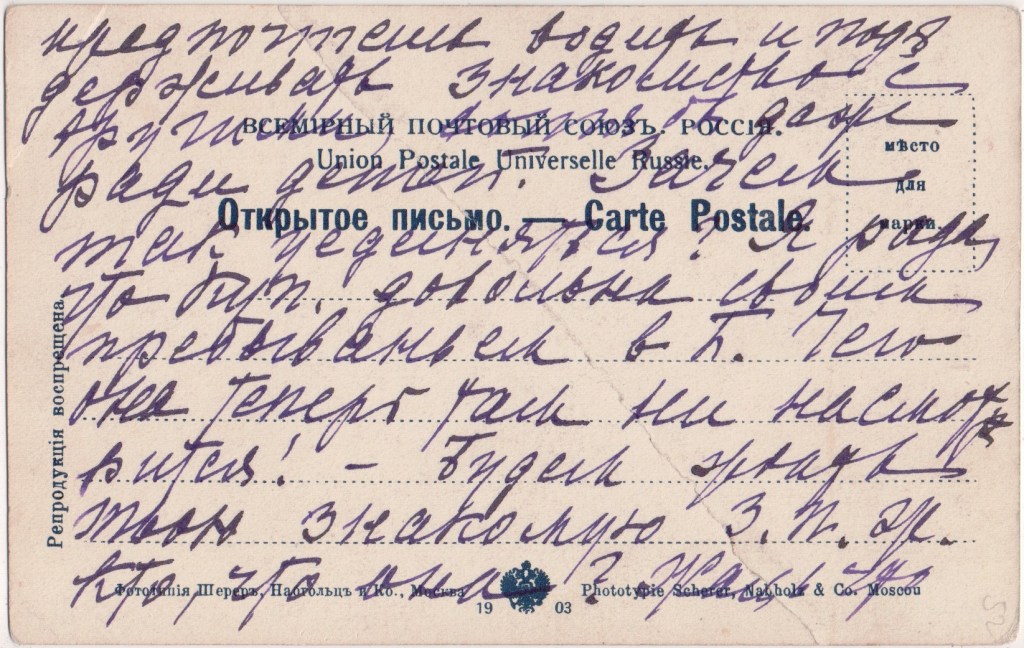
- Phototipie Scherer, Nabholz & Co. Moscou
Swiss Martin N. Scherer and Gottlieb (Georgy) I Nabholz, photographers in Moscow in a business active from 1863 to 1918. In 1863 Scherer and Nabholz organised a joint venture in Moscow, buying the studio of Karl August Bergner, then very well-known. Their production progressed from large varnished salt prints to cdvs, cabinet cards and, later, postcards.
The firm did photographic portraits, business cards and exhibition catalogues and pictures of famous writers, artists, musicians and public figures of the time. Their cabinet card portrait of the writer Leo Tolstoy (1828 to 1910) has him dressed as a peasant. They took photographs of Decembrists who returned from exile; The Decembrist revolt was a failed coup d’état led by liberal military and political dissidents against the Russian Empire in Saint Petersburg on 26 December 1825, following the death of Emperor Alexander I. Fifteen out of 124 Decembrists were convicted of state-crimes by the Supreme Criminal Court, and sentenced to exile in far-flung settlements. Some of their wives went with them. On 26 August 1856, with the ascent of Alexander II to the throne, the Decembrists received amnesty, and their rights and privileges were restored.
In 1865 the studio received a silver medal for photographic excellence at the Moscow industrial exhibition. The studio was given the high award of the right to place the image of the Russian coat of arms on its products and we see that here between the Russian and French versions of their name on the address side.
The studio was known for its large-format city views; Martin Scherer did the first photographic panorama of Moscow, which is still the best documentary panorama of the Russian capital. The panorama, composed of sixteen large-format albumen prints joined to form a 360-degree view of the city, is among the most technically ambitious photographic achievements of 19th-century Russia. Taken in 1867 from the rooftop of the then-unfinished Cathedral of Christ the Saviour, the photographs depict the city in panoramic detail – from the bend of the Moskva River to the walls of the Kremlin – providing a broad view of Moscow’s religious, political, and industrial centre. Extending over six meters when fully assembled, the panorama’s scale and the precision of its alignment represent a notable technical achievement. Using the wet-collodion process, they produced sixteen carefully composed exposures from their high vantage point, coordinating them so precisely that the transitions appear uninterrupted. The panorama, conceived at the height of their collaboration, is regarded as one of the studio’s principal works.
However, Scherer left the business soon afterwards, in 1867. He went to Dresden, where he founded the M. Scherer & H. Engler photographic firm.
In 1868 the firm became Scherer, Nabholz & Co. when it passed to Albert Ivanovitch Mey. From 1868 until August 1896, it was co-owned by M. A. Schindler, who pushed the firm into photomechanical reproductions, including collotypes and photolithography.
Distinguished photographer Pyotr Petrovich Pavlov (1860 to 1924) arrived in Moscow from St Petersburg and trained with the studio for a decade until he opened his own studio in 1891.
Scherer, Nabholz & Co took photographs of the representatives of Belgium and China at the coronation of Nicholas II in 1896. They produced cartes-de-visite and studio cabinet cards of the Tzar for publishers A. I. May and M. A. Schindler. In 1913 they photographed the Tsar and Tsarevich Alexei Nikolaevich.
After postcards became popular the firm became an important publisher themselves of black & white collotype view cards that were sold from the Dazziaro art shop until about 1918. The studio 1903 Types de Russie series featured in traders in costume.
Russian photographer Ivan Popov (1874 to 8 October 1945) shot in black-and-white and printed postcards of views of his 1910 to 1914 ethnographic expeditions across Yakutia and Buryatia through Scherer, Nabholz & Co
Sources: artsy.net; wkipedia Ivan_Popov_(photographer); bassengephotographs; The Moscow Times 15 April 2023 Pavel and Olga Syutkin
This Card:
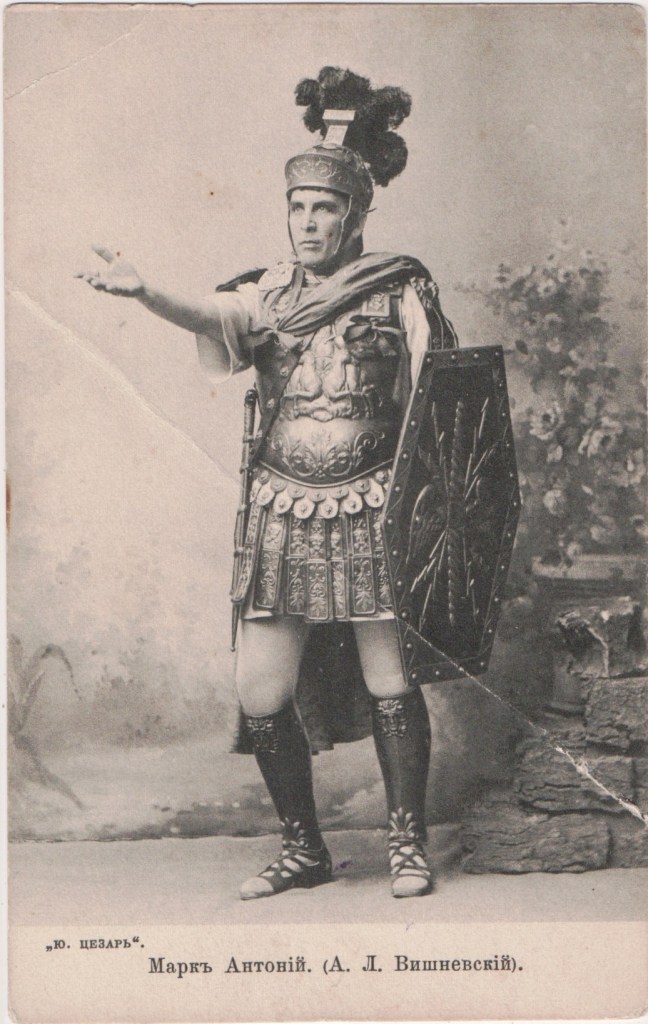
- “J. CAESAR”. Mark Antony. (A. L. Vishnevsky).
This card shows Aleksandr Vishnevsky (1861 to 1943) in the role of Mark Antony in the Scherer, Nabholz 1903 series Roman nobility in Julius Caesar. This was a record of the 1903 performance of at the Moscow Art Theatre of Shakespeare’s play, directed by Vladimir Nemirovich-Danchenko. Vishnevsky was a Russian actor and one of the founding members of the Moscow Art Theatre. Other cards featured Vasily Kachalov as Julius Caesar.
Source: filmstarpostcards.blogspot.com