Introduction
This is the story of Margaret Erskine, a Scottish noblewoman of the sixteenth century. It is the story of how a woman of influence and determination was able to access and use the law in lawless times. Margaret made a bad marriage but it is not a story of divorce; although divorce for adultery became possible with the Reformation in 1560 and for desertion by statute in 1573, other grounds were not introduced until 1938.
It is a tale of supplications – a procedure whereby the King or Parliament could be petitioned by any citizen. A supplication could be on a matter of general or particular concern – perhaps both present in the 1559 supplication of the Minister, Elders and Deacons of the Christian Congregation of St. Andrews that the magistrates of that town should require John Robertson, adulterer, to obey the voice of the Kirk. Balfour’s Practicks of 1575 provided that all actions and causes concerning the common well-being should be summarily decided be way of supplication and not by long process. A 1581 regulation of the Privy Council provided that the day on which supplications were to be presented to his Majesty and considered was every Saturday.
It is also the story of two places called Ruthven [pronounced RIV-ən]:
- Ruthven is a village in Angus. It is two miles north of the village of Meigle, where the A926 road crosses the River Isla. Ruthven Castle was a castle with a D-shaped tower at Ruthven in Angus. The castle was built before the 16th century near the eastern bank of the Isla River and was largely demolished in 1790 for construction of Ruthven House. It was once in the hands of the Lindsays, Earls of Crawford, then passed onto the Crichton [pronounced CRI-tən] family before being bought by an Ogilvy. In the title of his book Crichton of Ruthven Jack Blair of the Tay Valley Family History Society describes the Crichtons as Lairds of Ruthven in Angus from 1452 to 1788.
- The Place of Ruthven by Perth is a castle about 25 miles south-west of Ruthven in Angus. Mary Queen of Scots stayed there in 1565, while on honeymoon with Lord Darnley. The castle is linked to the Ruthven family who were Earls of Gowrie by the time of our tale. In the episode known as the Ruthven Raid, William Ruthven, the 1st Earl of Gowrie, held Mary’s son, James VI, here against his will in 1582. An equally bizarre event called the Gowrie Conspiracy led to the downfall of the 3rd Earl of Gowrie in 1600. The Ruthvens were disinherited and their forfeited castle was renamed Huntingtower.
The Ruthven Raid
When Catholic Queen Mary of Scotland was forced to abdicate in 1567, her one-year-old son became monarch with a series of regents who ruled on his behalf until James VI was proclaimed of age to rule in 1579.
The Scottish ruling class insisted that James be raised as a member of the protestant Church of Scotland. However, he came under the influence of French Catholic Esmé Stewart, Sieur d’Aubigny, first cousin of James’s father Lord Darnley. James made him Lennox, the only duke in Scotland at that time and gave him the custody of Dumbarton Castle.
William Ruthven, 1st Earl of Gowrie, devised a plot to abduct the 16-year-old King and remove him from the Catholic influences around him that supported his mother, the deposed Queen Mary. The Raid of Ruthven also involved many other powerful Protestant Scottish landholders.
In July 1582, Earl Gowrie organised what was called the Lords Enterprisers to oppose Lennox’s influence on the King. They seized James during a royal hunting party near the Earl’s castle of Ruthven in Perthshire in August and took him to Gowrie’s townhouse in Perth.
There, the Lords Enterprisers provided their list of reasons for their actions in a supplication on 23 August 1582. Their demands included a pure Protestant regime approved by the General Assembly of the Church of Scotland. They also wanted tighter financial controls; the King owed £48,000 to Gowrie, who served as Lord High Treasurer of Scotland.
From Perth, the King was taken to Stirling Castle and moved to several different houses over the course of the next year.
Lennox was accused of practises against the State, including advocating the Association – a plan he should rule jointly with his mother Mary – to James. The Ruthven regime forced Lennox into exile in France. With the assistance of those who remained loyal, James escaped in July 1583 and dismissed the Lords Enterprisers from Court.
Margaret Erskine, Lady Ruthven
Margaret Erskine was born about 1553, the daughter of Sir Alexander Erskine, 1st of Gogar. Margaret had a marriage contract with Adam Crichton, 5th of Ruthven, dated 20 October 1573.
Margaret survived Adam Crichton and later married James Reid, Tutor of Aitkenhead who was born about 1555.
Adam Crichton of Ruthven
All the information I have about Adam Crichton comes from Margaret, his estranged wife:
Accompanying himself with sundry wicked persons equipped for violence Adam chased and killed his tenantry, plundered their moveables, money, title deeds and documents, goods and gear, besieged houses, raised fire and ravished women.
He failed to appear before the Justice for those crimes and was denounced rebel – three blasts of his horn by the King’s messenger.
As even after that he continued in his oppressive and tyrannous behaviour, the King granted commission to apprehend Adam wherever he might be and transport and present him to the captain, constable and watchmen of Dumbarton Castle to remain in custody at his own expense while justice was ministered upon him.
Dumbarton Castle is more than one hundred miles south west of Ruthven in Angus. It had long been used as a prison; Thomas Stewart, Earl of Angus, died in the prison of Dumbarton Castle of the plague that broke out in 1361. It was an interesting choice for Adam’s confinement, then being in Lennox heartland. A copy of proposed articles of the Association treaty was left with Lennox’s papers there and burnt by his lawyer.
However, Dumbarton didn’t come to pass:
After great diligence and search at last Adam was taken, and kept in the house of Ruthven in Angus while opportunity might serve for his more sure transporting to the said castle. To be sure that the commission was executed on the rebel, he being so notable an offender, the King directed letters charging the provost and baillies of Dundee to direct armed soldiers of that burgh, with Captain David Crichton appointed, for the better convoy of the said rebel to Dumbarton.
On 13 March 1581, Captain David Crichton being then in Dundee for the purpose, fifty persons including John Lindsay, brother to David, Earl of Crawford, Archibald Cumming, servants and dependants to the said Earl, and diverse others of his friends and dependants, equipped for violence came as a group working together to the house of Ruthven’s, in which the rebel Adam was being kept and there in most treasonable manner set fire to the place, shot, hurt, and deadly wounded Patrick Crichton, George Crichton, his brother, and sundry gentlemen and others being in the said house in peril of their lives, and took Adam Crichton away, and transported him to the town of Dunkeld, where the said Earl remained for the time, in proud and manifest contempt of the King’s authority and laws.
David Lindsay, Earl of Crawford
Margaret complained to the King. When her complaint first called, Earl Crawford promised to keep Adam in his company, and take such control that the complainer and the tenants should be unharmed and untroubled by him on which promise further execution of her letters of complaint was stayed.
Nevertheless, on 10 May 1582, Adam Crichton with a dozen other rebels at the horn equipped for violence, came to Bridgetown of Ruthven’s and robbed and violently took from Margaret’s tenants and servants, twenty horse and more, thirty cattle and oxen, with all the rest of their movable goods, and took over their houses and remained in them and ejected the poor in consequence of which they were ruined and made altogether unable to labour or occupy their lands.
On 4 June 1583, towards the end of the Ruthven regime, the King, rather against the will of Gowrie and the other Lords who had controlled him for the last nine months, left Edinburgh to take a progress going first to Linlithgow, accompanied by some of the Lords Enterprisers.
Meantime, members of the Privy Council who were left in Edinburgh, in his absence received a further complaint from Margaret about her husband whom she described as heir apparent of Ruthven charging the Earl of Crawford to appear and answer, and to present and exhibit his said servants and followers and also Adam, the chief culprit and rebel.
Charge was given to the Earl of Crawford, again to appear and present the culprit under pain of rebellion. But he failed to appear or present Adam Crichton in response to the charge and the Lords ordered the Earl to be denounced and put to the horn.
The Cuming Brothers
There must have been some communication between the spouses as Archibald Cuming and his brother, Cuming of Condie, became cautioners for the young Laird of Ruthvens. Caution is an obligation of guarantee as surety for another that if the principal oblligant does not pay the debt or perform the act for which he has engaged, the cautioner will pay or otherwise fulfil the obligation.
The obligation that the Cumings guaranteed to Margaret was that that Adam would not molest nor trouble her, nor her tenants of the lands that appertained to her by right in their joint property, but that she should peaceably use and possess the same; and, in terms of the contract, if he did in the contrary or contravened, that she have referred to her oath the cost, injury, and damage that was done to her, without any farther process.
Things didn’t go well and Archibald Cuming was charged in terms of his obligation and bankrupted, fled to the safe refuge of the Canongate and Abbey and Holyroodhouse; and being there, Mr John Graham, justice-depute, by letters of caption, took him furth of the sanctuary and kept him in the Castle of Edinburgh. Letters of caption are an authority to arrest a debtor, or someone who has not fulfilled a promised obligation.
Cuming v Ruthvens 1583 Mor 3147 ( July 1583)
Cuming brought a supplication to the Court of Session. With the foundation of the Court of Session in 1532, the judicial functions of the lords of council and session were hived off into a separate court, thereby leaving political matters to the privy council which continued until 1708, soon after the union of parliaments. In 1600 eleven petitions and 56 supplications were heard.
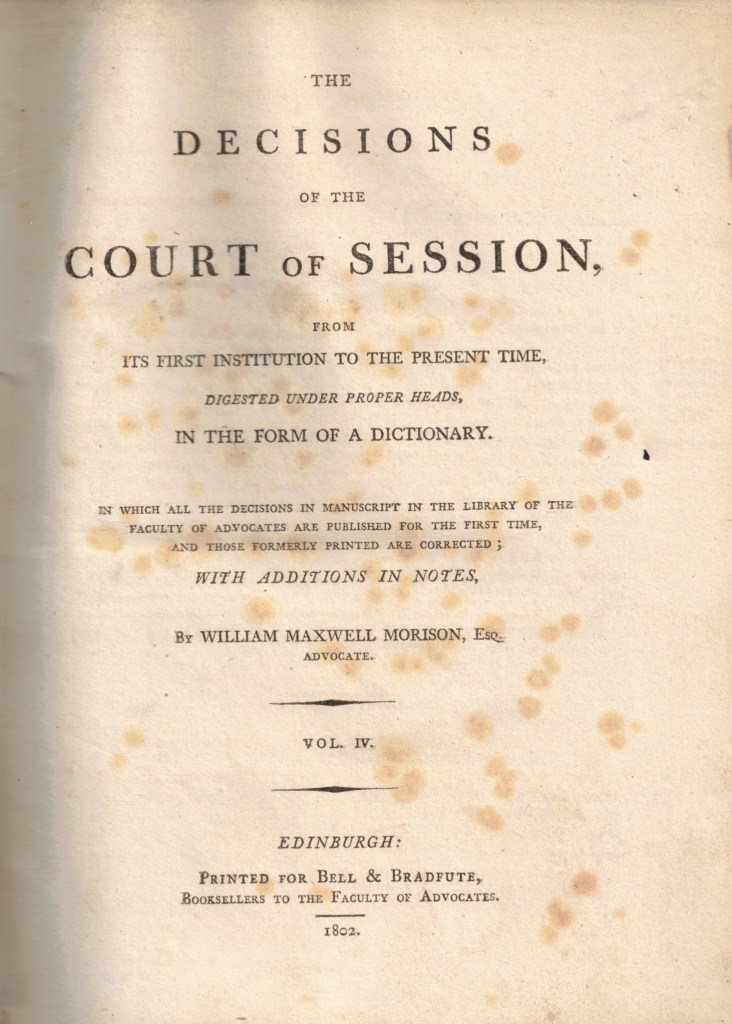
This case is reported in volume 3 of Morison’s Dictionary, published in 1802. William Maxwell Morison (1762 to 30 June 1821) advocate was Sheriff-Substitute of Clackmannan from 1787 to 1789. Morison is best remembered for The Decisions of the Court of Session from Its First Institution to the Present Time, Digested Under Proper Heads, in the Form of a Dictionary (Edinburgh: Bell & Bradfute, 1801 to 1808). Morison collected cases from around the founding of the Court of Session in 1532 to the beginning of the 19th century and arranged them under the legal subject headings of the day.
Cuming complained in his bill and sought liberation until the cost, injury, damage and interest, which was done to Margaret by her husband’s molestation was calculated as a liquid debt on which he offered sufficient caution for payment.
A liquid debt is one that is a due debt of a clear amount proved or admitted by a written obligation, the oath of an adverse party or a judicial decision.
Of the 22 cases reported under the heading Damage and Interest by Morison in 1802, this is the oldest and the only 16th century one. The heading is a translation of damnum et interesse, a latin term used in Scots law to describe the loss and damage sustained by a party, the words referring to actual and consequential loss respectively. They arise in the context of another latin maxim locum facti imprestabilis subit damnum et interesse [damages take the place of an act which was not performed]. In 1926 Lord President Clyde explained that direct loss is the damnum and the consequential loss of the gain or utility is the interesse; “The rule plays, in the contract, a part analogous to that played by the exclusion of remote damage in delict.” (Duke of Portland v Wood’s Trustees 1926 SC 640 at 649).
To modern eyes, the most striking feature of Morison’s report of the hearing in July 1583 is the absence of any legal argument by any lawyer on behalf of either party and the fact that the judges debated amongst themselves in open court. All fifteen judges were likely present when the question was reasoned in the afternoon hours.
The Debate in Court
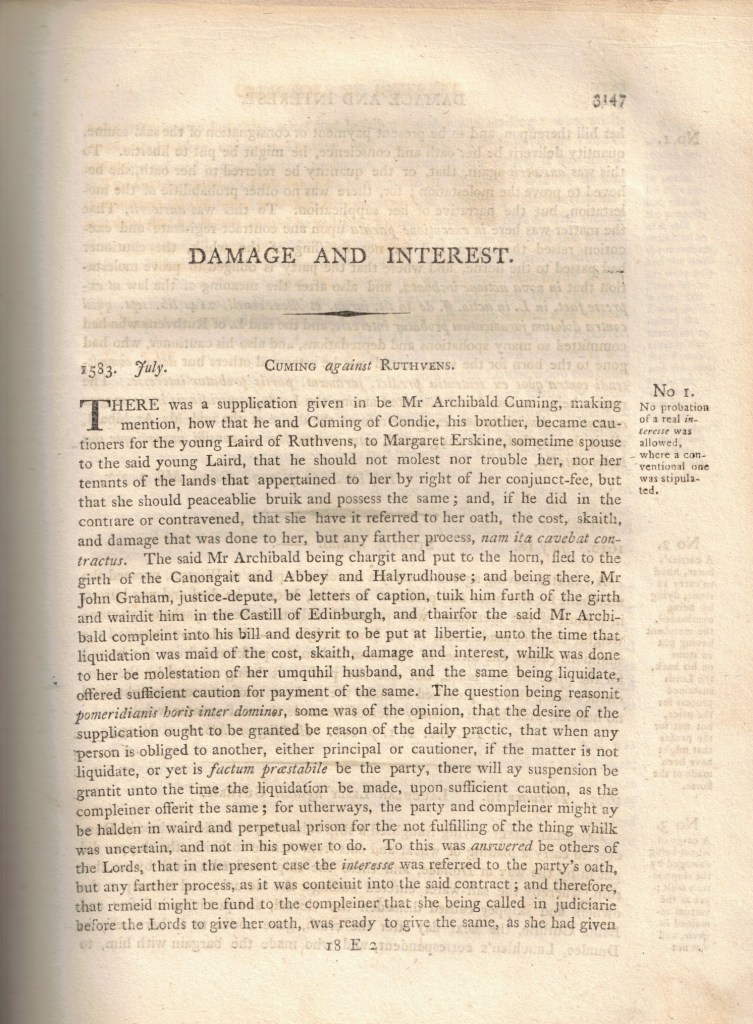
Some the Lords were of the opinion, that the supplication ought to be granted by reason of the daily practice, that when any person is obliged to another, either as principal or cautioner, if the matter is not liquidate, or yet is an obligation for the performance or fulfilment of a specific act on a party, there will aye suspension be granted until the time there is a liquid claim, upon sufficient caution, as the complainer offers here; for otherwise, the party and complainer might aye be held in fateful and perpetual prison for the not fulfilling the thing which was uncertain, and not in his power to do.
To this was answered by others of the Lords, that the cautionary contract in the present case refers the right to damages to the party’s oath, without any further process; and therefore, Cuming might be given the remedy that Lady Ruthven be called before the Lords to give her oath, as she was ready to do and as she had given her bill upon, and so Cuming might be liberated by payment or consignation of the sum delivered by her oath and conscience.
To this was answered again, that, before the quantification was referred to her oath, she should prove the molestation for there was no other proof of the molestation, than the narrative of her supplication.
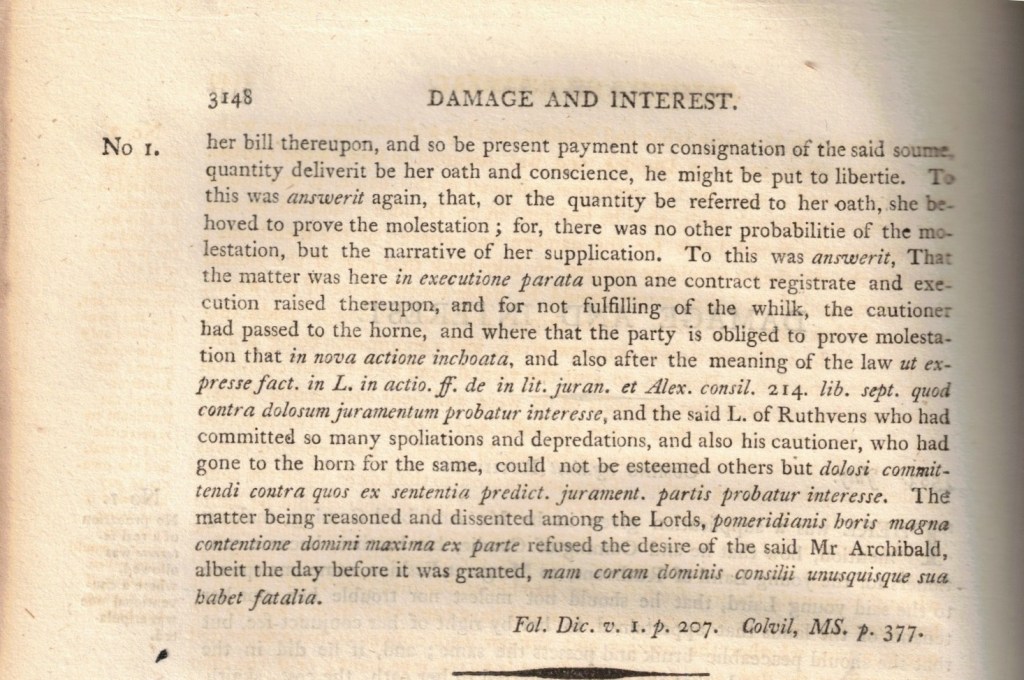
To this was answered, that the matter was pursued on a registered contract and an execution raised thereupon, and for not fulfilling it, the cautioner had been sequestrated; the oath of the Laird of Ruthvens who had committed so many spoliations and depredations, and also his cautioner, who had gone to the horn for the same, could not be relied upon.
The Result
The matter being reasoned and dissented among the Lords in the afternoon hours with great contention, the Lords, by a majority, refused Cuming’s application. Morison’s summary of this case is that Margaret didn’t have to prove her entitlement to damages where it was contained in the contract of caution: “No probation of a real interesse was allowed, where a conventional one was stipulated.”
And so Margaret brought down not only her evil husband but three of his supporters – the Cuming brothers and the Earl of Crawford.
Sources: Register of Privy Council of Scotland, Burgh of Dundee Volume 2 – 1569-1578; Clan Forbes Society post on 15 March 2021 Ruthven; Historic Environment Scotland Hunting Tower; wikitree Morison-255

