Tanner & Van Ness
Lynchburg, Virginia
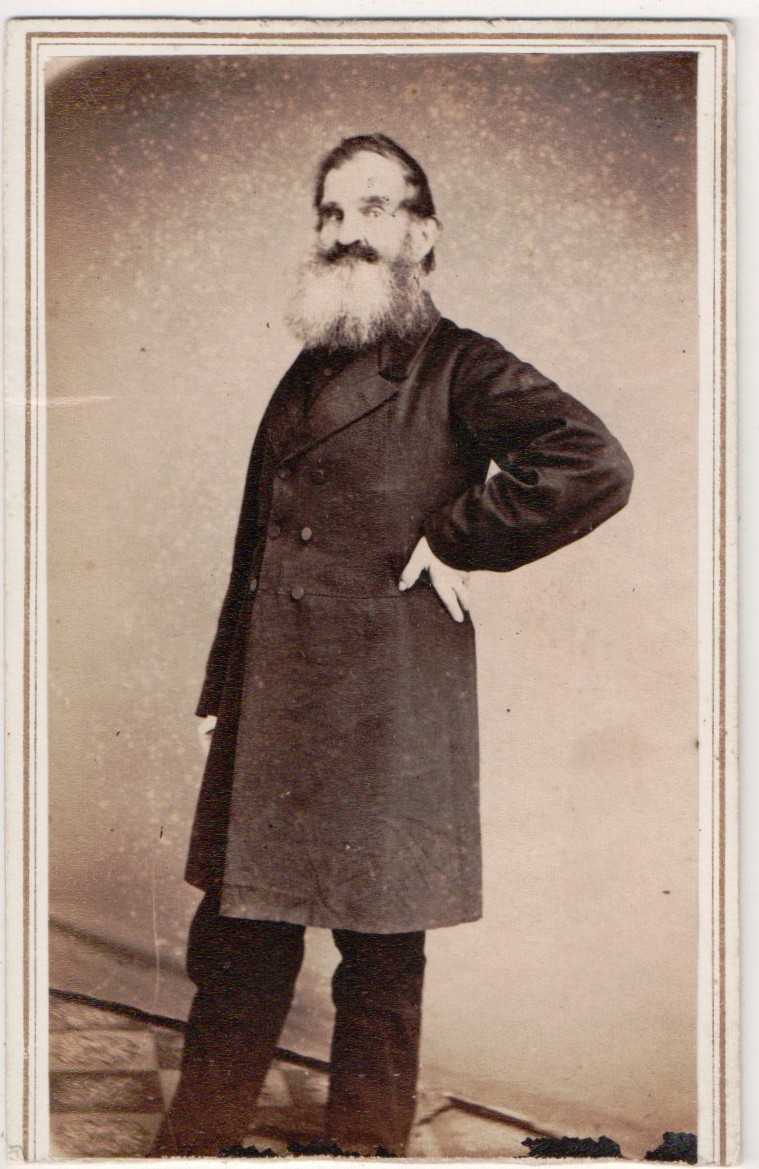
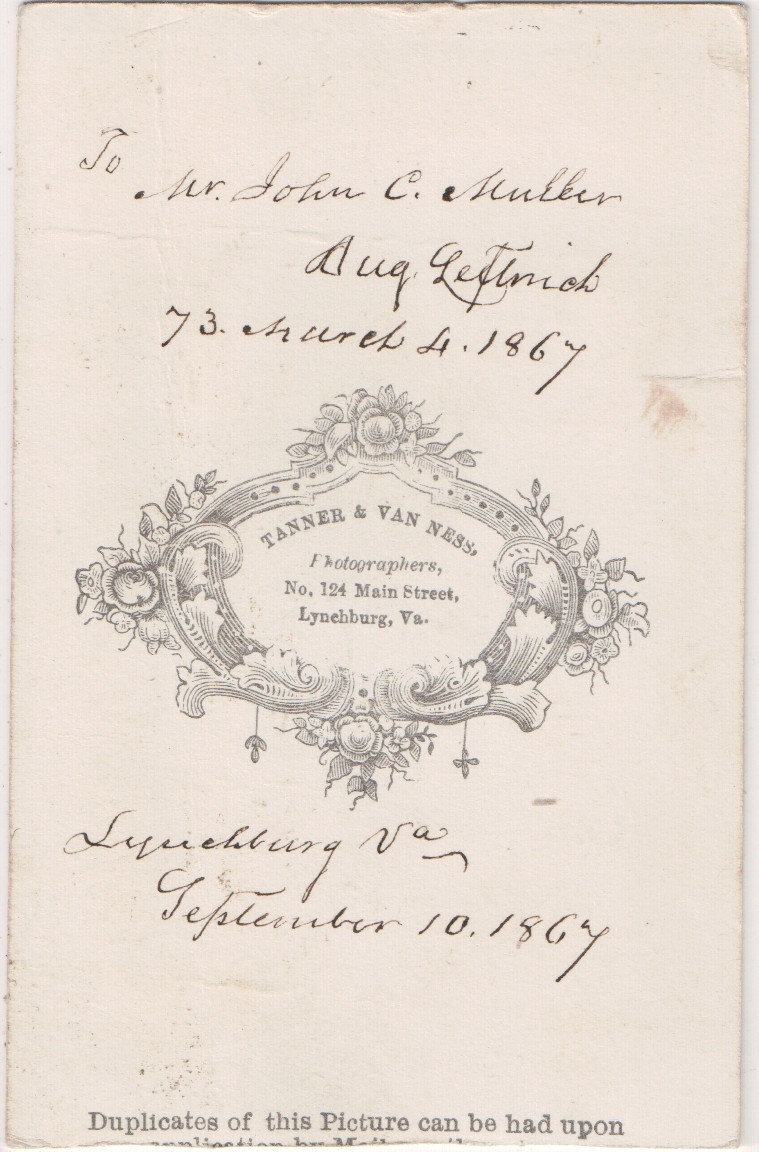
Norman Stephen Tanner (15 October 1824 to 15 November 1888) was in partnership with C W Minnis until the end of 1856 when they went their separate ways to the extent of Minnis establishing his own business at 217 Main Street, Richmond while Tanner retained the old stand of Minnis & Tanner, Main Street, 3rd Door From Bridge, Lynchburg. From 1 January 1957 Tanner established a partnership with A Cochran trading as N S Tanner & Company.
Tanner’s advertisement on 26 August 1857 in the Lynchburg Daily Virginian advised:
“The business will be greatly enlarged, and everything new in the business will be found at our Gallery, and pictures warranted to please.
“We are agents for the sale of Neff’s Patent Melaniotype Rights. Melaniotype, is a new and beautiful style of picture, and can be colored very highly with pleasing effect. The Melaniotype manual contains full and complete instructions in Ambrotyping, Photographing on paper, and infact everything that belongs to the business. Also Lockets, Breast Pins, Rings, &c.
“Instruction in either of the above arts given on reasonable terms, and satisfaction given in all cases. N. S. Tanner, A. Cochran.”
Melaniotype is a reference to the tintype process patent for which was assigned to William and Peter Neff in 1856. William Neff died a short time later, but his son Peter. who named the process Melainotype, continued on with his work. The great majority of tintype photographs in the Smithsonian’s collection are studio portraits, including the very popular ‘Gem’ size (about ¾” x 1”). The advertisement appears to anticipate setting customers up to make their own images at home.
At some stage after February 1860, Tanner formed a further partnership with James H Van Ness who was privileged to have his name above the door. The business became a classic source of record of the American Civil War (12 April 1861 to 26 May 1865). This was a civil war in the United States between the Union (“the North”) and the Confederacy (“the South”), which started in 1861 after southern states seceded from the Union to preserve slavery which they saw as threatened because of the election of Abraham Lincoln and the growing abolitionist movement in the North. The war ended with Union victory, the dissolution of the Confederacy and the abolition of slavery and the freeing of four million.
A common subject in tintype photography is the civil war soldier. The durability of the tintype meant that photographs taken in the field could be sent home. Tanner and George S. Kyle who both operated photographic studios on Main Street, worked constantly as local soldiers lined up for pictures taken in full uniform. On 15 January 1863, over a thousand Federal prisoners from the battle of Murfreesboro in Tennessee arrived in Lynchburg. Several blocks of Main and Church Streets were quartered off to accommodate them. Tanner captured a likeness of the prisoners and earned quite a profit from selling copies to the citizens, The prisoners were soon were soon ushered to the fairgrounds by city officials.
James Henry Van Ness (17 March 1841 to 15 November 1925 ) was born in Baltimore, Maryland. Educated at a private school, Waugh and Majors, Van Ness graduated in 1858, and began working at his father’s grocery store until 1862. Van Ness then joined the Confederate Army and served with the 15th Virginia Cavalry.
The 15th Virginia Volunteer Cavalry Regiment was a cavalry regiment raised in Virginia for service in the Confederate States Army. It was formed in September 1862, by consolidating the 14th and 15th Battalions of Virginia Cavalry. On 8 November 1864 it was absorbed by the 5th Virginia Cavalry. NWT Skirmisher records that of the 440 men who answered the roll call of 1862, at least 410 had been lost in over 100 battles throughout the state of Virginia.
From all accounts, Van Ness was engaged in numerous battles and skirmishes where he performed bravely. Van Ness settled in Lynchburg where more than one Confederate regiment disbanded in 1865. There he learned the art and trade of photography. One of the cartes de visite produced by Tanner and Van Ness is identified in the Library of Congress as Lieutenant Van Ness.
Meantime, the war was causing difficulties to Tanner’s former partner Minnis:
SUBSTITUTE WANTED—Wanted, a substitute for first-class artillery company. Any person over 45 years of age, who can produce evidence of good character and physical ability, will receive a liberal price by calling at MINNIS’S Photograph Gallery, No. 217, Main street, next door to the Southern Express Company. Ask for Mr. BRADLEY.
Richmond Dispatch 26 August 1862
The Confederate Conscription Acts of 1862 to 1864 were a series of measures taken by the Confederate government to secure the manpower needed to fight the American Civil War.
The First Conscription Act, passed on 16 April 16 1862, made any white male between 18 and 35 years old liable to three years of military service. On 27 September 27 1862, the Second extended the age limit to 45 years. The Third, passed on 17 February 17, 1864, changed this to 17 to 50 years old, for service of an unlimited period.
Originally, anyone drafted could hire a substitute, a provision that was heavily criticised, and abolished on 28 December 1863. In addition, an Act of 21 April 1862 created reserved occupations excluded from the draft.
The war was still featuring strongly two years later when Minnis and Tanner seem to have resolved their differences and advertised for “A good Photographer, who is exempt from military service. One who understands the business can apply at C W Minnis’s Gallery, or to N S Tanner, Lynchburg.” (Monday, 11 April 1864 Daily Despatch)
Tanner and Van Ness seem still to have been going in 1867 when Tanner took steps to copyright a Robert E. Lee Military Medallion Albumen. Tanner, was 37 when his son William Benjamin Tanner (24 November 1861 to 1912) was born.
So, pulling these strands together, it may be that Tanner took the opportunity of the arrival of the young war hero Van Ness to enhance his business cudos by making him a named partner when he was in truth an apprentice.
Sources: CONFEDERATE LYNCHBURG, 1861-1865 by George Graham Morris (Thesis submitted February 1977 to the Graduate Faculty of the Virginia Polytechnic Institute and State University in partial fulfillment of the requirements for the degree of MASTER OF ARTS in History);
Civil War Richmond; The Charlotte-Mecklenburg Story James H Van Ness 1841-1925; Smithsonian Photographic History Collection :tintypes; Pioneer American Photographers; wikipedia 15th_Virginia_Cavalry_Regiment & Confederate_Conscription_Acts_1862 to 1864; NWT Skirmisher 15th-regiment-virginia-volunteer-cavalry
This Card: Colonel Augustine Leftwich (4 March 1794 to 24 March 1881)
When Colonel Augustine Leftwich was born on 4 March 1794, in Bedford, Virginia, his father, Thomas Leftwich, was 53 and his mother, Jane Stratton, was 39. He married Mildred Adams Ward on 17 June 1825, in Edgehill, Roanoke, Virginia. Leftwich lived in Lynchburg for about 30 years. In 1880, at the age of 86, his occupation is listed as tobacco manufacturer: retired in Lynchburg. He died in Lynchburg at the age of 87 and was buried in Presbyterian Cemetery there.
He dedicated this CDV photo of himself to Mr John C Muller on 10 September 1867 to mark his 73rd birthday on 4 March that year.
Leftwich’s Row on Harrison Street was named after the subject of this photograph; it was where enslaved labourers working in the city, were kept in housing by the tobacco tycoon. The housing was built in 1845 and stayed there for 60 to 70 years.
There were many slaves in Lynchburg before the Civil War, indeed, census records show nearly half of the population. They worked all the industries including the tobacco factories, the foundries, the warehouses, the railroad depot: “Many visitors from out of town who came to Lynchburg commented on their first sight of the city how many African Americans that were here. Slavery just hit them immediately when they got off of the rail car or the packet boat.”
The Library of Congress has a carte-de-visite of Leftwich’s son Fifth Sergeant Augustine Leftwich (7 August 1840 to 29 July 1863) of Lynchburg Virginia Light Artillery Battery in uniform taken by Holyland’s Gallery, Baltimore. Leftwich was wounded at Gettysburg, Pennsylvania on 1 July 1863 and died within the month.
Sources: abc13 NEWS February 2024 uncovering-lynchburgs-dark-history-of-urban-slavery; Library of Congress; Family Search Colonel Augustine Leftwich 1794-1881
A & G Taylor, United Kingdom
The largest Photographers in the World
PHOTOGRAPHERS TO HER MAJESTY THE QUEEN
BY SPECIAL ROYAL WARRANT
and Their Royal Highnesses
THE PRINCE & PRINCESS OF WALES.
The largest photographers in the World.
Miniature & Portrait Painters
70 & 78 QUEEN VICTORIA ST. E.C.
and at 62 & 64, LUDGATE HILL, E.C.
129 FENCHURCH STREET E.C.
Forest Lodge, London Road, Forest Hill.
LONDON
Also at most of the principal towns throughout
the United Kingdom.
NEGATIVES KEPT .- COPIES MAY BE HAD.
Cartes enlarged to life size x finished in Oil or Water.
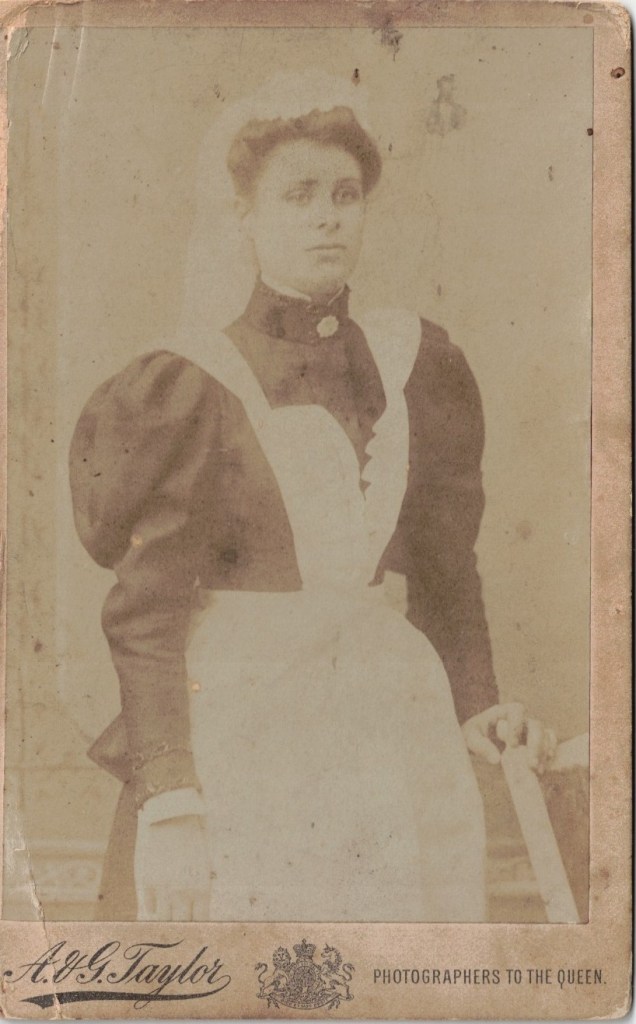
Brothers Andrew and George Taylor were born in Aberdeen, Scotland, in 1832 and 1840, respectively. They began producing miniatures and gradually transitioned to the more lucrative vocation of photography. They opened their first London gallery at 11 Cannon Street West in 1864. They specialized in portraiture for collections and by commission, and soon were so successful they expanded their business throughout England, Scotland, and Ireland, opening studios in such cities as Birmingham, Leeds, Liverpool, Manchester, Newcastle, Glasgow, and Dublin.
By 1878, the year they opened the Edinburgh studio at 63 Princes Street, they had studios in about 70 towns and cities throughout Britain, and in 1879, the company opened studios in Paris and the USA.
The following table gives some of the managers of some of their branches.
| Branch | Manager | Date |
| Glasgow | Low Wilson | 1885 |
| Edinburgh | J F Wyllie | 1890 |
| Greenock | Alex Gibb | 1891 |
| Greenock | R Corstorphine | 1891 to 1893 |
| Greenock | G Gibson | 1897 |
| Sheffield | William Middleton | 1879 to 1891 |
| Nottingham | William Middleton | |
| Derby | William Middleton | 1899 to 1901 |
| Brighton | Arthur Bruges Plummer | 1882 to 1884 or 5 |
| Brighton | Robert Bourne | 1886 |
| Franklin Chambers, Granby St, Leicester | Thomas Kemp | c1884 to 86 |
| London corporate headquarters | Andrew Taylor | until the 1880s |
| Hanley, Staffordshire | H J Glover | from 1882 |
| New Briggate, Leeds | James Bogie Law | 1878 to 89 |
| New Briggate, Leeds | William Middleton | 1881 |
| Wolverhampton | William Janeck | 1884 |
Manager A & G Taylor,

Sources: Historic Camera; Glasgow Museums; Derbyshire Photographers’ Profiles by Brett Payne; List of branches and dates Victorian Photographs; Edin Photo
Tufnell Thompson
Blackpool, Lancashire, England
- T. Tufnell Thompson, South Beach, Blackpool
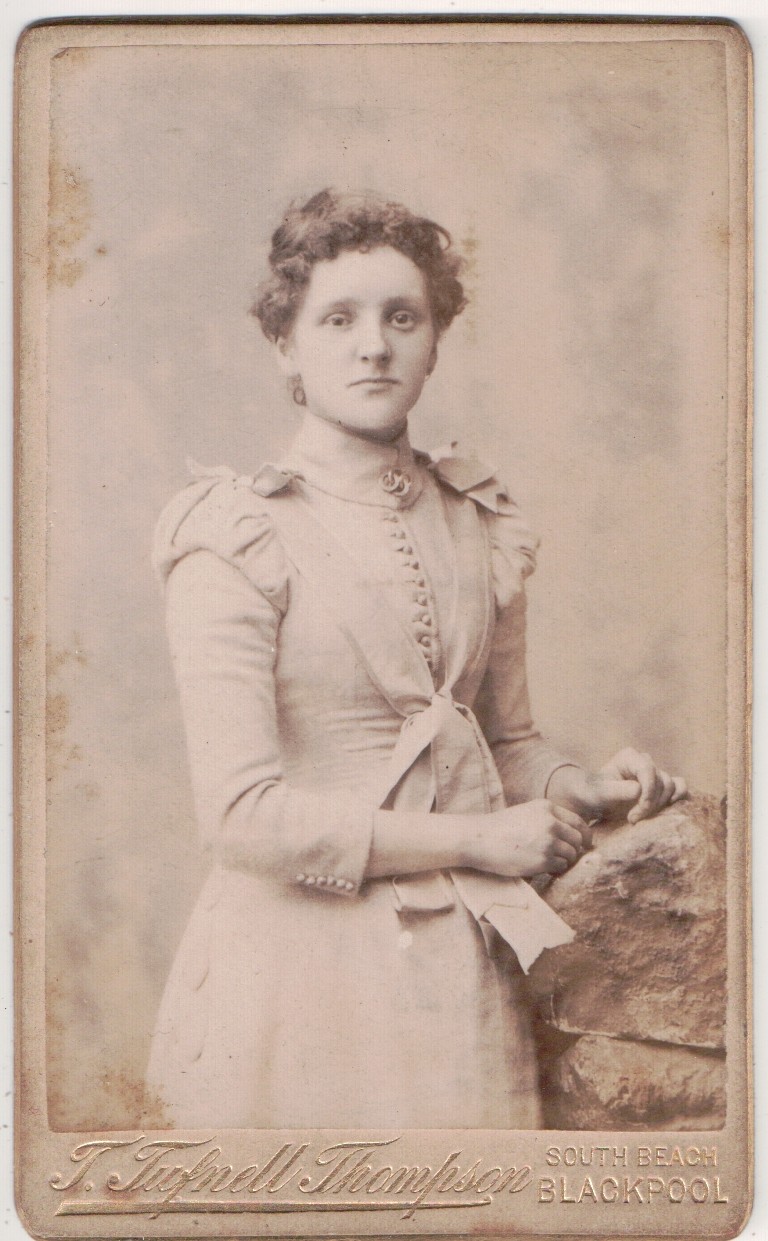
Thomas Tufnell Thompson, (1839 to 16 June 1892) 13 Wellington Terrace, Blackpool. Thomson was born in Macclesfield and married Didsbury-born Ann Thompson who was four years his senior.
His son Ernest A Thompson who was then 25 and his niece Geraldine Taylor (38) were also living in the household. Ernest Thompson succeeded Tufnell in the business which produced cabinet prints of the Sergeants and Colour Sergeants of the 2nd Volunteer Battalion of the York and Lancaster Regiment, who attended annual camp in Blackpool in 1883 and photographs of members of the King’s Own Royal Lancaster Regiment in about 1897.
Sources: London Gazette chrome-extension://efaidnbmnnnibpcajpcglclefindmkaj/https://www.thegazette.co.uk/London/issue/26311/page/4337/data.pdf
Rootschat

