January 2026
Day 20 Thursday 1 A windy New Year
I hear the new year fireworks but they don’t wake me. Another calm, sunny day, just warm enough for breakfast on our balcony at 8am – there is no morning exercise on New Year’s Day. Out soon after the bike centre opens at 10.30 collecting our medium mountain-bikes from a Green Team member who doesn’t appear to have been to bed.
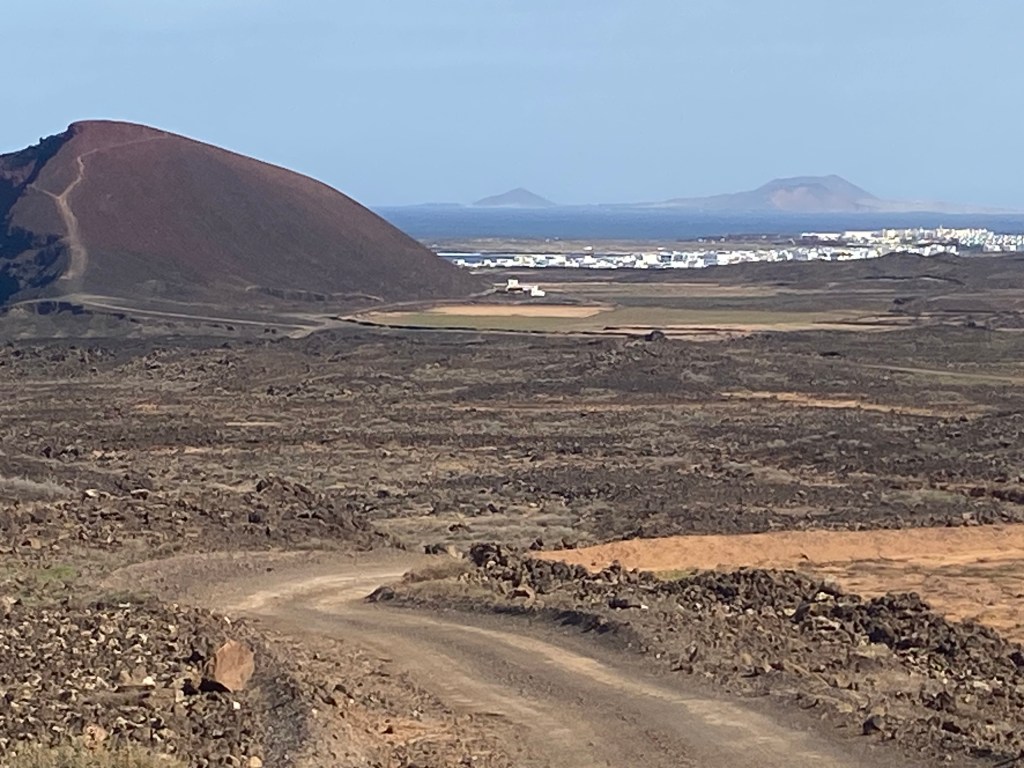
But the moment we leave, the headwind becomes a challenge. Both the cafes in la Santa village are closed or I would probably call it off there in favour of zumo de naranja. We press on through the village and on to the coastal path but turn back after about five miles. We are blown back in record time and hand the bikes in after about 90 minutes. Pleasant lunch on the balcony of the prawn sandwiches we carried out and back.
Day 21 Friday 2 la Santa to Arrecife
Our last 8am stretch where the weather is good despite the forecast. We are checked out by 10. After a last visit to the gym, coffee and cheesecake in the tent that is serving as the pool bar while the old one is being rebuilt. €10 price doesn’t please J. And the high wind makes the tent shake and shudder in an unpleasant – alarming even – manner.
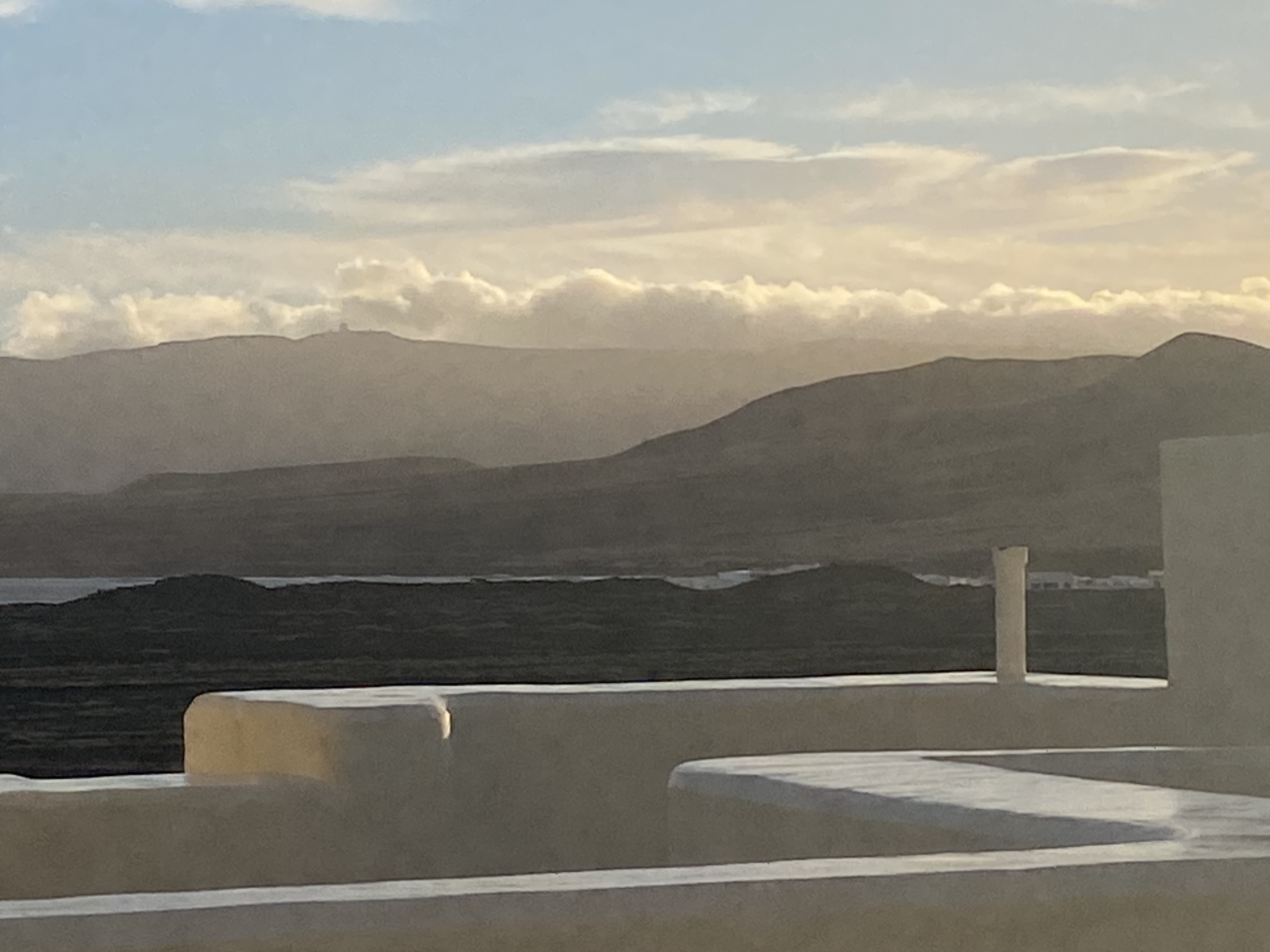
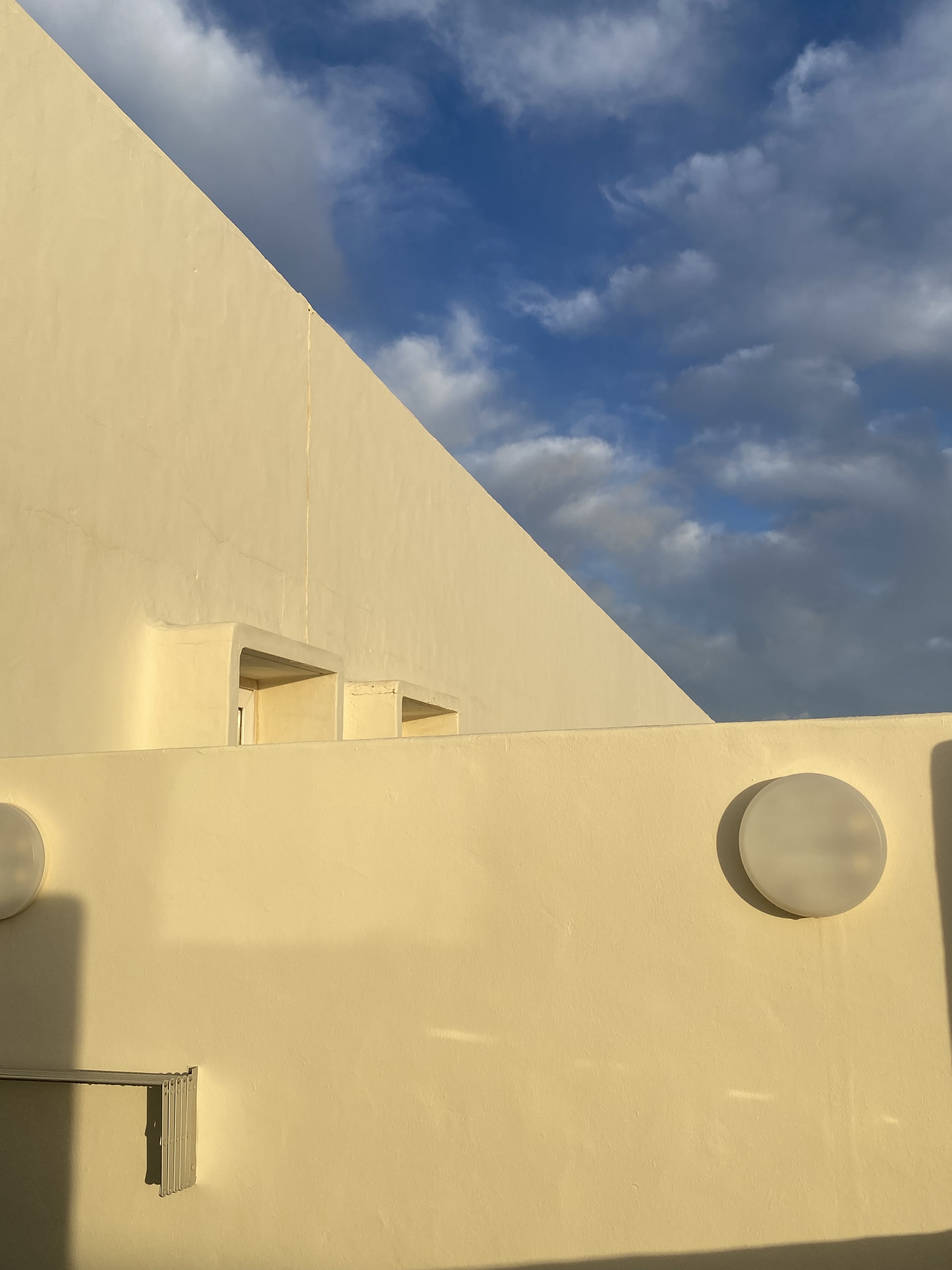
Walk up to Soo in very windy conditions arriving a little before Munsoo opens at 1pm. Their menu more limited than on previous occasions but still excellent; more aubergine fritters, a light beetroot soup and more pulled pork tacos.
3pm service bus to Arrecife with very dark clouds all the way. The driver’s difficulties in fitting a replacement paper roll results in him issuing blank bits of paper as tickets for a while. Our accommodation is on the street behind the lagoon front. In the cloudy conditions the street looks particularly down at heel. My knock at number 48, the address we have been given, brings forward a weary-looking woman no doubt fed up with such intrusions. We are also civilly rebuffed next door. It transpires that we are at 44 with an entrance on a side street. Three different locks are operated by three different uses of an app we have had to upload to our phones. It is all quite Orwellian.
No sooner are we in than a heavy shower welcomes us to Arrecife. Soon after that, our host arrives, very talkative and welcoming. She has another flat in the same block entirely operated by technology which we would love.
What we would love would be washing powder and washing up liquid. The day finishes dry but still cloudy with a storm forecast in the middle of the day tomorrow.
Day 22 Saturday 3 Stormy day in Arrecife
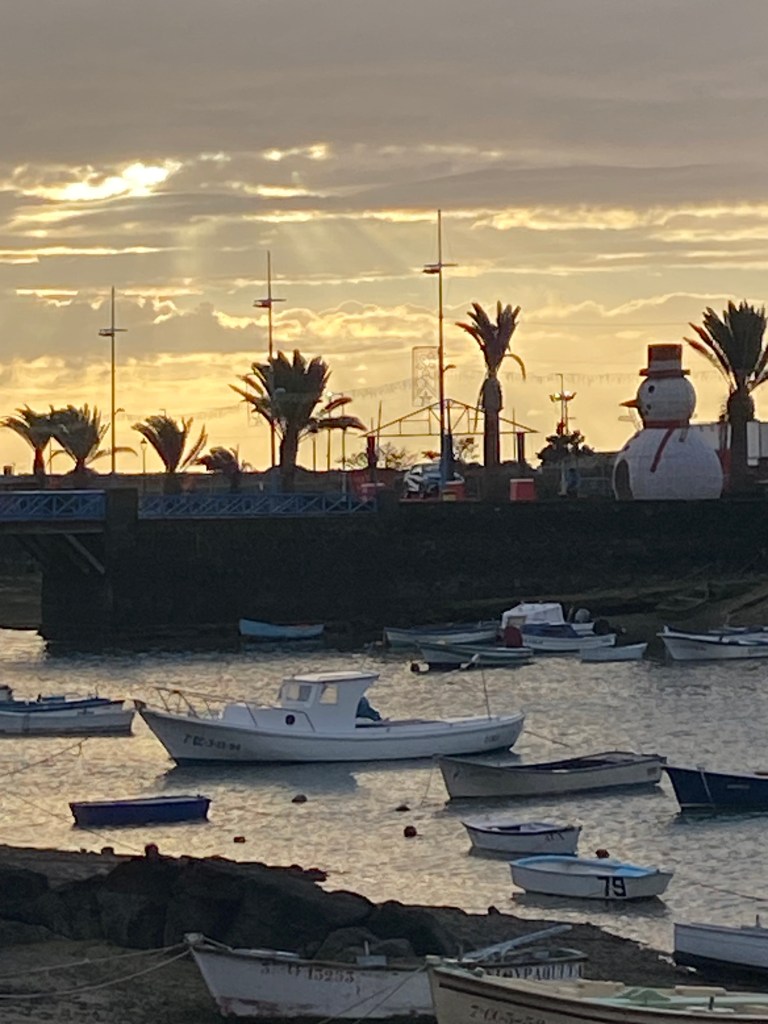
Out on the first of three shopping trips by 8am in light of the forecast storm. I cut my hand on the monkey bars on the far side of the lagoon, a fact that first comes to my attention when I put out my bloody hand for change for the purchase of stamps I have just made – a surprise for the shopkeeper too.
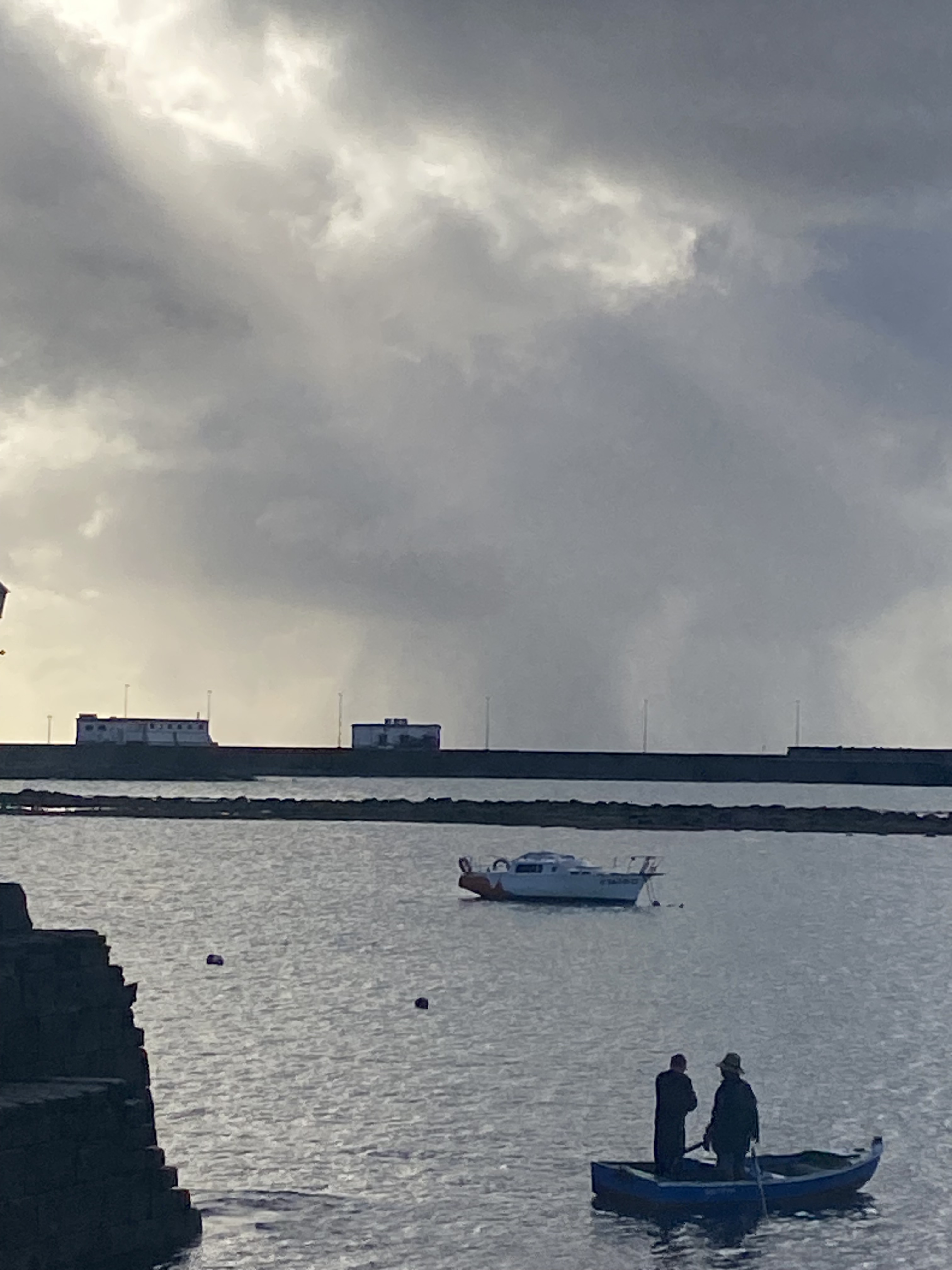
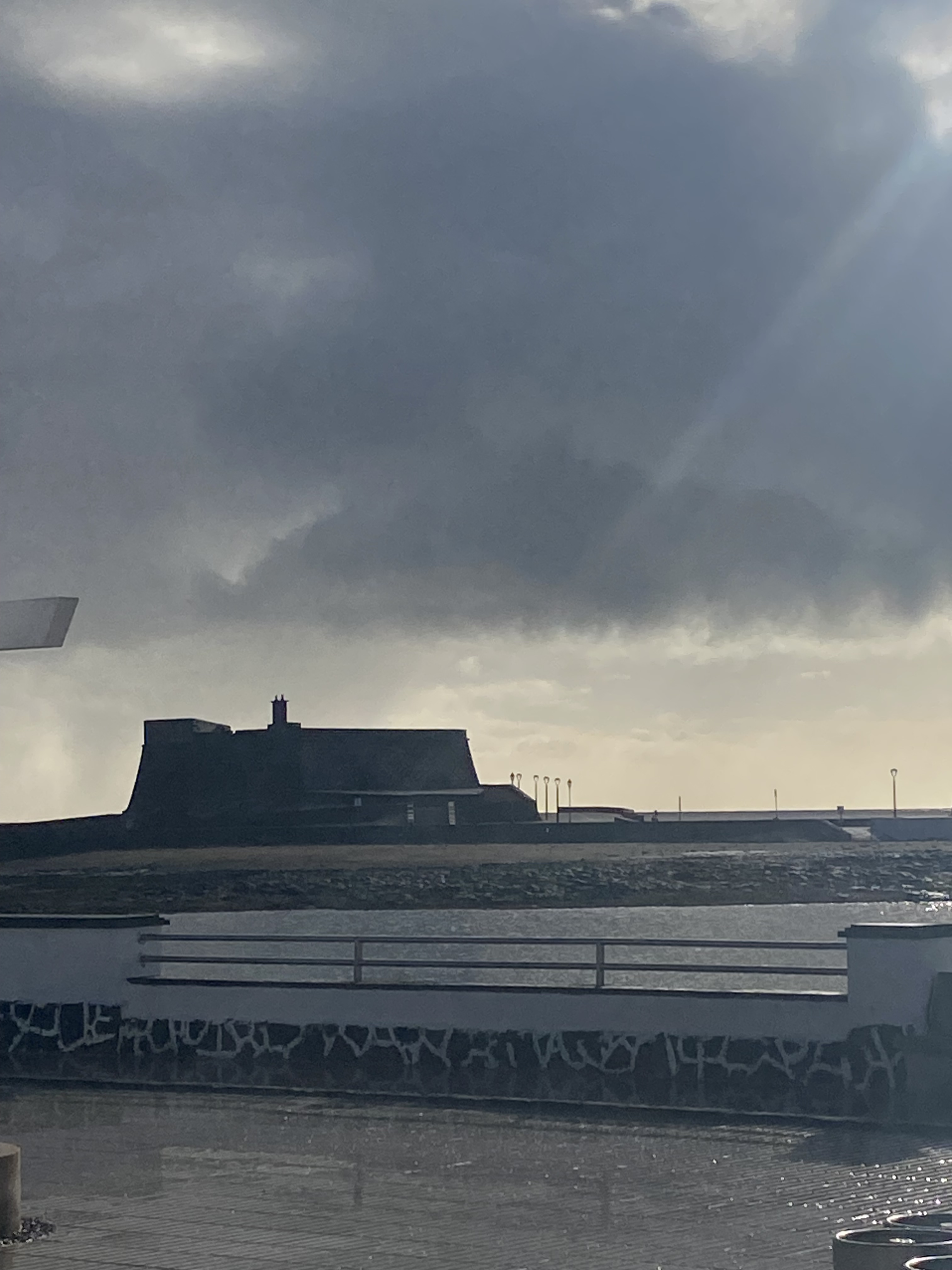
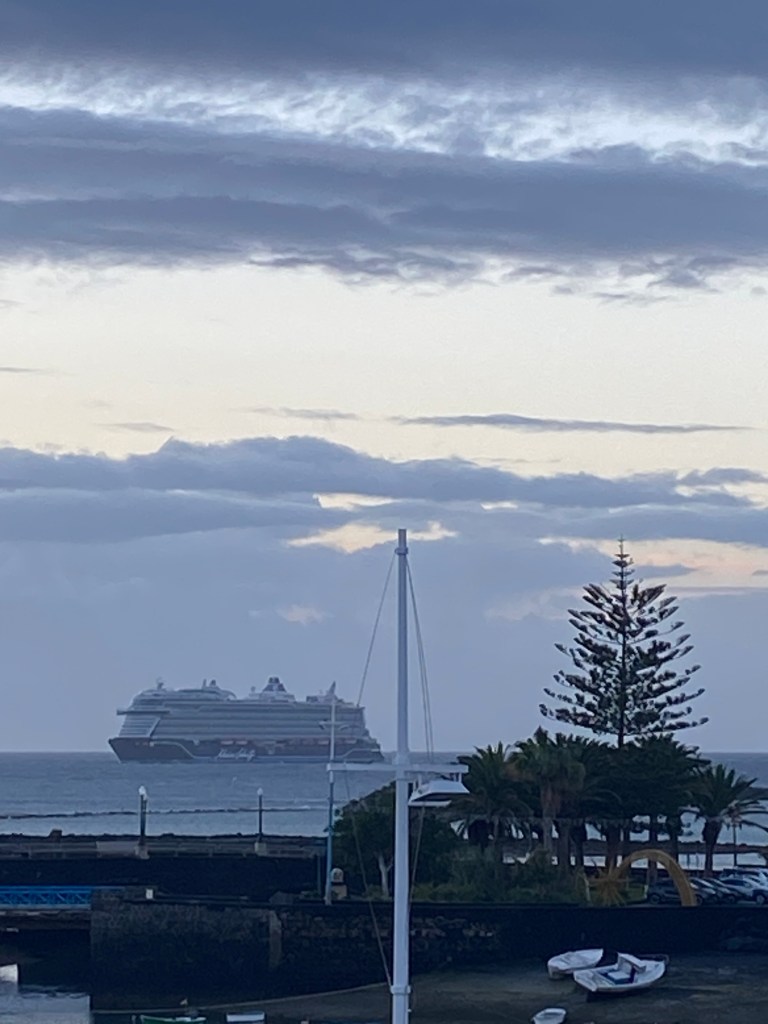
Sunshine and threatening skies persist until mid-day when enthusiastic bell-ringing from the church is a feature. The restaurant in front of us has to tie up its umbrellas almost as soon as they are up. A huge cruise ship provides a lot of pedestrian traffic on the laguna. The people in the house off to the left have allowed their dogs to cover the flat roof of the building in their filth.
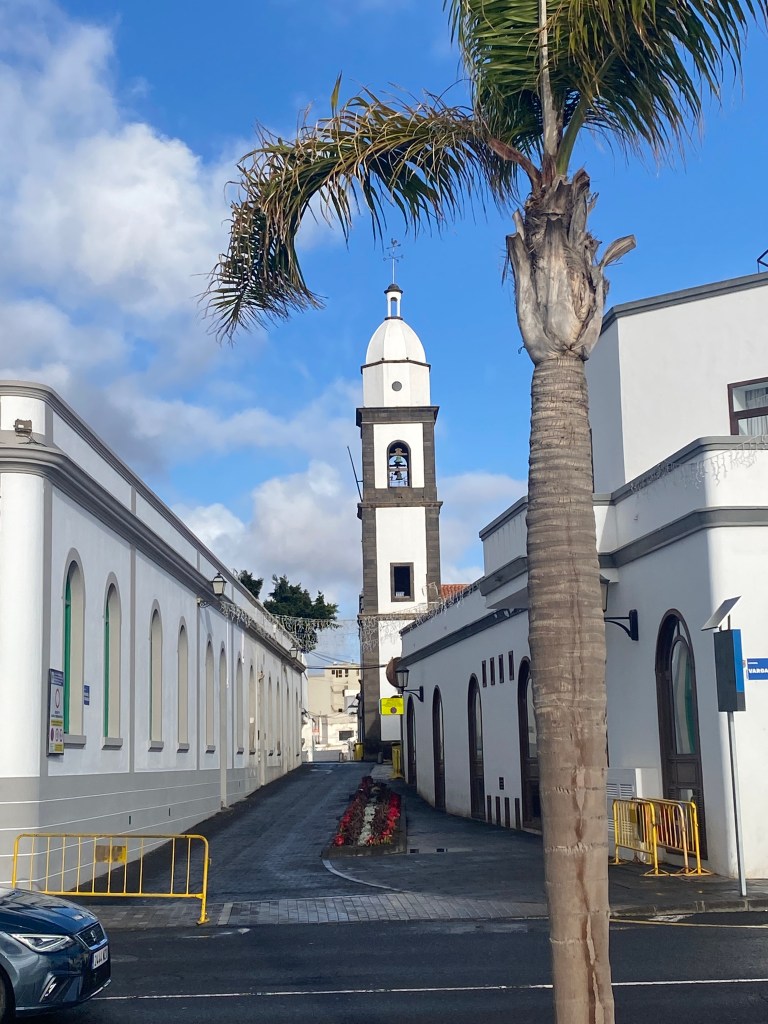
A very changeable day with rain every time our laundry get to be nearly dry. The forecast storm produces a couple of heavy showers and quite a lot of wind but it is mild and a mile away from the six inches of snow reported from Scotland.
Dinner at la Raspa restaurant which always produces a stylish meal.
Day 23 Sunday 4 Gym and Cinema
Out round town before 9am; it is sunny and (very briefly) showery in turn. Very little has changed in Arrecife since last year – the commercial properties that were empty last year are still empty. The AIDA cruise ship we see arrive is leaving at 5 for Lisbon which it will reach in two days. This would be convenient for those who want to avoid the Armas experience though the rail journey from Lisbon to Madrid takes all day.
After lunch we walk to the Area Fit gym beside the bus station. Day membership is €8; they need to see my passport. The place is huge and the equipment new – much of it still wrapped in polythene. The locks in the changing room require your own padlock.
No rain while we are out so our washing is dry on return. Several closed shops on the way have sandbags across their entrances. After we get back, light flurries of rain but far more sunshine.
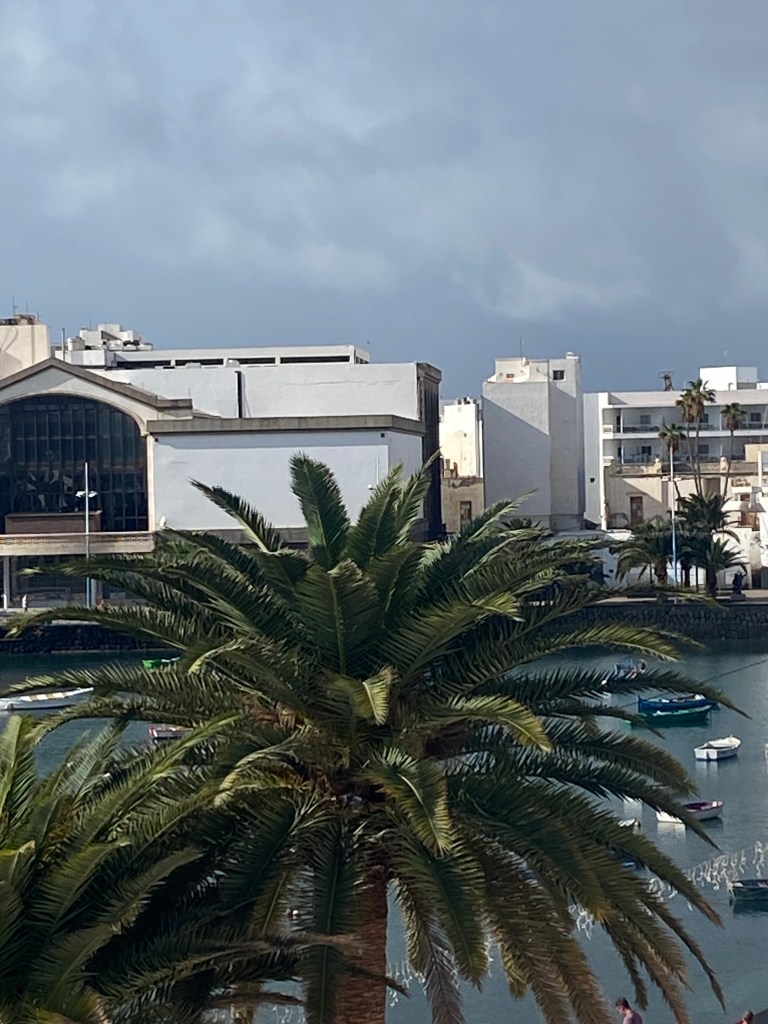
Out to the 4.50 showing of Rondallas in the huge cinema on the Lagoon. The cinema consists of several small rooms and a theatrical cine that is huge in a way that one doesn’t find at home. We have seen some dreadful flicks there but the latest Avatar is a step too far and our choice is a charming Spanish film with a slight feel of Local Hero. Although neither of us speaks Spanish, J is able to follow it enough to explain it to me which is all one can ask of a film. Cinema 3 is small but properly raked though the house lights start to go up before the end of the film.
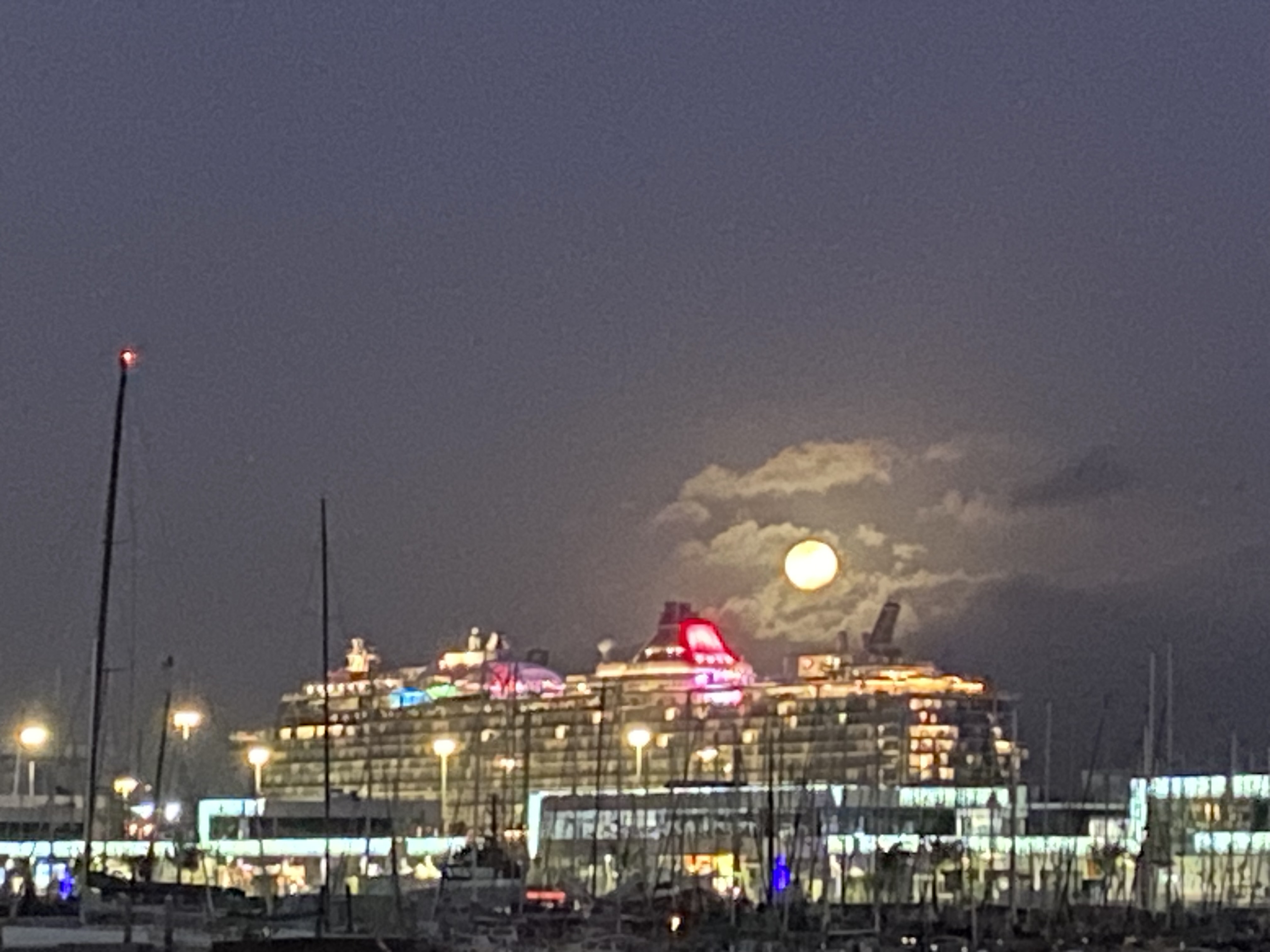
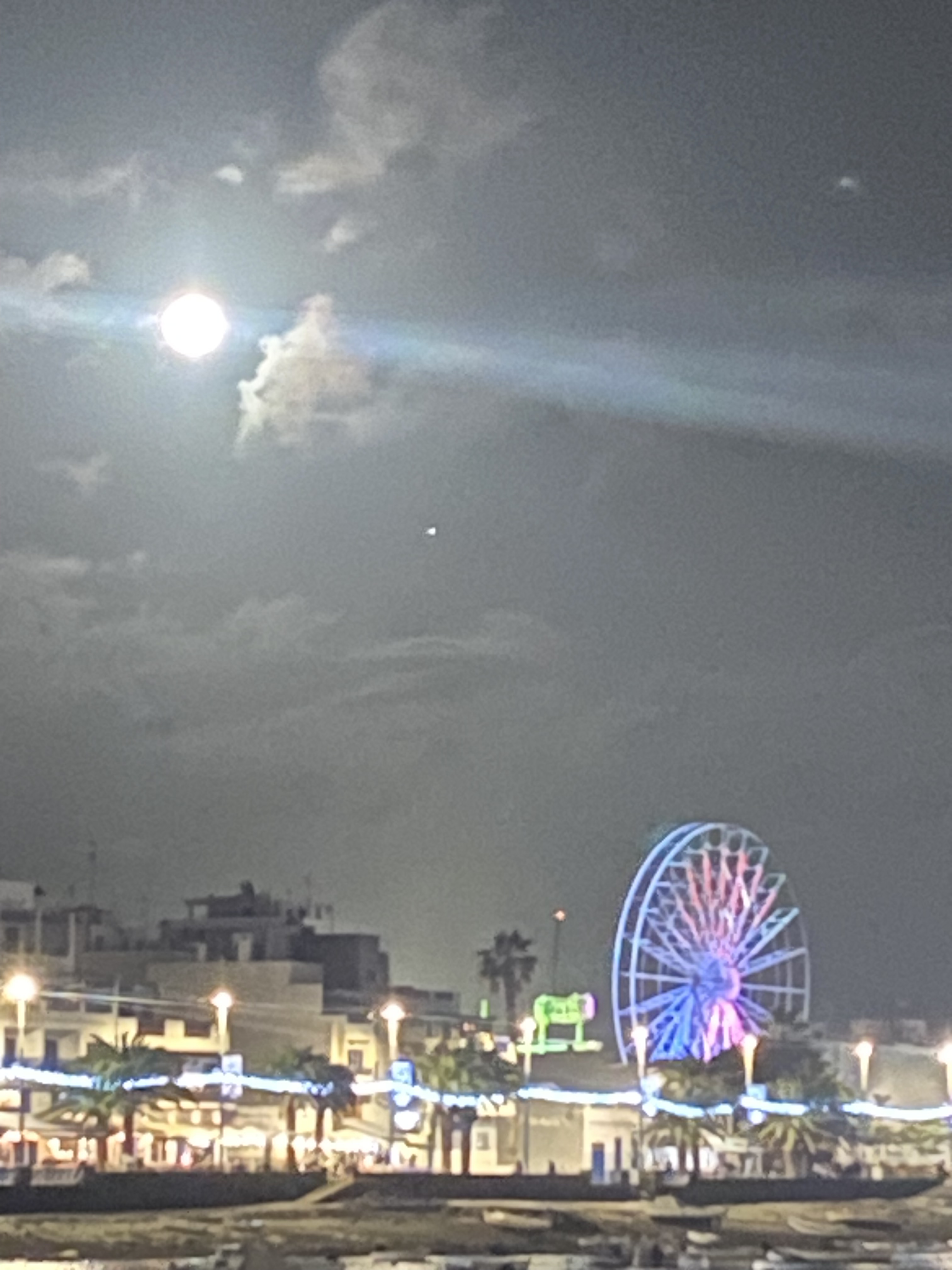
Day 24 Monday 5 Fuerteventura
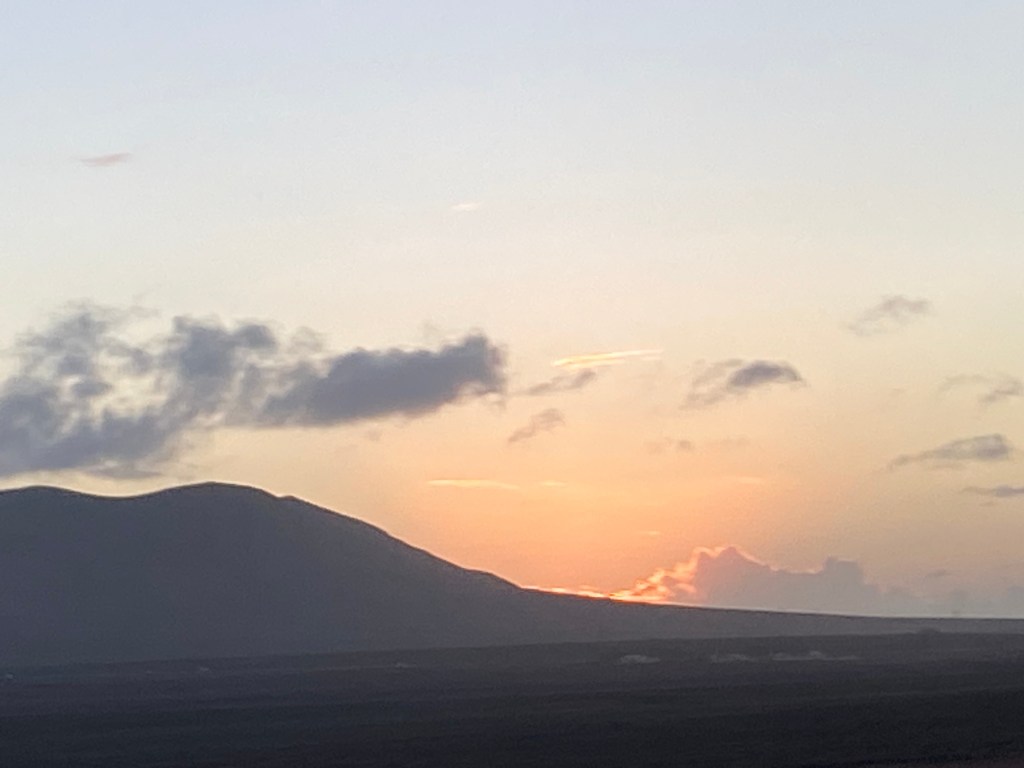
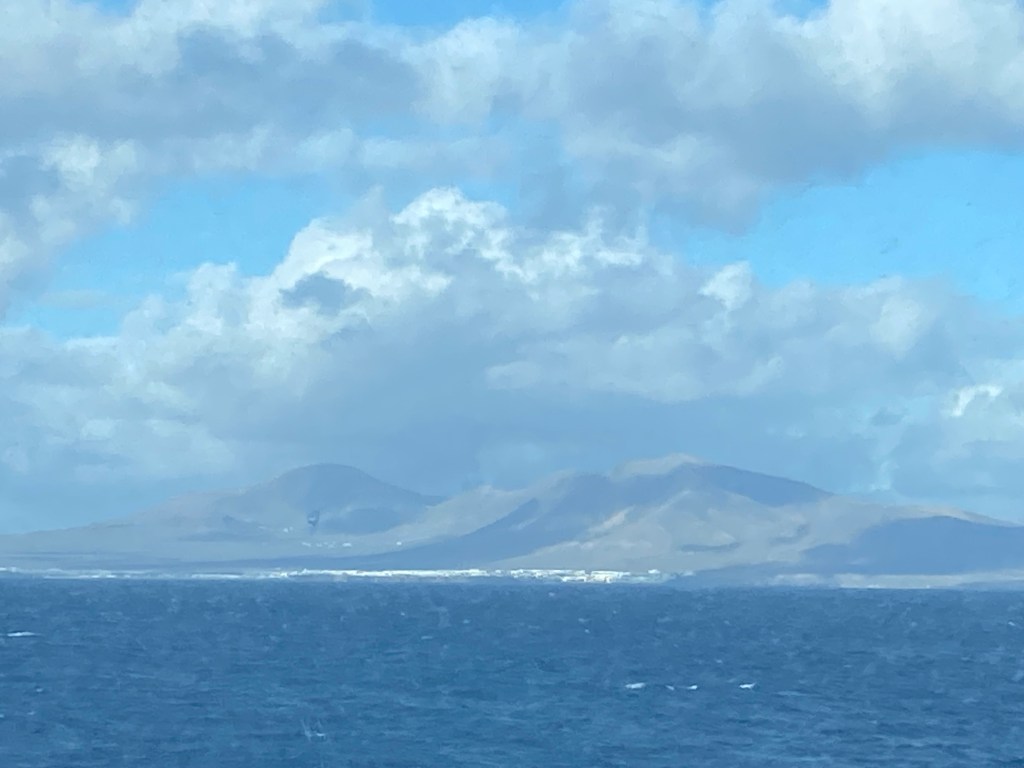
Both wakened by our 6am alarm though we are often awake by that time. Walk up to the 7am bus from the Guaguas Bus Station to Playa Blanca. We have to join a queue and it is entirely full by the time we leave the city. The usual winding route takes us eventually to the port at Playa Blanca in good time for the 8.40 Armas ferry to Corralejo on Fuerteventura.
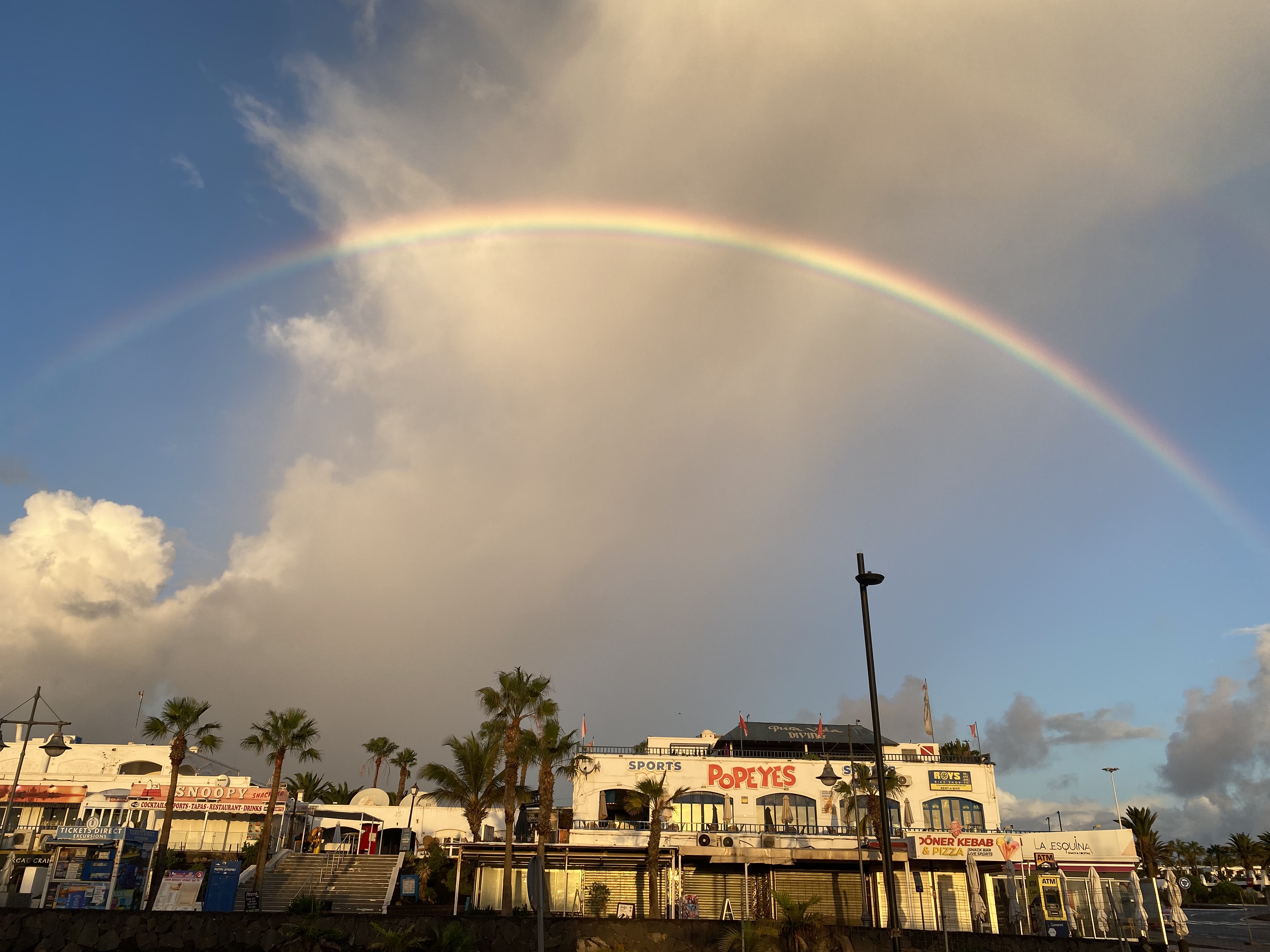
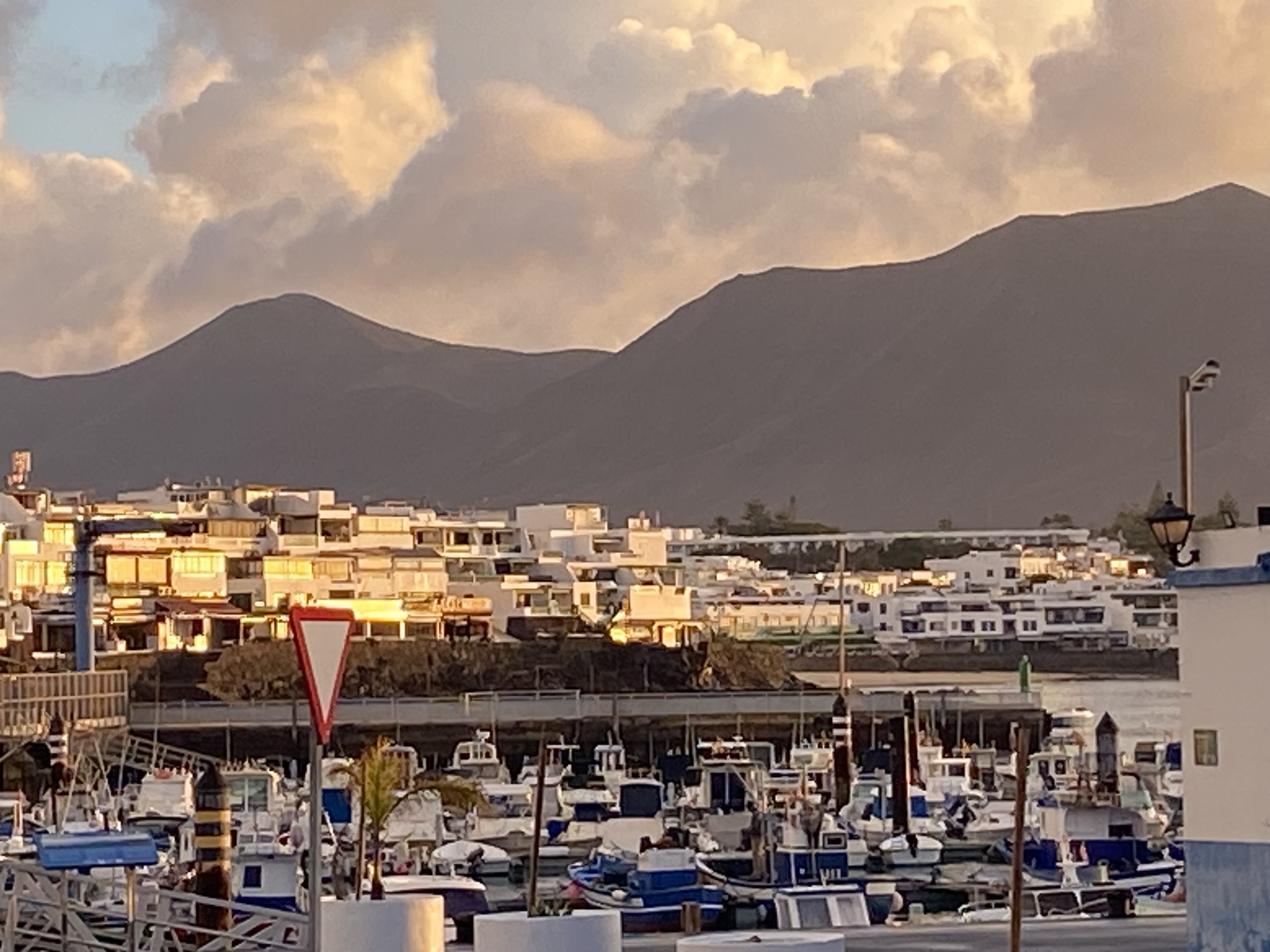
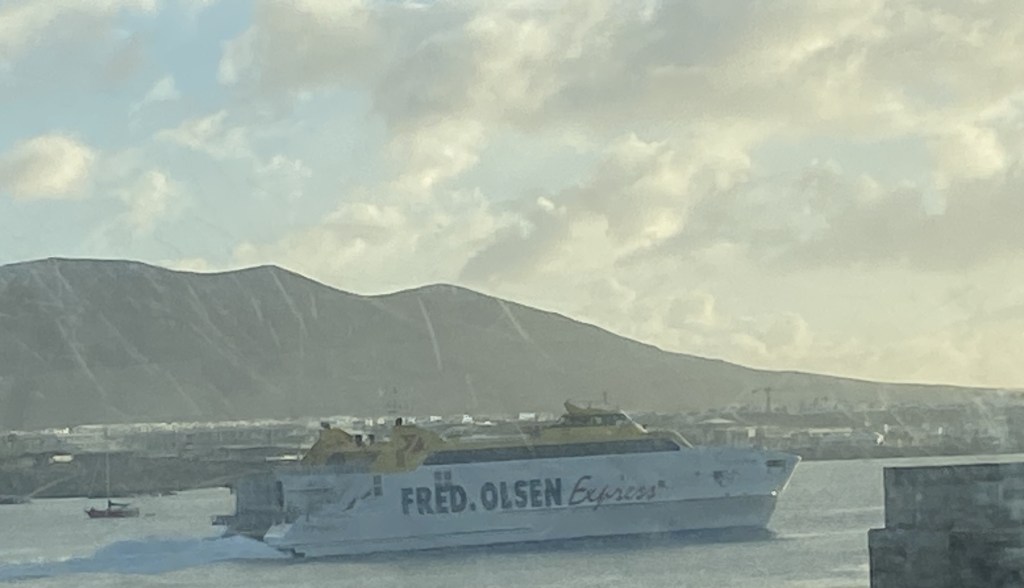
We see the Fred Olsen catamaran arrive and depart while we are waiting. Just as J had to put our passport numbers into the booking yesterday, we have to produce them for scanning as we board.
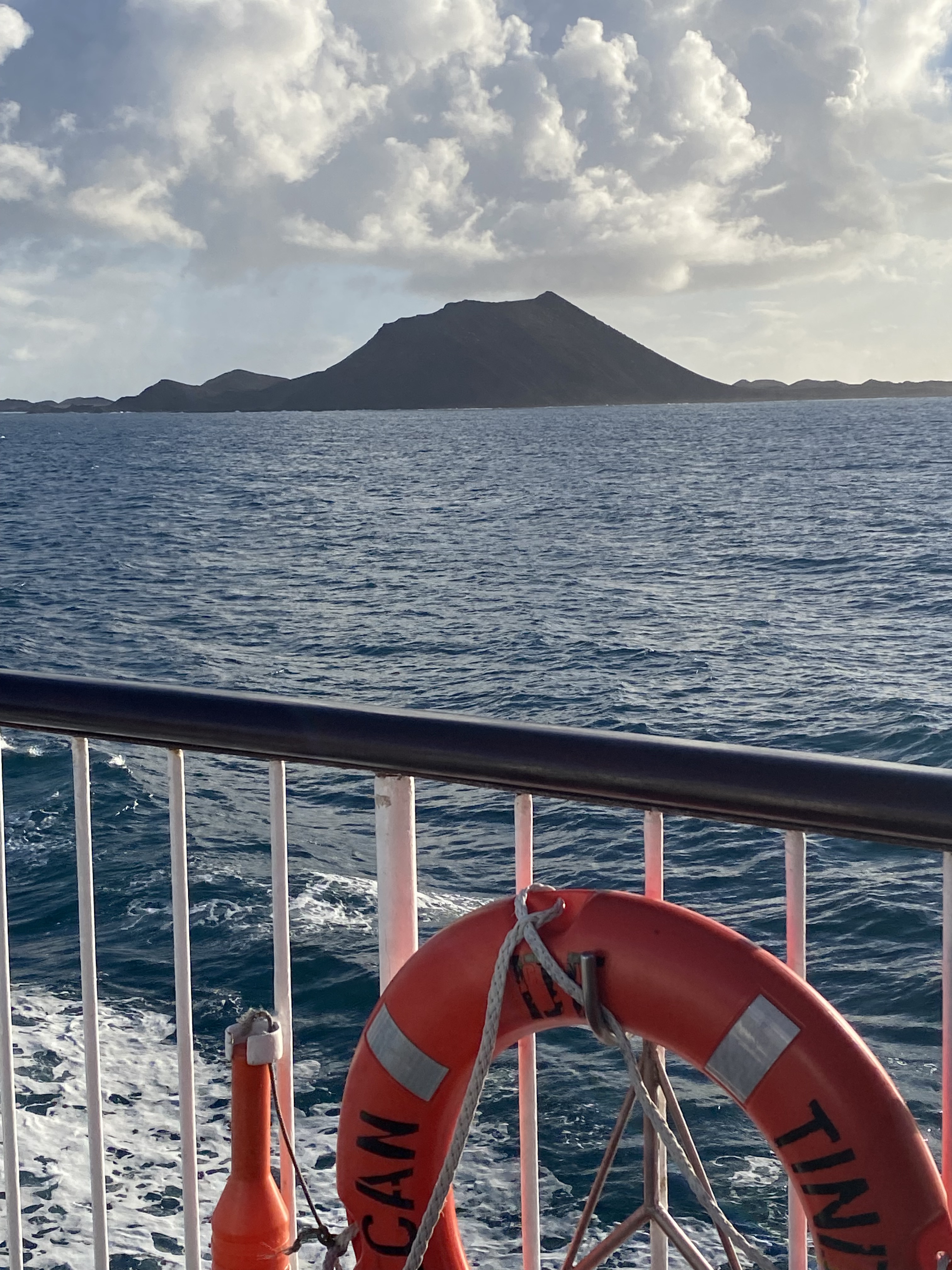
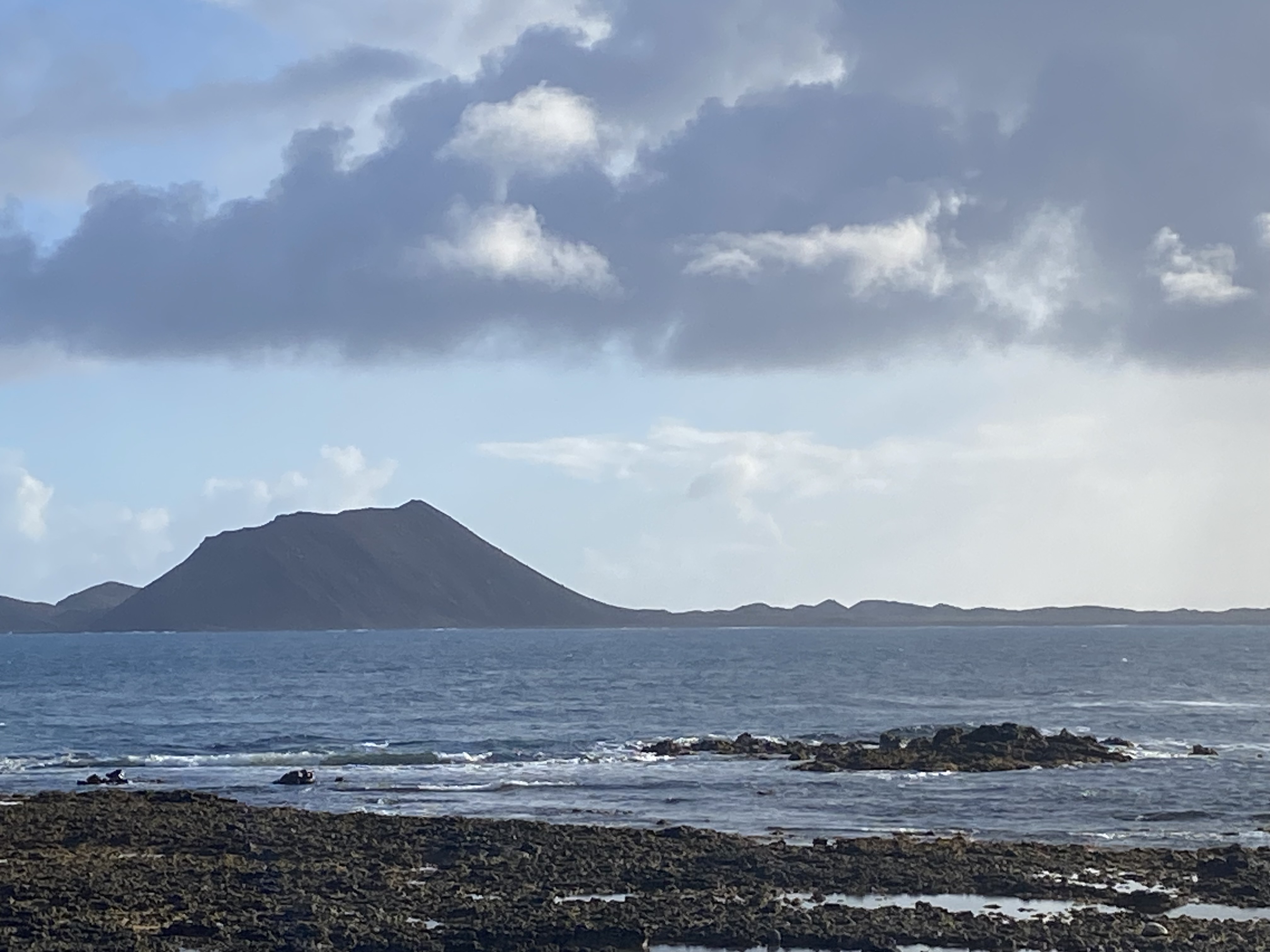
The tickets are inordinately expensive for a 35 minute ride, particularly as J bought into the risk of being bounced if we didn’t upgrade. In the event, there are half a dozen foot passengers and no more than a couple of dozen souls wandering the decks. However, we get coffee, hot chocolate and croissants for our troubles.
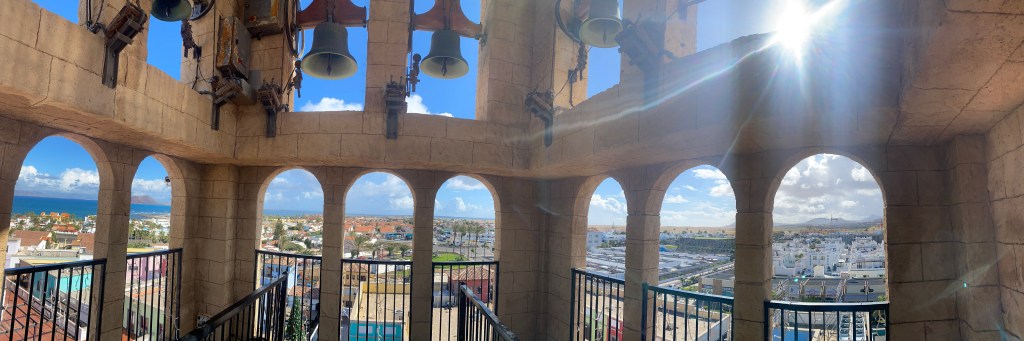
On arrival, the impression of greater wealth than Lanzarote is quite strong. New buildings in the centre seem quite well designed.
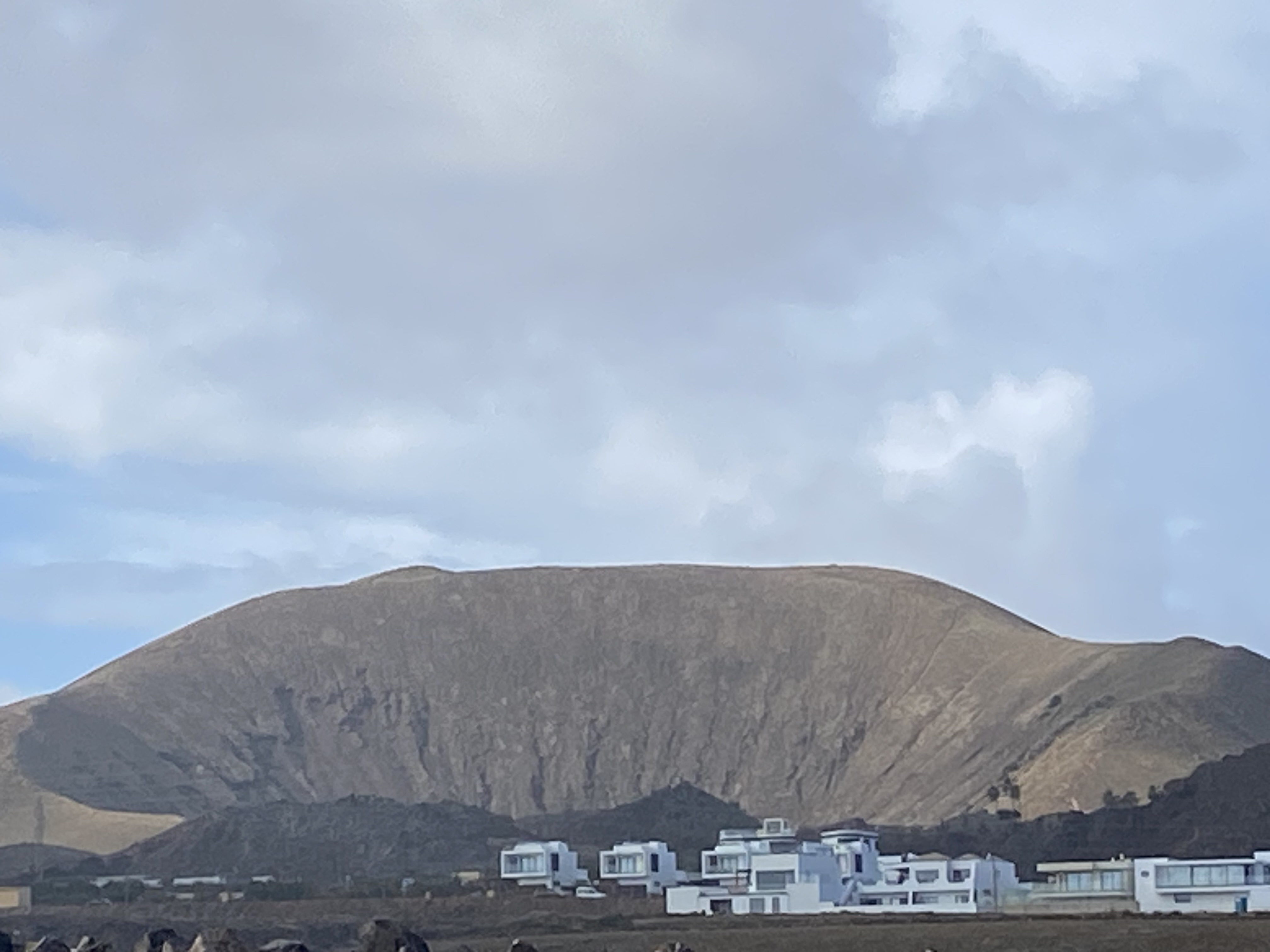
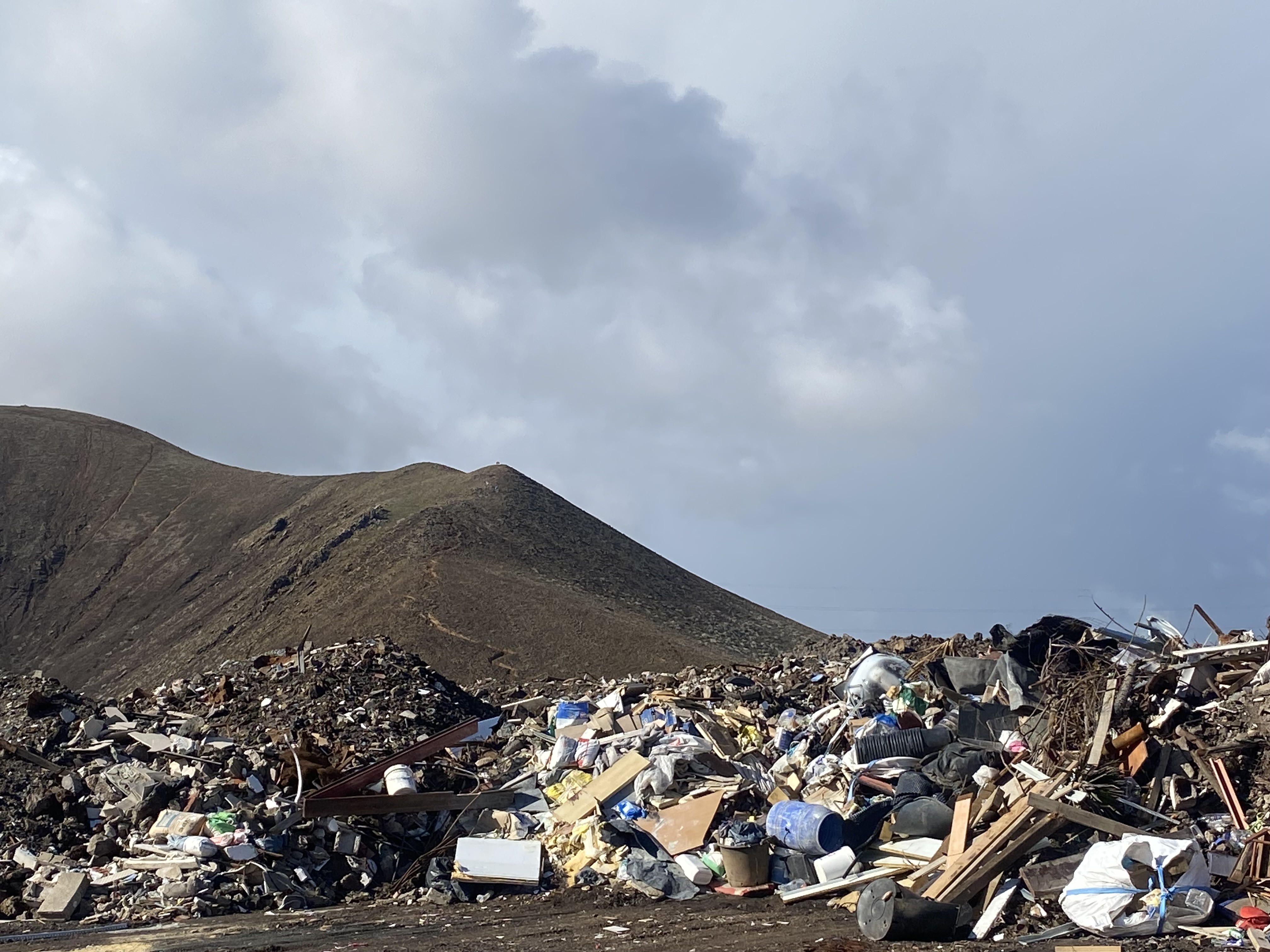
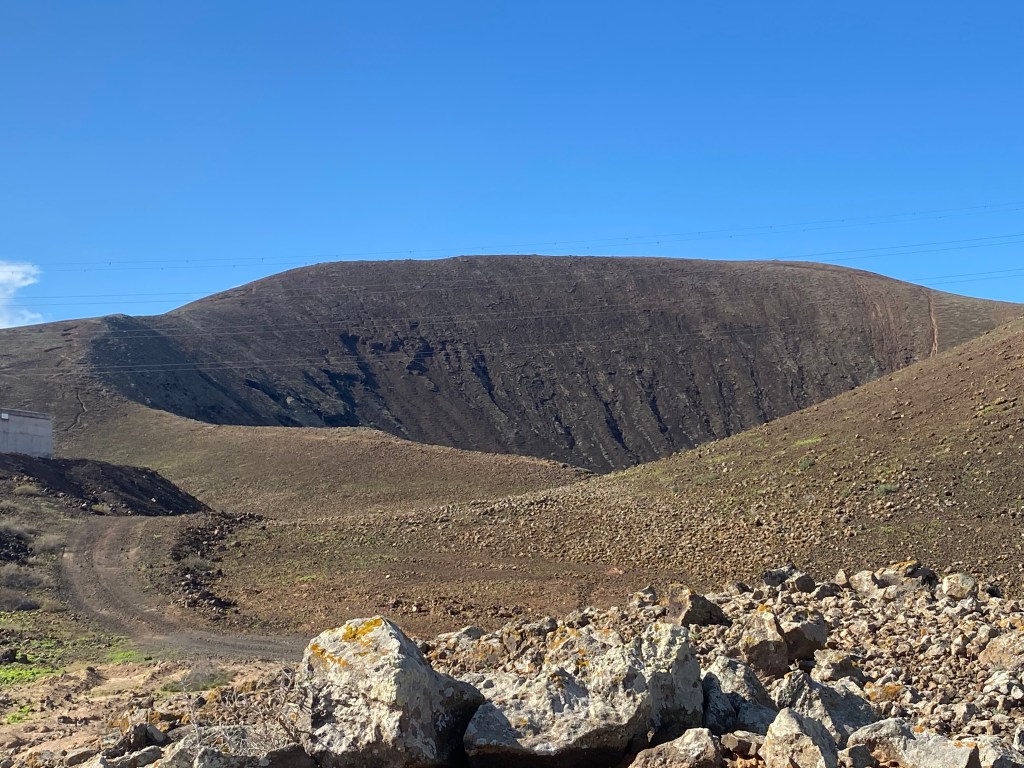
Outside the town is the Bayuyo volcano. This is guarded by a rubbish dump and a working quarry but still impressive.
Back to town past large developments of high-end hotels and other recent holiday accommodation to a good, if potato-heavy, lunch in a family-run tapas bar featuring a splendid display of fresh veg outside. It is good home-made food with the dates in bacon a clear favourite while J has an attractive array of breads. The waitress is doing the work while her father is exchanging shots at the bar.
On the 4pm ferry back J has to produce his passport to get the upgrade snacks. Soon after 5 a bus to Arrecife via the airport comes and these prove to be the only stops, a welcome change from the Cook’s Tour that is more usual. Unfortunately, we hit rush hour on return to the city and, waiting in the traffic to reach the bus station, lose the time we have gained.
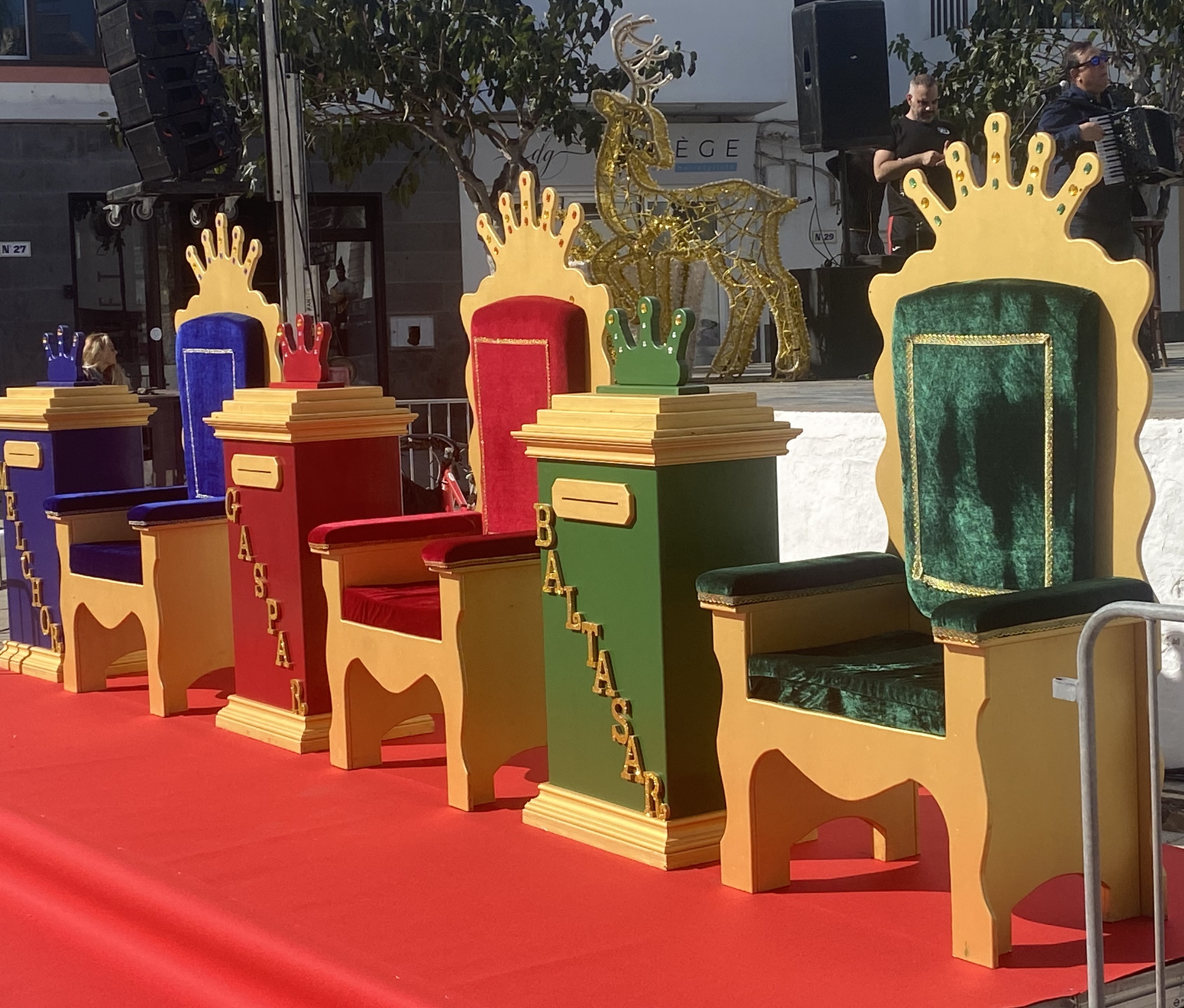
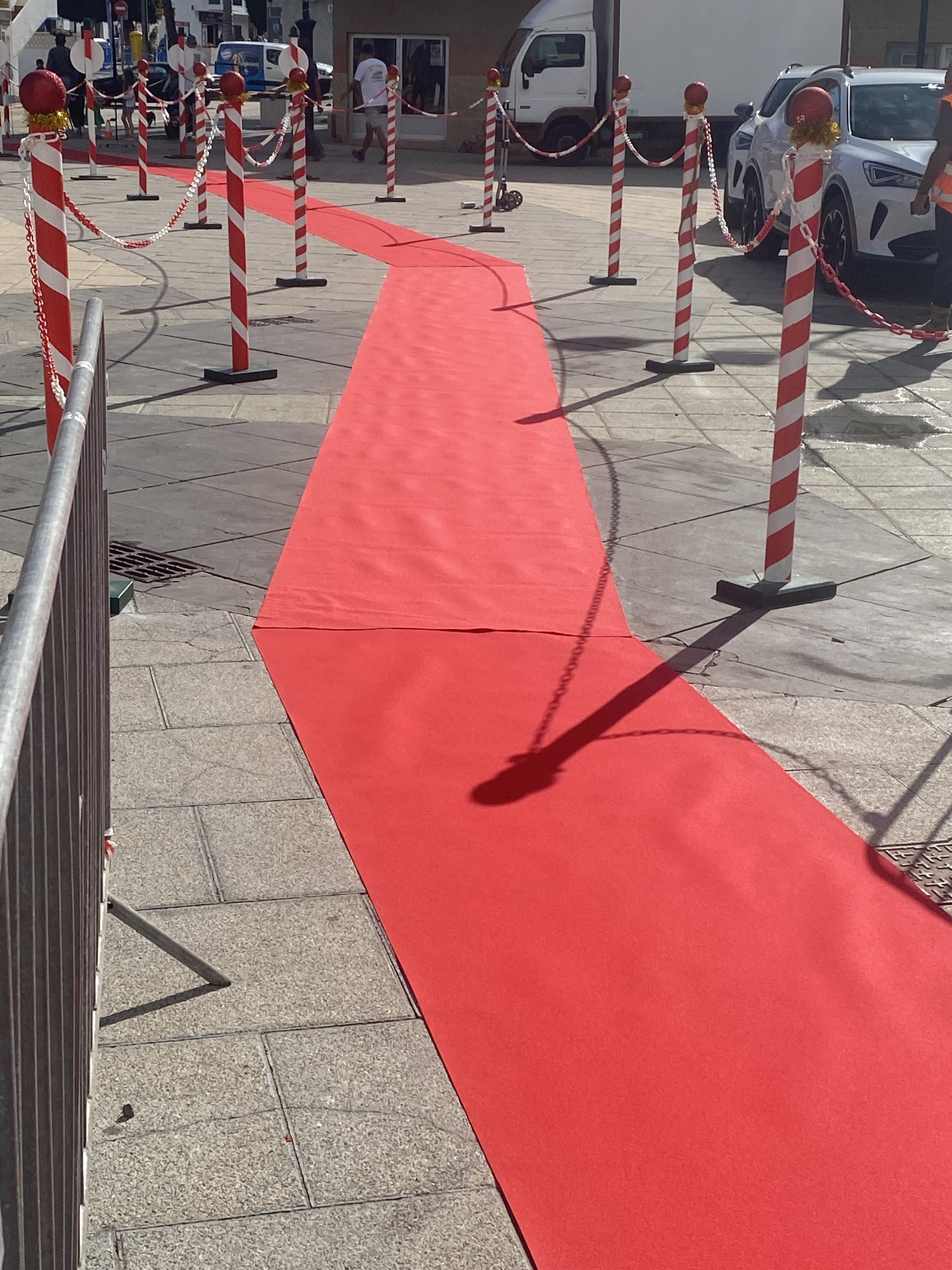
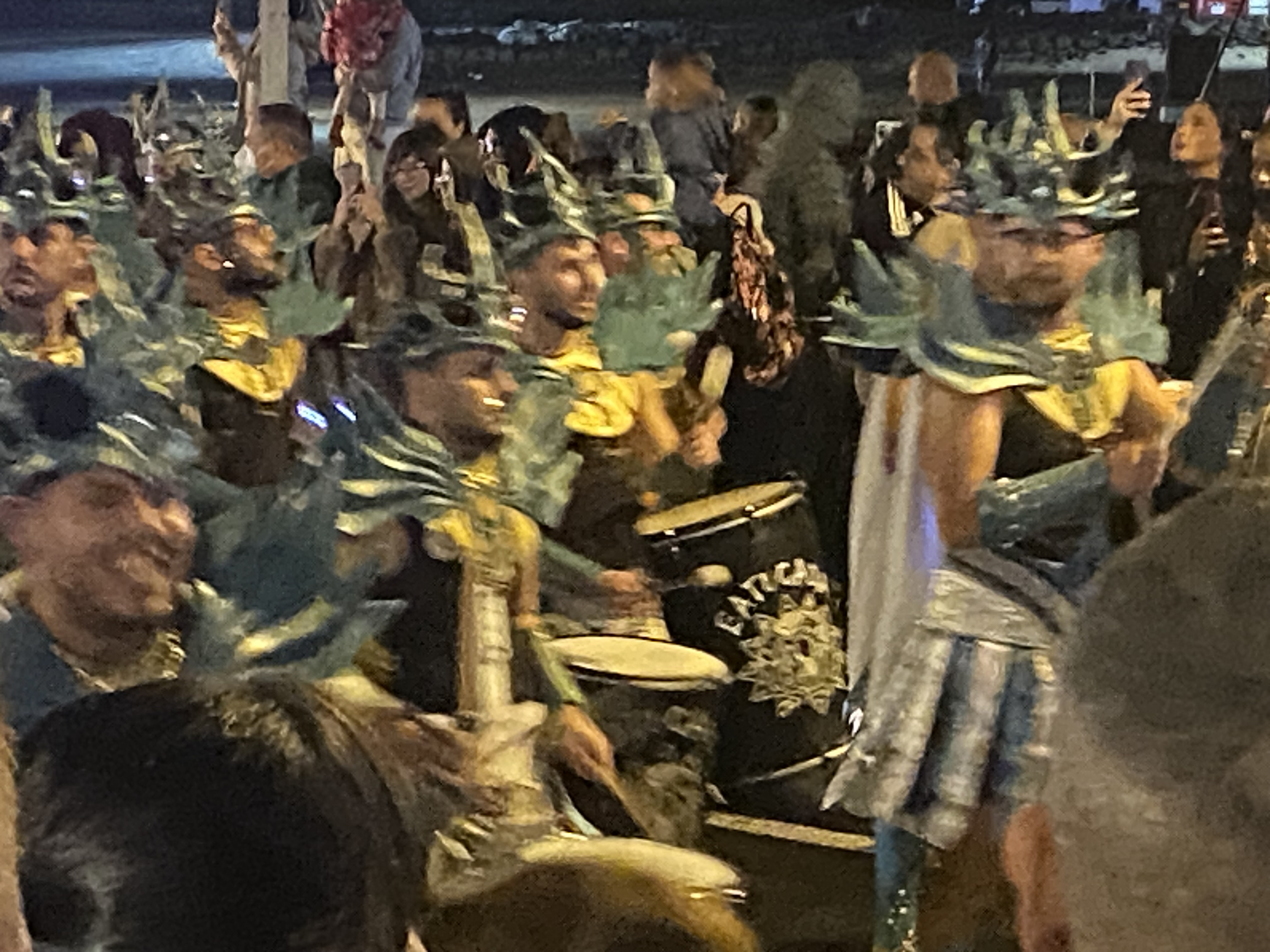
Rain as we walk down the hill bodes ill for the Kings’ Day parade but when we venture out towards 7, it is dry and remains so. The parade is short and the Kings on real camels are the highlight though the falanx of kilted drummers are a good sight.
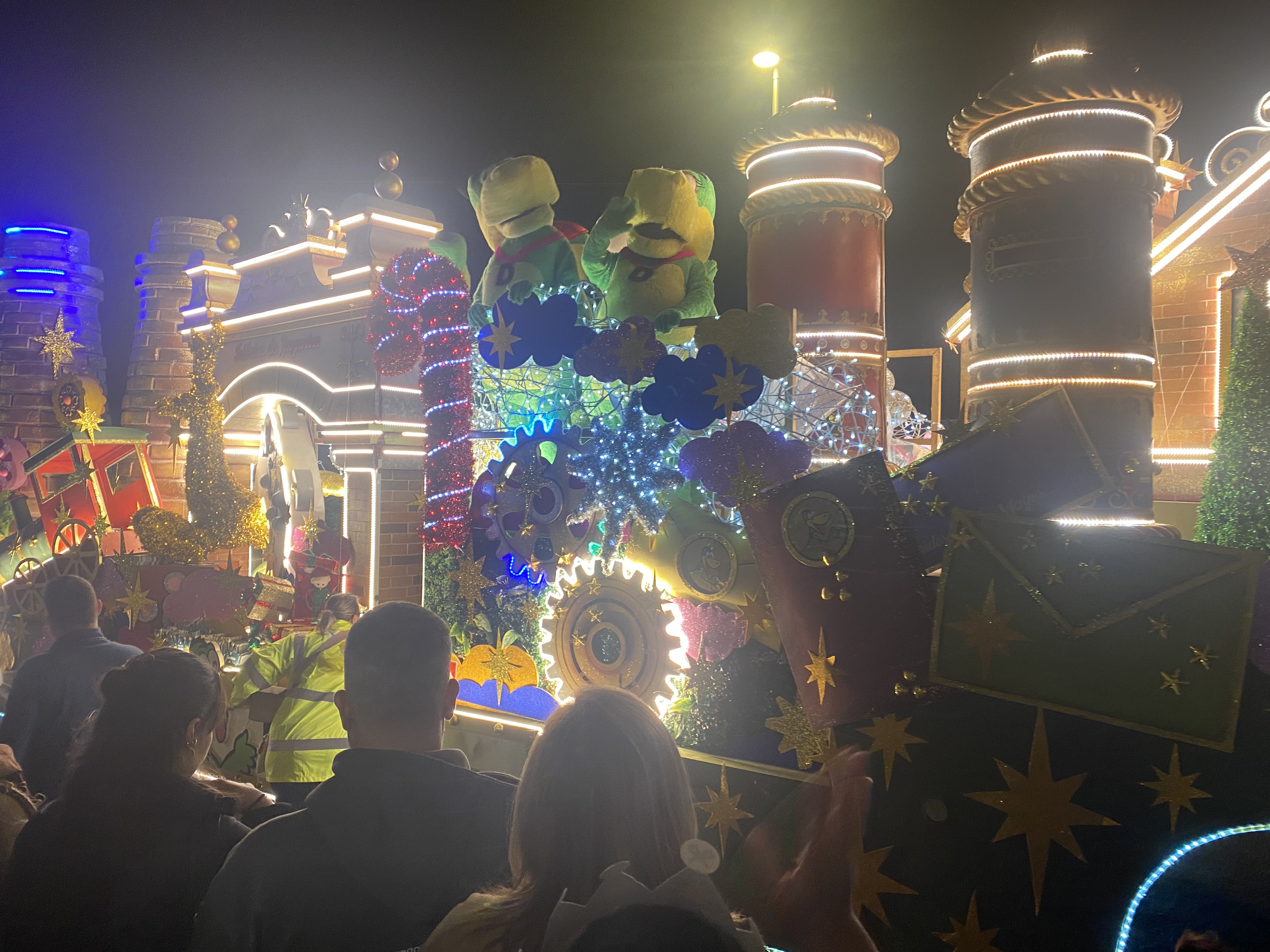
The local supermarket have the most glamorous float. Everyone has sweets for the children.



Day 25 Tuesday 6 Manrique of it

Sunny and relatively (15°C) cool day recovering from yesterday’s exertions and reflecting on our day trips to these islands and the extent to which both Las Palmas on Gran Canaria and Corralejo on Fuerteventura seem wealthier and better-presented than Arrecife.
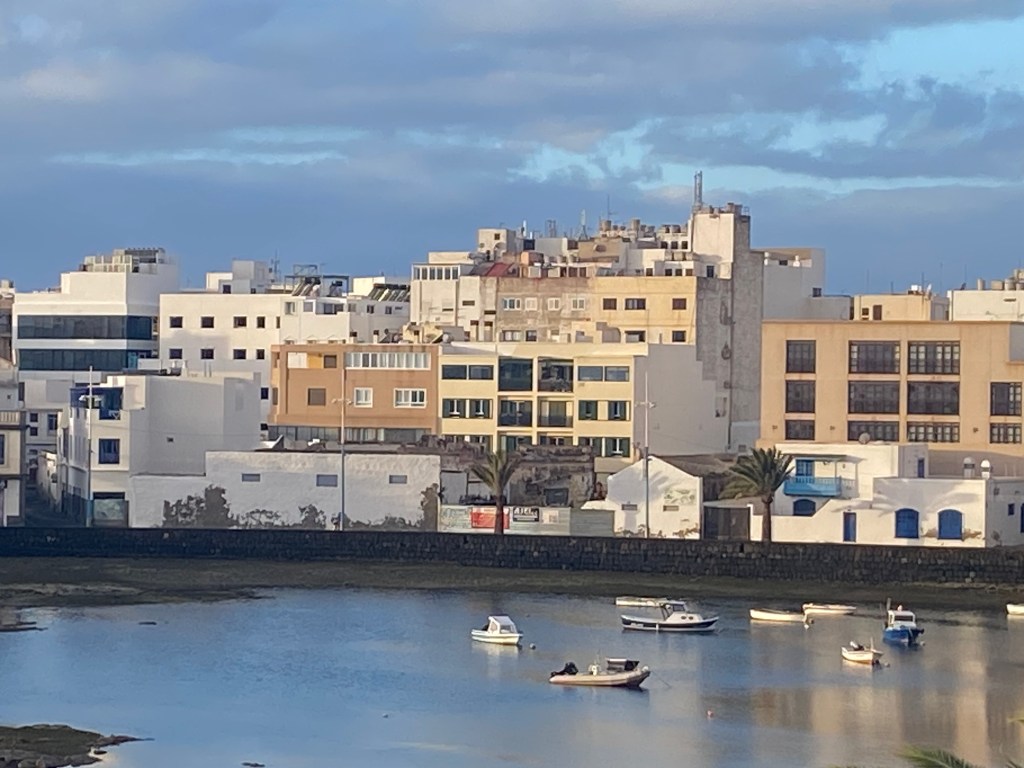
In that regard I particularly miss that Arrecife has no element of a feature that would allow it to stand out namely the Manrique-inspired rules that every building should be white with windows and doors in particular colours.
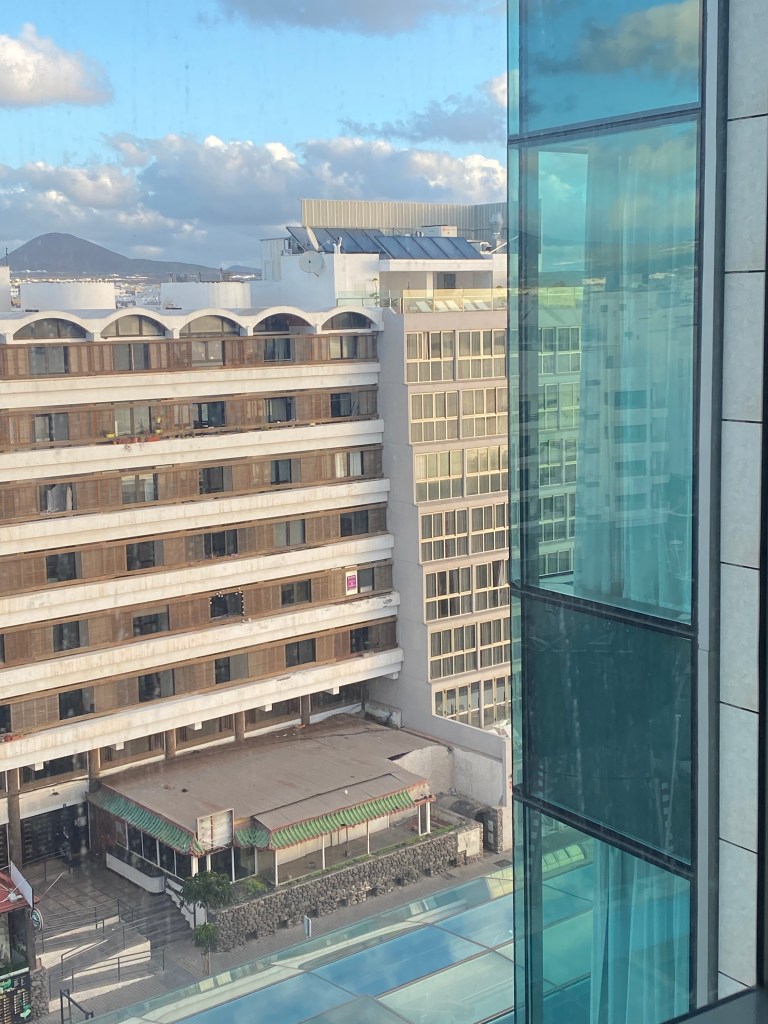
César Manrique Cabrera (24 April 1919 to 25 September 1992) was a Spanish painter, sculptor, and artist, known particularly for the architectural projects in which he participated as artistic director. Born and bred on Lanzarote, Manrique, then an internationally-renowned artist, returned to the island in the 1960s and persuaded the Cabildo (the local parliament) and the people, to take overall control of the tourist development and to allow only strictly-controlled developments in particular designated areas. It was recognised at the time that this decision would directly limit the growth of the potential tourist economy and income. This decision, on an island with no natural resources, an economy dependent upon sparse agricultural production and a declining fishing industry, was a courageous step. Strict controls on development on the island were implemented, which limited tourist development to three specific areas within which there were strict controls on the density, style and height of buildings. Outside these areas no large development was permitted, with the exception of the capital, Arricife, where six storeys were allowed.
The rest of the island was restricted to two-story developments following the external appearance of traditional buildings. This control included restricting the colour of external rendering to white and paintwork to green, blue, black or brown. The result and benefit of these decisions is seen on the island today making it a unique tourist destination and recipient of the designation in October 1993 of a Unesco Biosphere Reserve.
In his 1974 book Lanzarote – Arquitectura Inédita [Lanzarote – Unseen Architecture]– one of the key elements of his legacy – Manrique identified colour as one of the features of his vision:
“Peasants always painted their doors and windows green because this was the cheapest paint, while sailors added blue because that was the colour left over after painting their boats. That’s why coastal houses are painted green and blue and those that lie inland are green.”
The result was a homogeneous look to the island which some say froze Lanzarote at a moment in time, somewhere between the 1950s and the 1970s. The architectural development of the island was regulated by the Plan Insular de Ordenación del Territorio [Island Development Plan] (PIOT). The only part of the island which followed a non-regulated pattern of development was the capital, Arrecife.
Today the most striking element of the Manrique vision is the colour restrictions which still apply widely albeit with exceptions – we saw little sign of it on our brief trip to Playa Blanca.
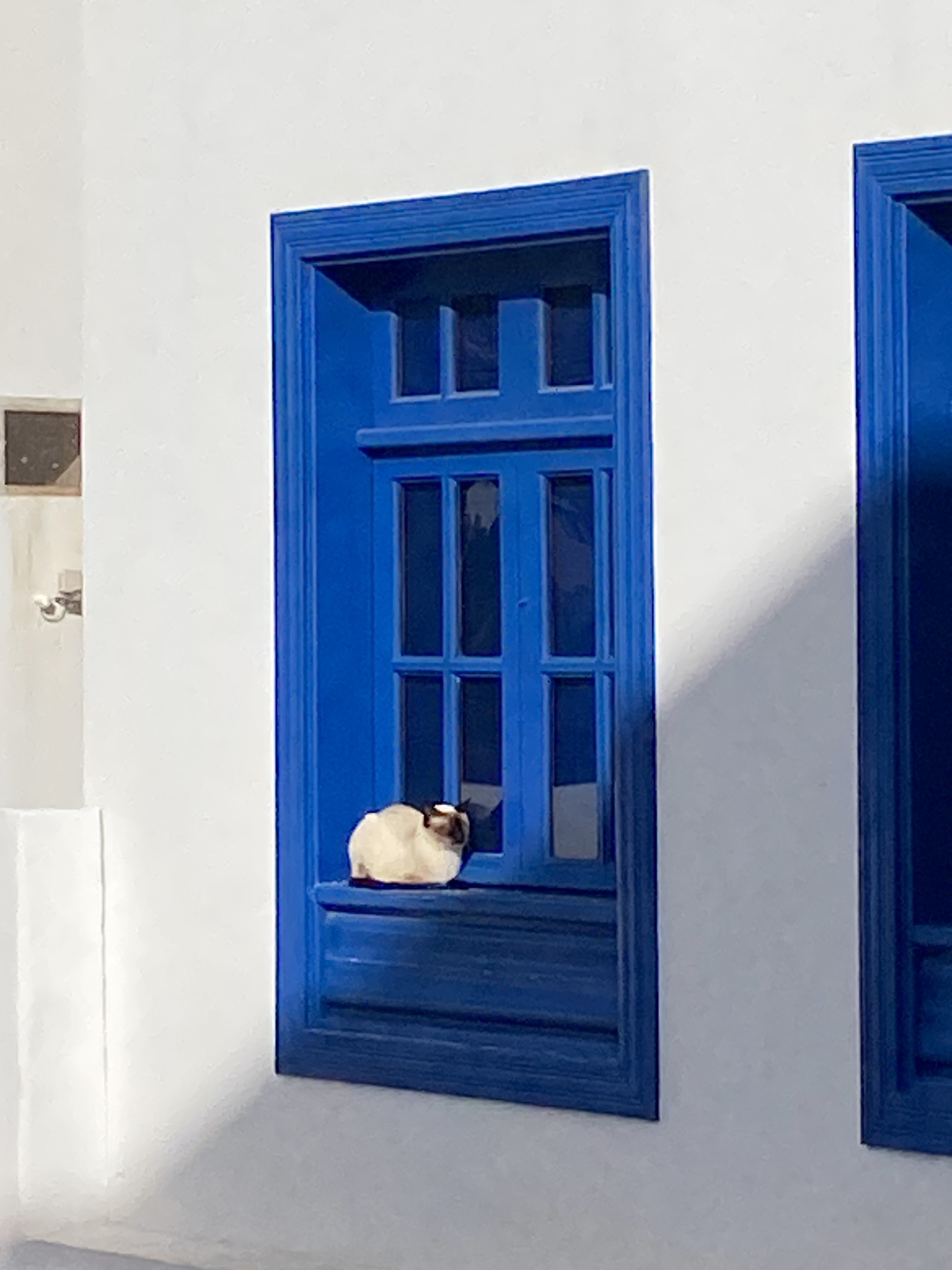
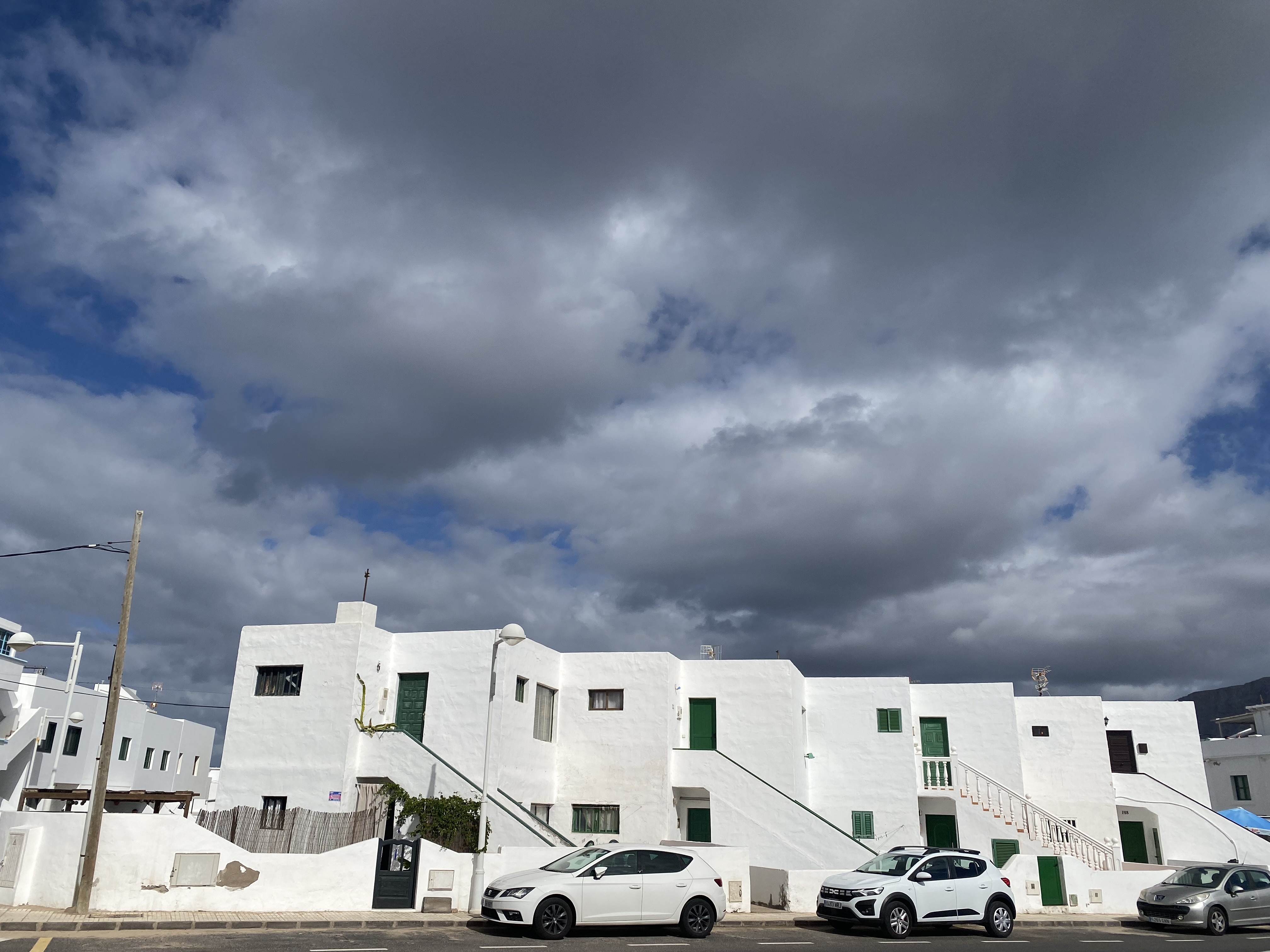
The blue used on Lanzarote has never been strictly defined and can vary from the deep blue of Lanzarote’s flag to the much paler sky blue of the Canarian tricolour, but the green is much more clearly recognisable and a number of paint manufacturers have marketed “Lanzarote Green” as one of their main colours for decades, and the paints offered are the tough, durable emulsions designed for painting windows and doors. The green is used for doors, windows and shutters all over the island, but without doubt the most attractive centre is Teguise, where sleepy whitewashed streets are livened up with green doors, some gleaming with a fresh lick of paint, others faded and weathered.
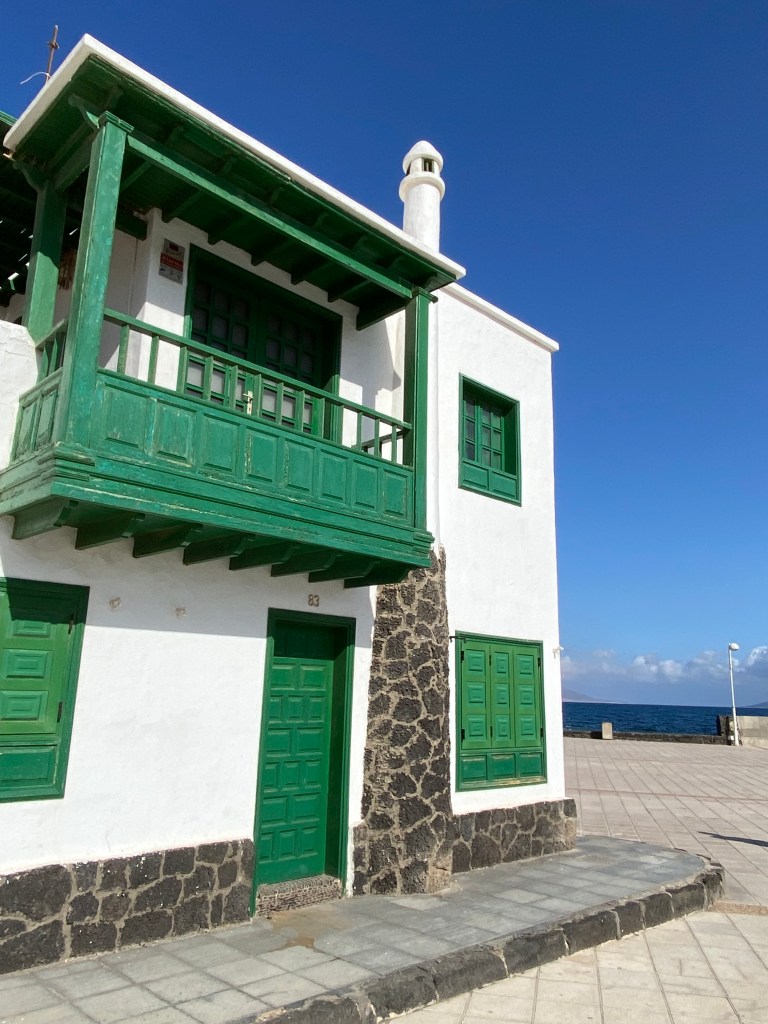
Arrecife wasn’t obliged by the PIOT to follow the same regulations as other municipalities and so its appearance is radically different from the rest of the island; relatively high buildings, traffic lights, groups of flats in any colour, standard-issue modern buildings. It simply resembles any other rundown coastal city.
Writing in 2013 Maria Giulia Pezzi argued that “… the capital has greater appeal for tourists than the rest of the land in that it offers a more vibrant and “real” atmosphere, which is otherwise lacking elsewhere.”
Visiting again in 2026, I could not disagree more; The extent to which the uniform application of colour gives charm is remarkable; attention is drawn away from the quality of the building to a consideration of the overall effect. By failing to follow this approach, Arrecife has lost much of its charm and an opportunity to present itself in a unique manner. I am not arguing for a strict set of rules about the size or style of buildings, just the colours. Imagine if the airport terminals were to comply with it.
Sources: ‘We don’t need to copy anyone’: César Manrique and the Creation of a Development Model for Lanzarote Maria Giulia Pezzi (Karl-Franzens-Universität, Graz, Austria) Urbanities, Vol. 3 · No 2 · November 2013; REDISCOVERING THE MUSIC OF THE SILENCE – WHAT CAN CESAR MANRIQUE’S SPRITUALITY ADD TO THE RENEWAL OF THE REFORMED SPRITUALITY OF THE UNITED REFORMED CHURCH? DEREK MUNRO HOPKINS (thesis submited to The University of Birmingham for the degree of MASTER OF PHILOSOPHY Department of Theology and Religion College of Arts and Law The University of Birmingham October 2010);Why does Lanzarote use the colour green? gazettelife.com 28 February 2025.
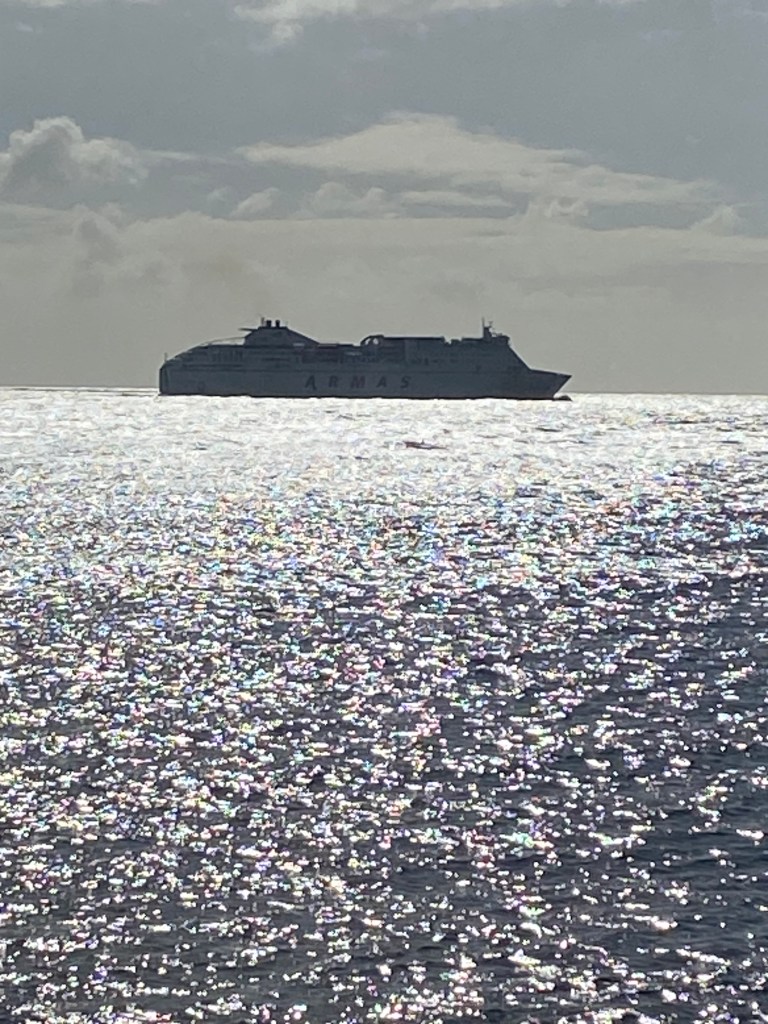
Shops and gym all closed for the 6 January holiday. Walk to the fortress and see the Armas ferry leaving but there are no cruise ships today. Ice cream on the balcony.
Day 26 Wednesday 7 Arrecife
Thinking that we might establish whether one can join a cruise ship for the relatively short journey between the islands and mainland Europe, we walk out to the cruise ship pier. It is, however, entirely unwelcoming; the pier office only deal with small boats, the TUI office’s doors are shut though there are several staff behind plate glass and, by the time we and today’s cruise ship passengers are passing, the tourist information office is also closed.
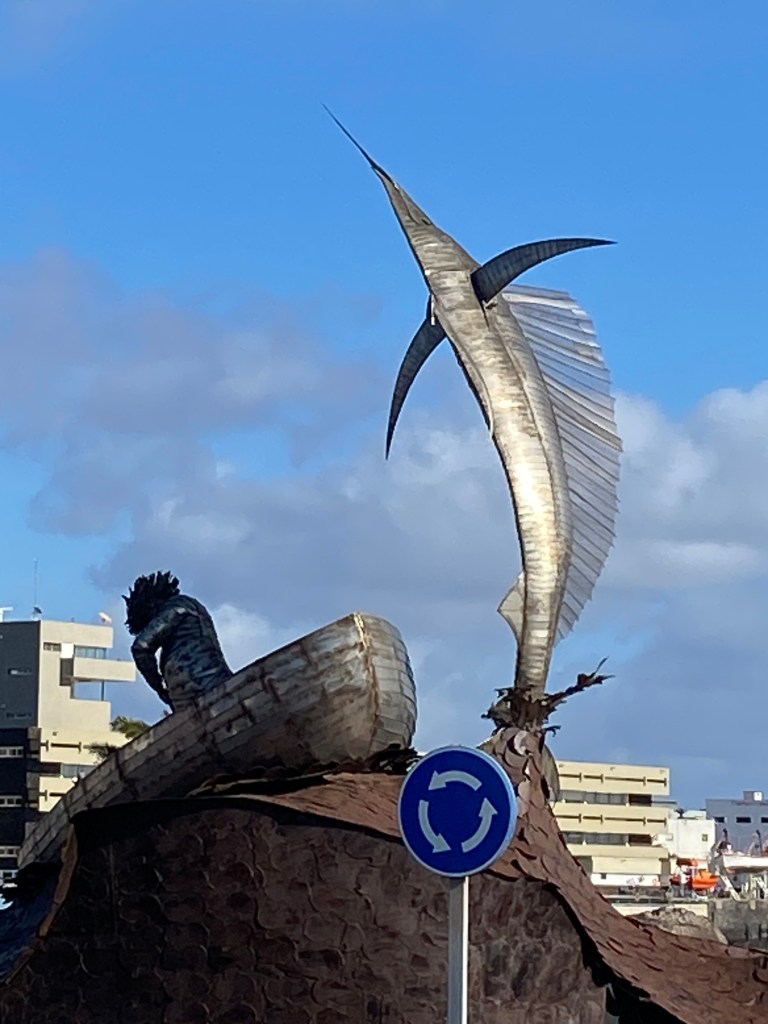
Breezy but sunny and dry day. Both restaurants down below are shut.
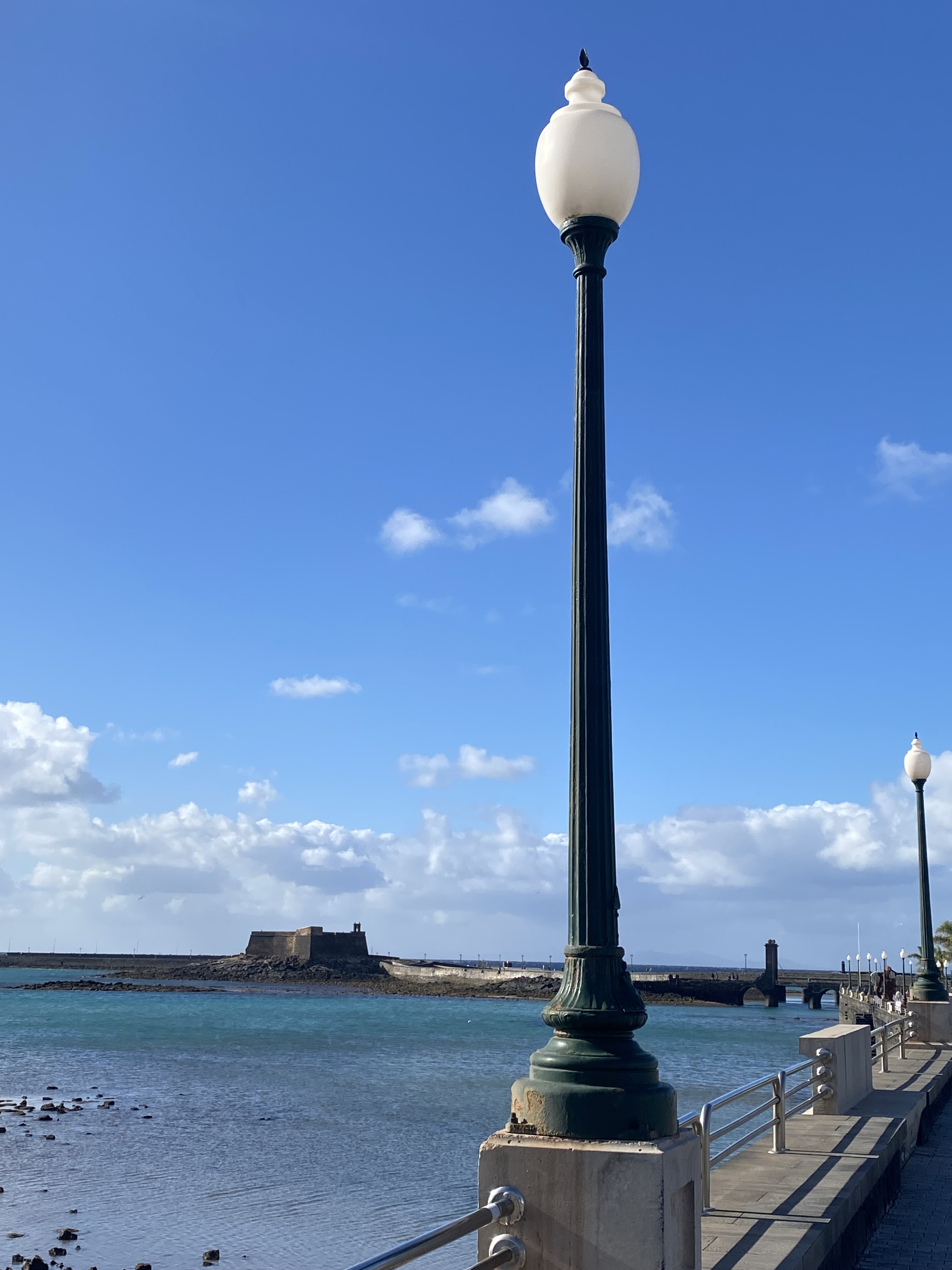
Very smooth check-in at the Armas office in town and then to el Rincon de Granaino, a rather ordinary-looking bar opposite where we are warmly welcomed by the lady of the house and fed with excellent tapas including fried cheese and the best tortilla of our stay on the island. We check in at the Gran Hotel for the booking we have changed from the Sunday we were due to arrive before Armas changed our plans. Back to the flat for my gym stuff and off to Area Fit where they have me on their system and entry is correspondingly straight-forward.
Another fine ice cream, Dulce de Arce flavour, and then dinner of the last of the sweet potato from Soo and, when we are packed, a last hot chocolate on the balcony. Walk from the flat to the Gran Hotel. Like the apartment we are leaving, it has two single beds pushed together no doubt in the hope that simpletons will mistake this arrangement for a double.
Day 27 Thursday 8 the Ferry again
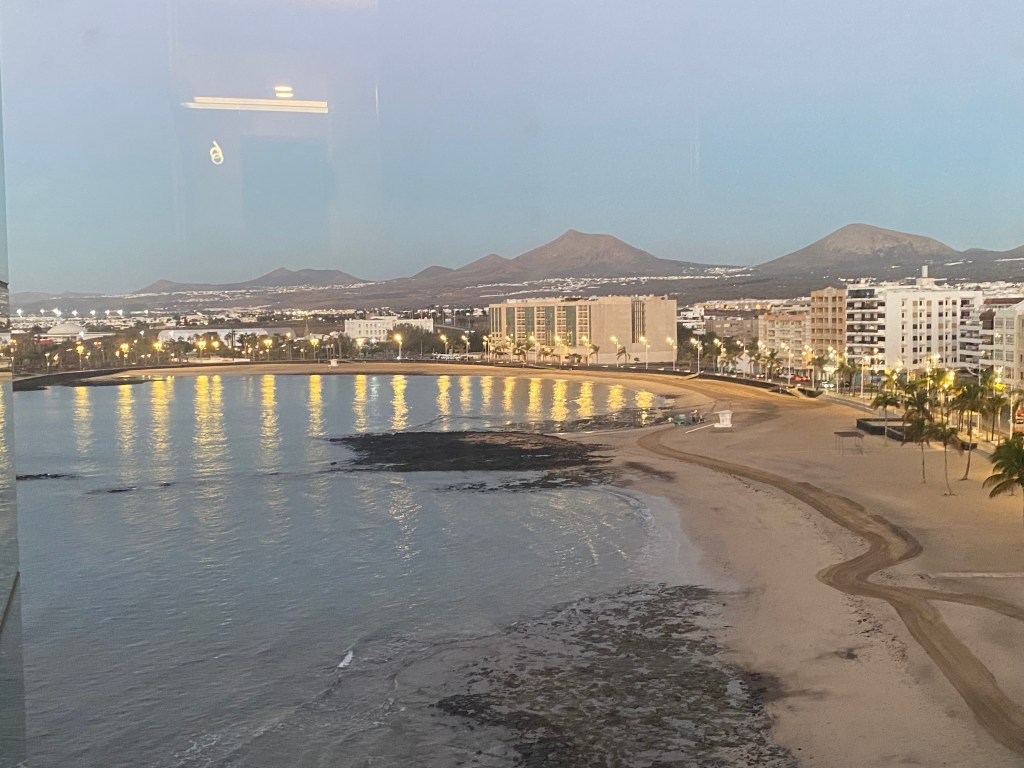
Good breakfast with a great view from the Gran Hotel, one of the genre of modern building with a great outlook on the views they are spoiling. Good enough gym though the smell of electrical burning as I leave the basement is rather disconcerting. Another fine lunch at the Granaino, this time with the yuka [cactus] that was unavailable yesterday. As at Escorial, we are defeated by a pork dish – Columbian Pork Rinds – crackling in a barbeque sauce. The plantain fritters with it looked the part of a banana biscuit but didn’t taste. Our host left the uneaten pork bits with us until we left.
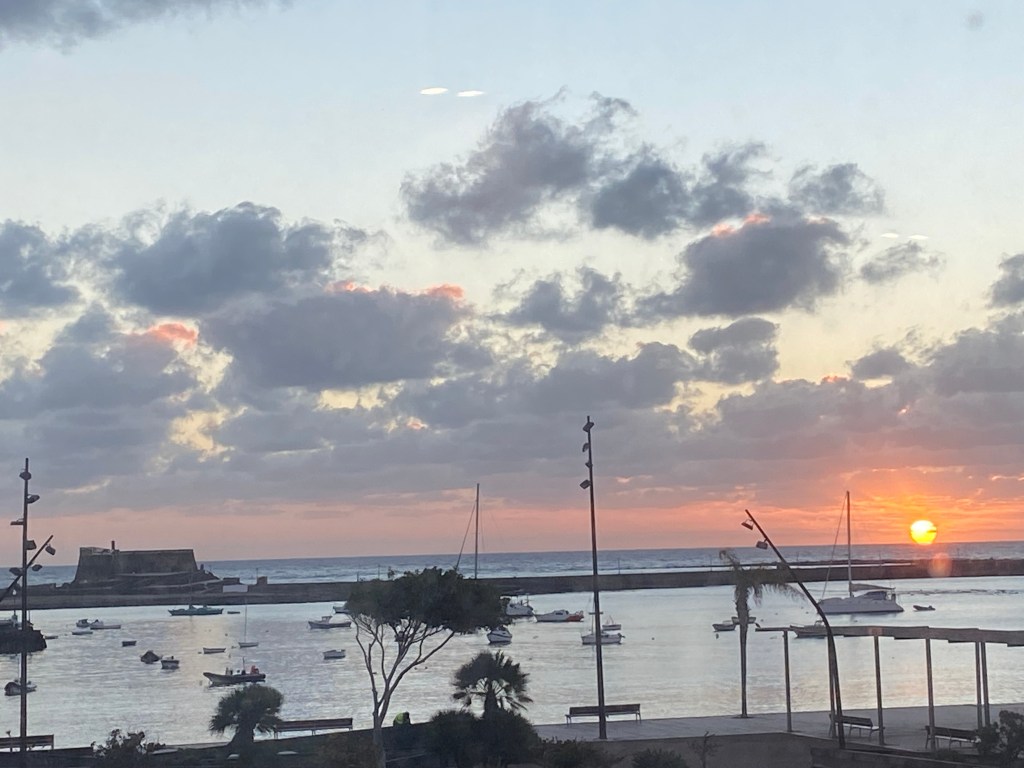
Taxi from outside the hotel soon after 1pm takes longer than I expected as I am only used to such journies in unsocial hours but we are soon back at the Armas terminal. No sign of the ferry by 2pm but it is soon backing gingerly into place past the AIDAbella parked nearby. Clearly the cruise port has limited capacity and the third ship has to go to the main port which is a €12 taxi ride away from the town if you miss the transfer bus.
Boarding is rather Heath Robinson; passports are scanned but no luggage is. Then we are led in single file away from the boat only to turn on to the vehicle ramp and into the nether regions of the ferry. After that the small numbers of cabiners have to queues for the single man who allocates them.
Announcements are in Spanish and English and equally incomprehensible in each language. Although we are not arriving in Cadiz until 10pm tomorrow, the last meal included in our cabin ticket is lunch. On the other hand, today’s lunch is on til 4.30 so we supplement our supplies for tomorrow’s shortcomings.
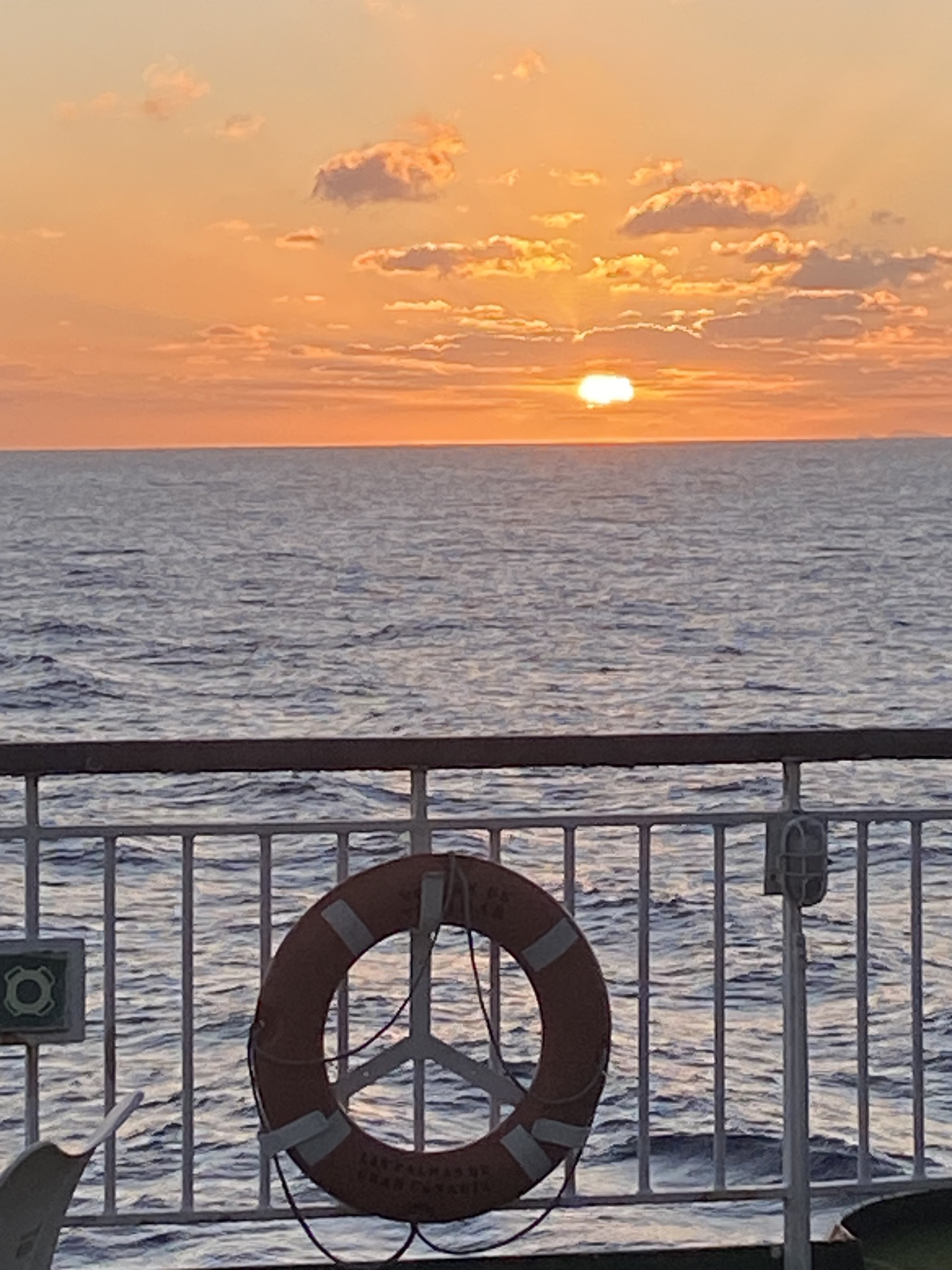
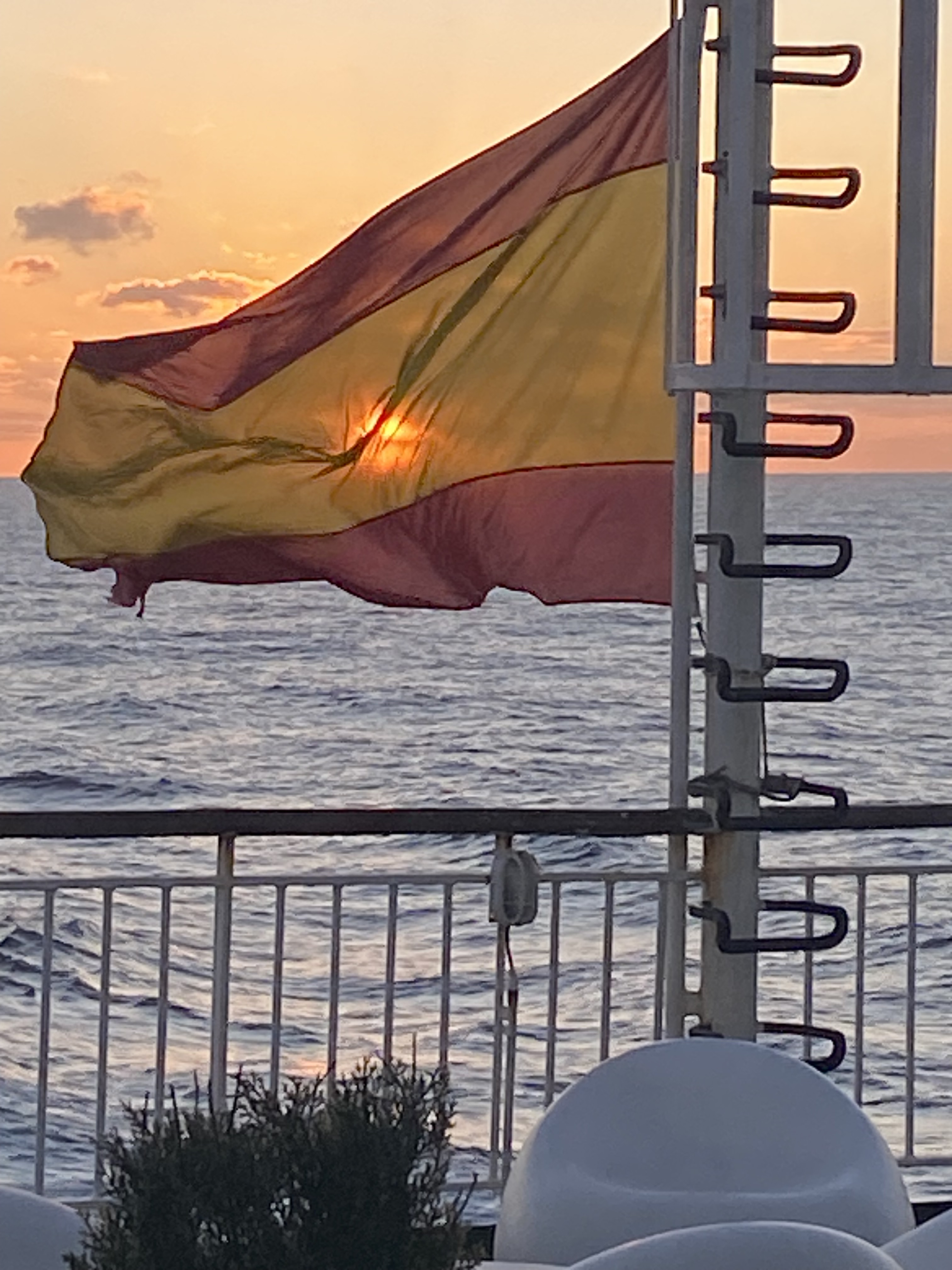
We leave at 3.30 which is a faster turnaround than anticipated, passing some of the yachts for the race across the Atlantic that starts on the 11 January. A very calm and sunny sea as we travel up the side of the island towards Graciosa which we have seen so much from the other side. Very few passengers, even quieter than on the way out. It is still sunny enough to sit out at the back of the boat at 5.20. The plunge pool has been filled but doesn’t attract any takers. Rather bored by 6pm. A nice sunset revealing the Canaries we have been solidly steaming away from. Experience last time teaches us not to try for the internet and this improves the experience though it provides more time to be filled. The few other passengers (117 of us) stand around looking at their phones.
Staff seem a bit friendlier than last time though the Hondurans were good then too. But the food they are dishing out is cold at the point of service and the veg gave their all some time ago. The microwave ovens in the dining room (only one of which works) are rather symbolic of the approach to service which does not reflect the cost of the cabins or even the reclining chairs.
Day 28 Friday 9 At sea til late
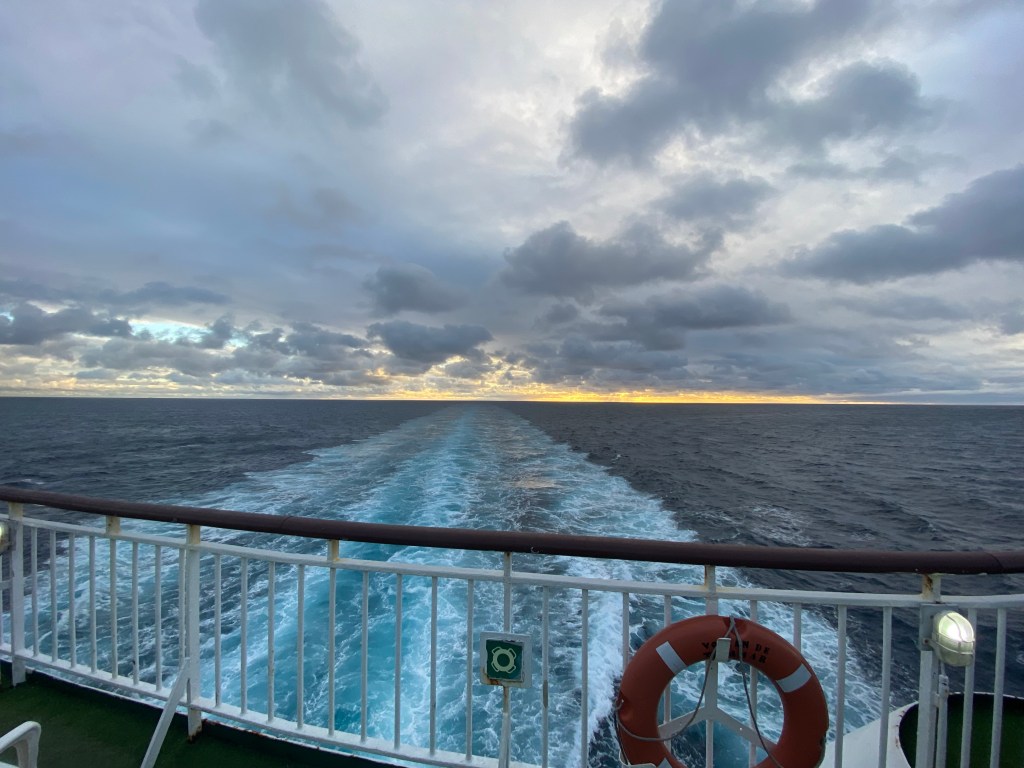
Neither of us indulges in the cooked breakfast offering. Rather, we supplement cereals and fruit with our own GF cereal and crackers. Calm sea and overcast conditions. J plans for the lack of dinner before our 10pm arrival. The pool has been drained. A few sub-chair souls sleep across the lounge provision though much of it is designed to prevent this. Coffee at 10, erroneously marking twelve hours until arrival – actually eleven because the clocks go forward an hour on arrival in Europe. We choose seats looking on to the pool deck and its constant stream of smokers. Sunshine breaks through about mid-day.
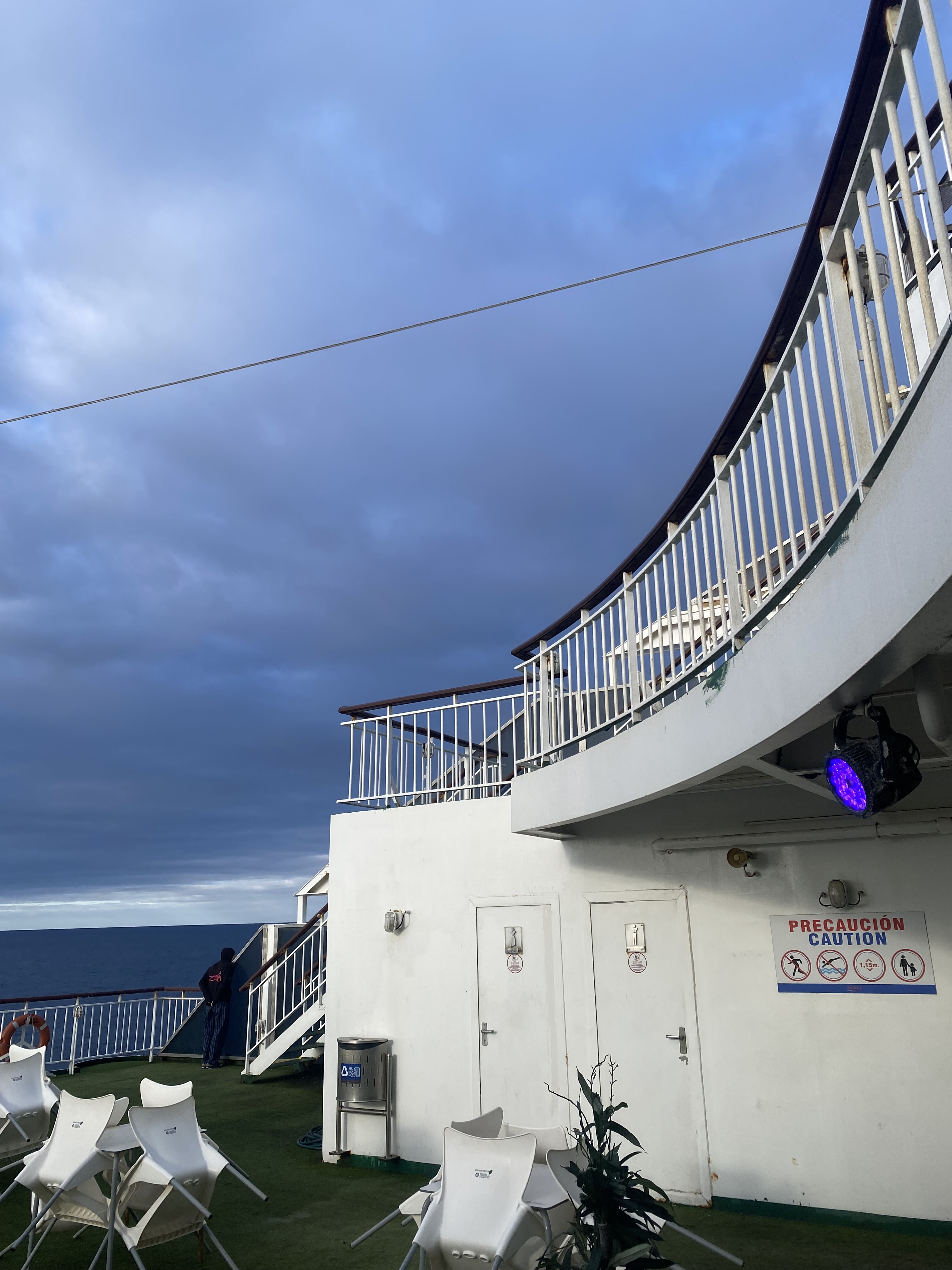
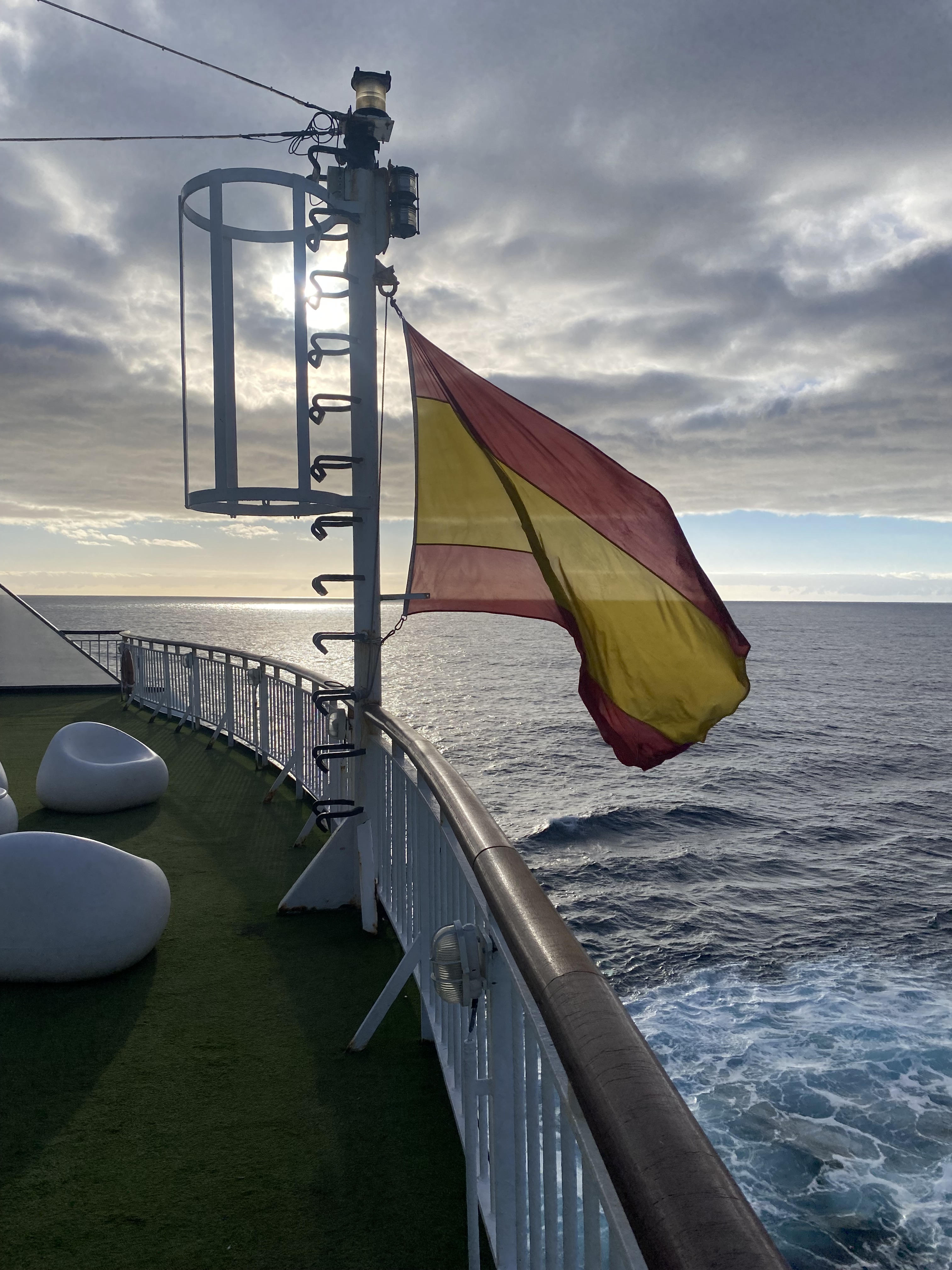
Final meal aboard is a lunch of meatballs and ratatouille of veg not too sensitive about cooking times or being reheated.
Find four pieces of gym equipment on a bit of deck at the back of the ship. Only three of them work but they encourage me to do the exercises the physio has given me to get back to running. A good shower in the cabin and back to our chosen places for the last hours and a picnic of the assembled foods. By 8pm Cadiz time people are assembling the lounge, changed and clearly ready to arrive.
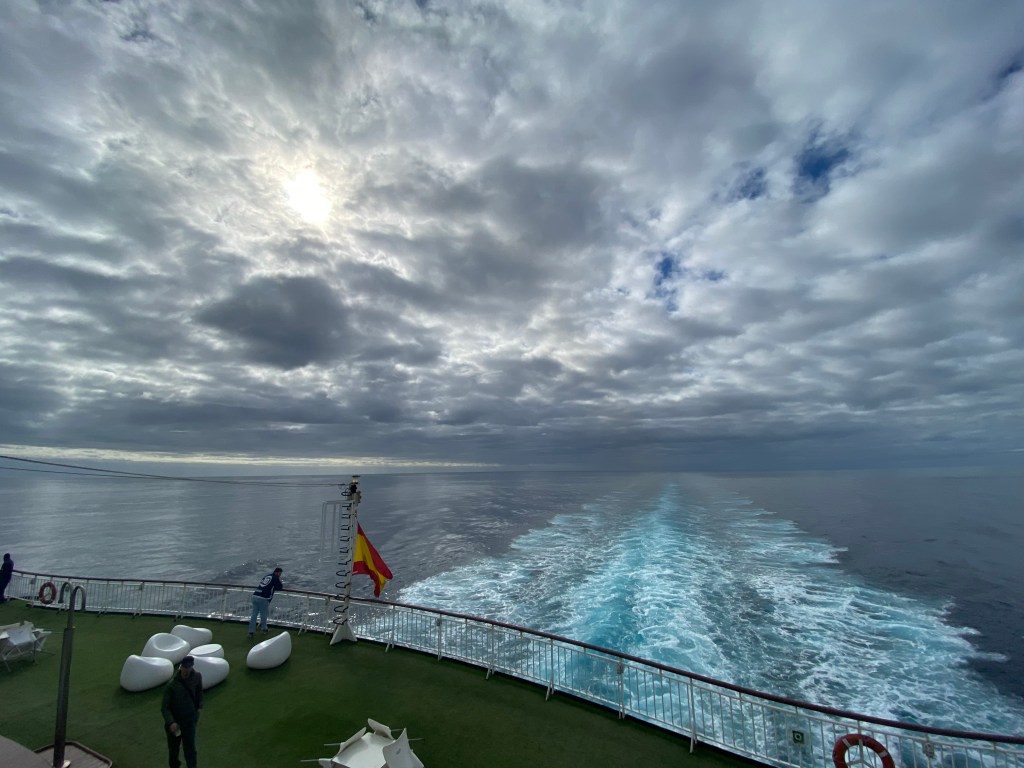
We dock after 10.30 and the few foot passengers are uploaded to a taxi for the short journey to the Armas terminal which we do not enter; rather another enquiry from a figure of authority, apparently a customs check as we are entering the EU. This seems to be a surprise to a young woman laden with purchases.
It is mild and dry in Cadiz though the ground is wet. Doors of Hotel Argantonio closed but opened for us and a friendly welcome. A stylish room with a double bed, a pleasant change from two singles pushed together.
Day 29 Saturday 10 Cadiz
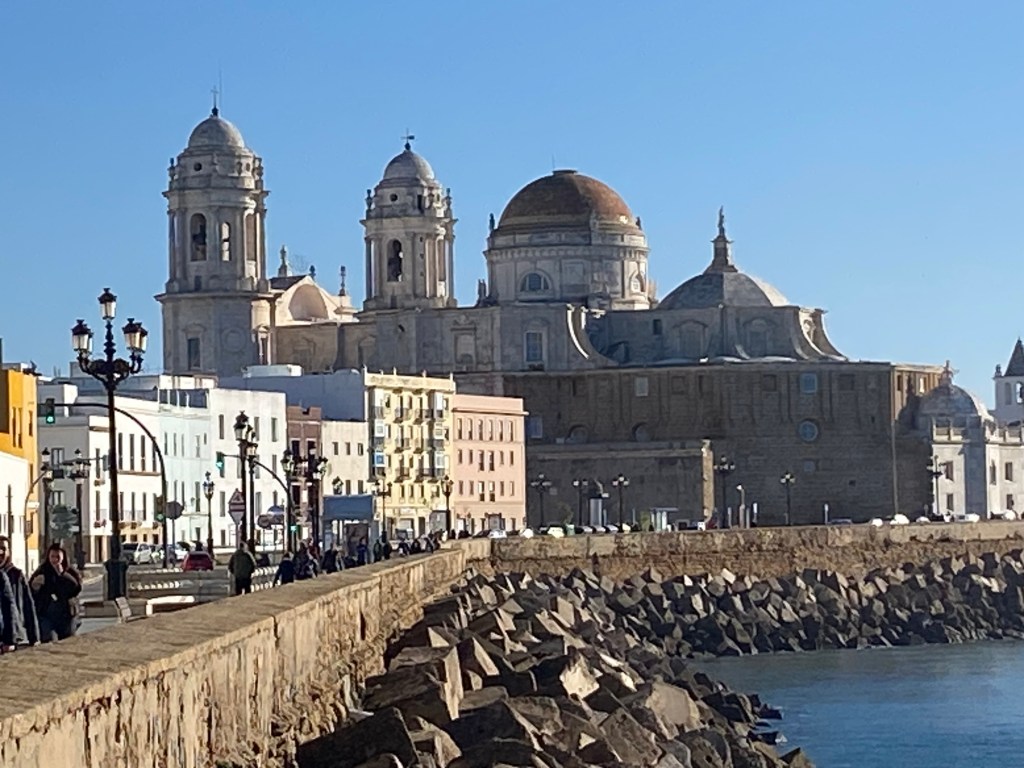
A good night’s sleep and a good breakfast where we are the only guests, served at our table with a continental breakfast and lots of GF breads. Out into pleasant sunshine and a stroll through the old town which is very much more attractive than we found it on the way out. The Central Market is predominantly fish with many kinds of prawns and big lumps of tuna on display. The baker there has GF bread and cake. Early lunch and off to the station for our first train in weeks.
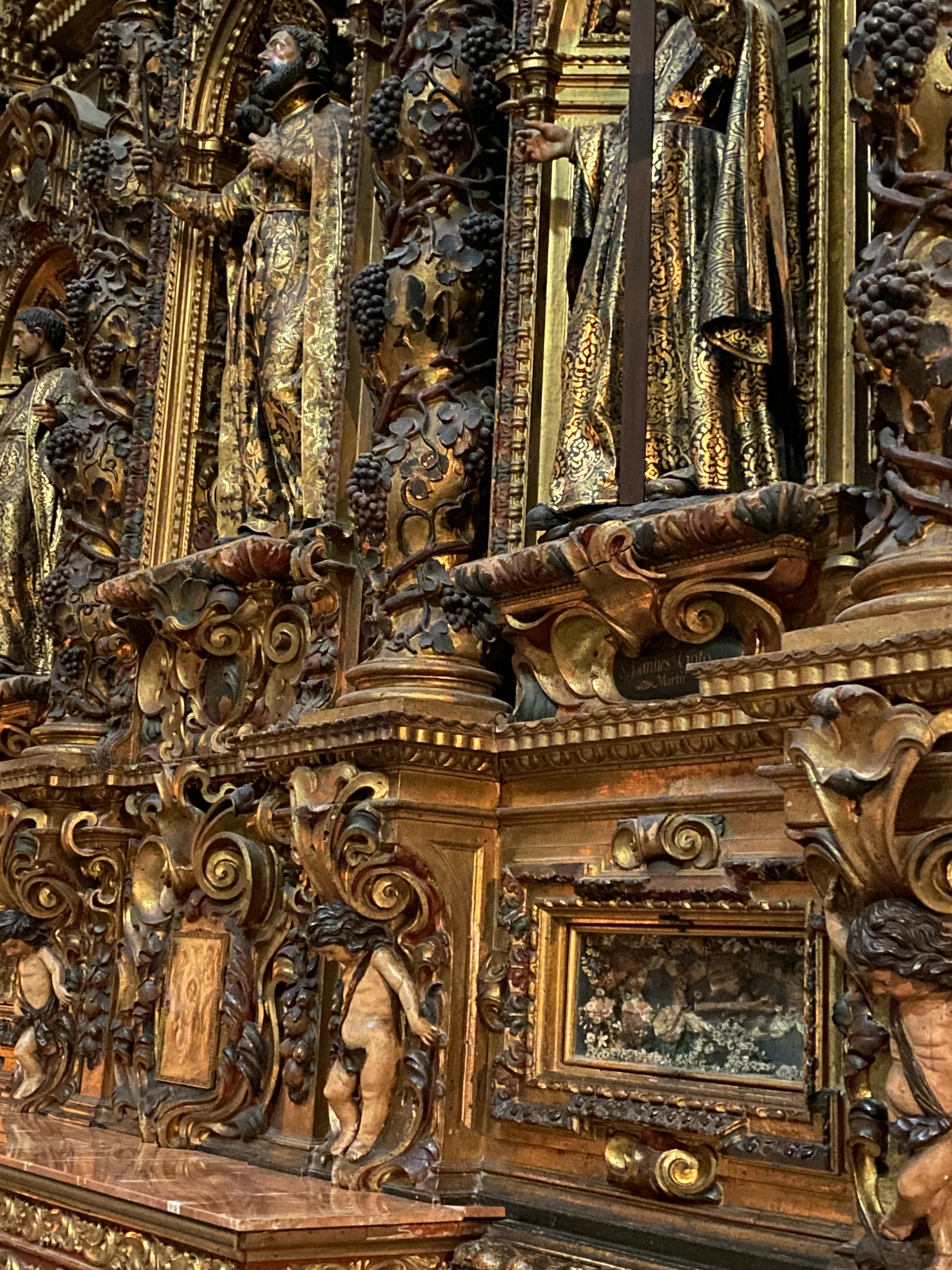
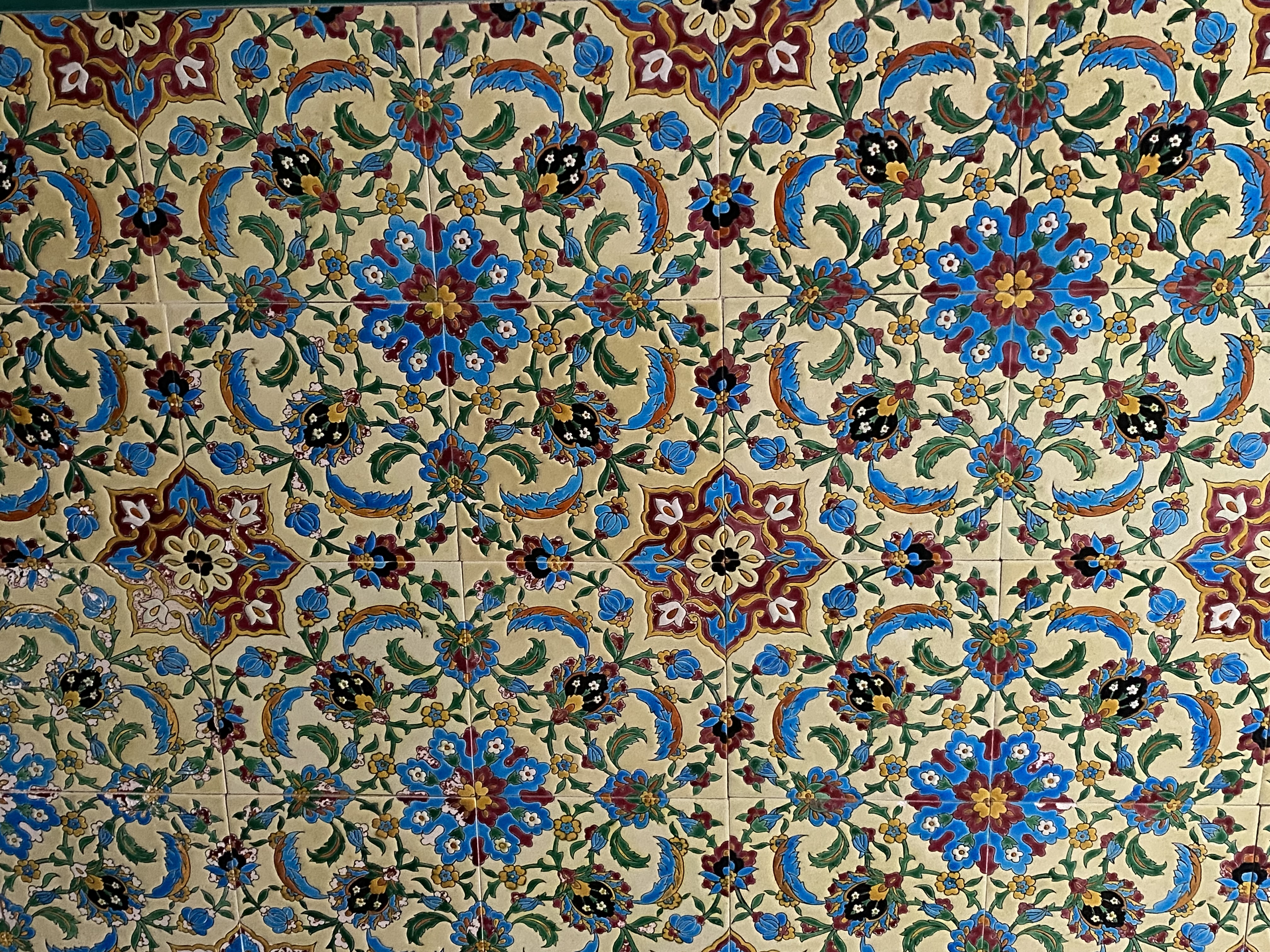
Because Spain continues to be hugely centralised, our journey takes us to Madrid on our way to Barcelona. For the same reason, this is quicker than going up the coastal route.

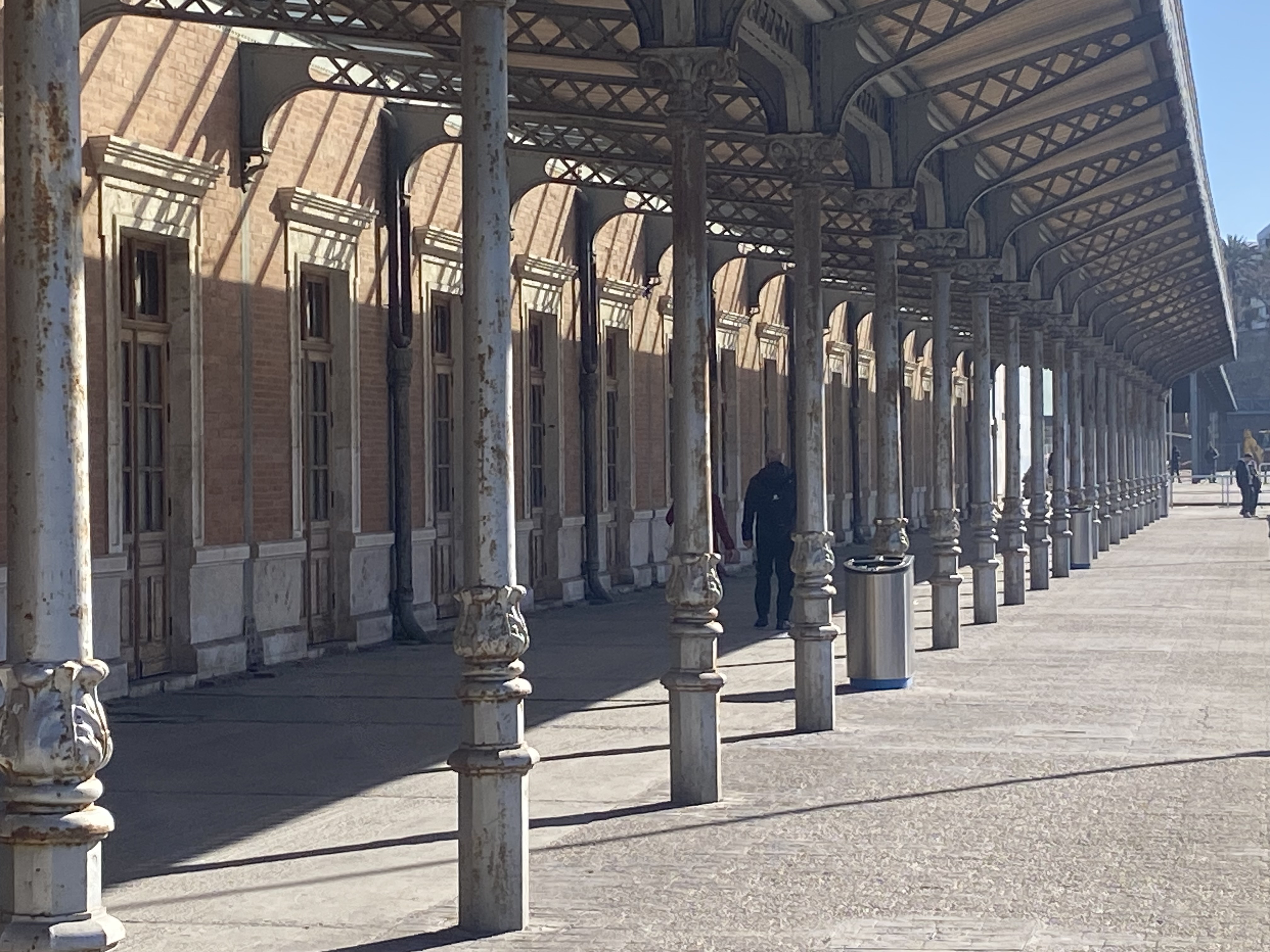
The 1.30 Renfe train is a shaky old bus but the windows are clean. People behind allow their child to kick my chair until I tell her to stop after which she plays a number of toys she no-doubt regards as music-based.
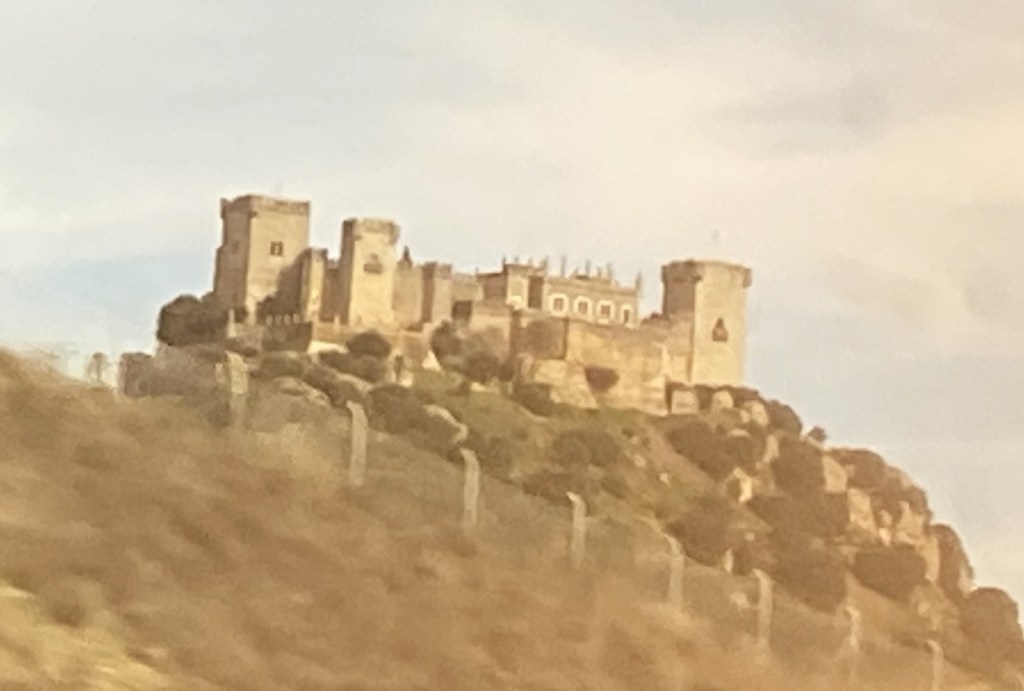
Journey to Seville flat and not very photogenic despite plentiful sunshine. The GF cake from Cadiz is crumbly but tasty. We become 20 minutes late. J gets a message from Renfe to say that we will be arriving at 6.28, four minutes before our 6.32 transfer. Although the train sometimes reaches to 250 kmph, we don’t make up any time. The facility on the interrail card app allowing a change of reservations won’t allow us to change our reservations. J buys a further pair of reservations, for the 7.30 train that will get us to Barcelona at five to eleven, refusing to consult the guard before doing so. The temperature outside drops as we head north; 15°C at Cadiz; 11 by Ciudad Real. As we approach Madrid, certain to miss our connection, I speak to the guard about our situation. He shrugs and points out that our next train is with IRYO, a different company. No doubt his shrug would have been more sympathtic if we had been continuing with Renfe.
In fact, we arrive about 6.25 and, by not re-entering the departure hall, we make it to the departure gate. Gate 4 is closed and the staff have departed. But the door to Gate 3 is open and lets us on to platform 4 where the train is still to depart. On board staff tell us we should return to the Gate to have our bookings scanned but don’t insist on this and we are still aboard when the train leaves. J cancels our later booking, retrieving all but US$5 of the $36 we spent on this insurance policy, a worthwhile investment.
The IRYO train is more modern than the one we have just left and zips along at 280 plus kmph, at one point reaching 300. Its lavatory door is less wilful than the Renfe one and the flush button easier to spot. The Cadiz GF bread and tuna and cheese cubes make a tasty meal. Best of all, the service is non-stop to Barca and we arrive a little early.
The Marriott AC Sants Hotel is near the station, easy to find and welcoming. Lavender bags for your pillow are a nice touch.
Day 30 Sunday 11 Barcelona & Paris
A short walk round the Sants area, very cold compared with our recent experiences. The impression of modern monoliths having replaced all is a little false – there are areas of older properties with very fine art nouveau buildings from the 1910s. Barca charm will out – though not at the Sants railway station where the back entrance is more or less across the road from the hotel. Luggage scanning and double ticket checks before we are herded into corales that make the eurostar lounges look luxurious. Our Ouigo TGV to Paris is a double decker, off on time and nearly 15 minutes underground before it emerges at the last of the city. It is a sunny and picturesque journey. After Figueres the train is full and settles into a very civilised – and French – routine though the cafe au lait is the worst coffee of the whole trip.

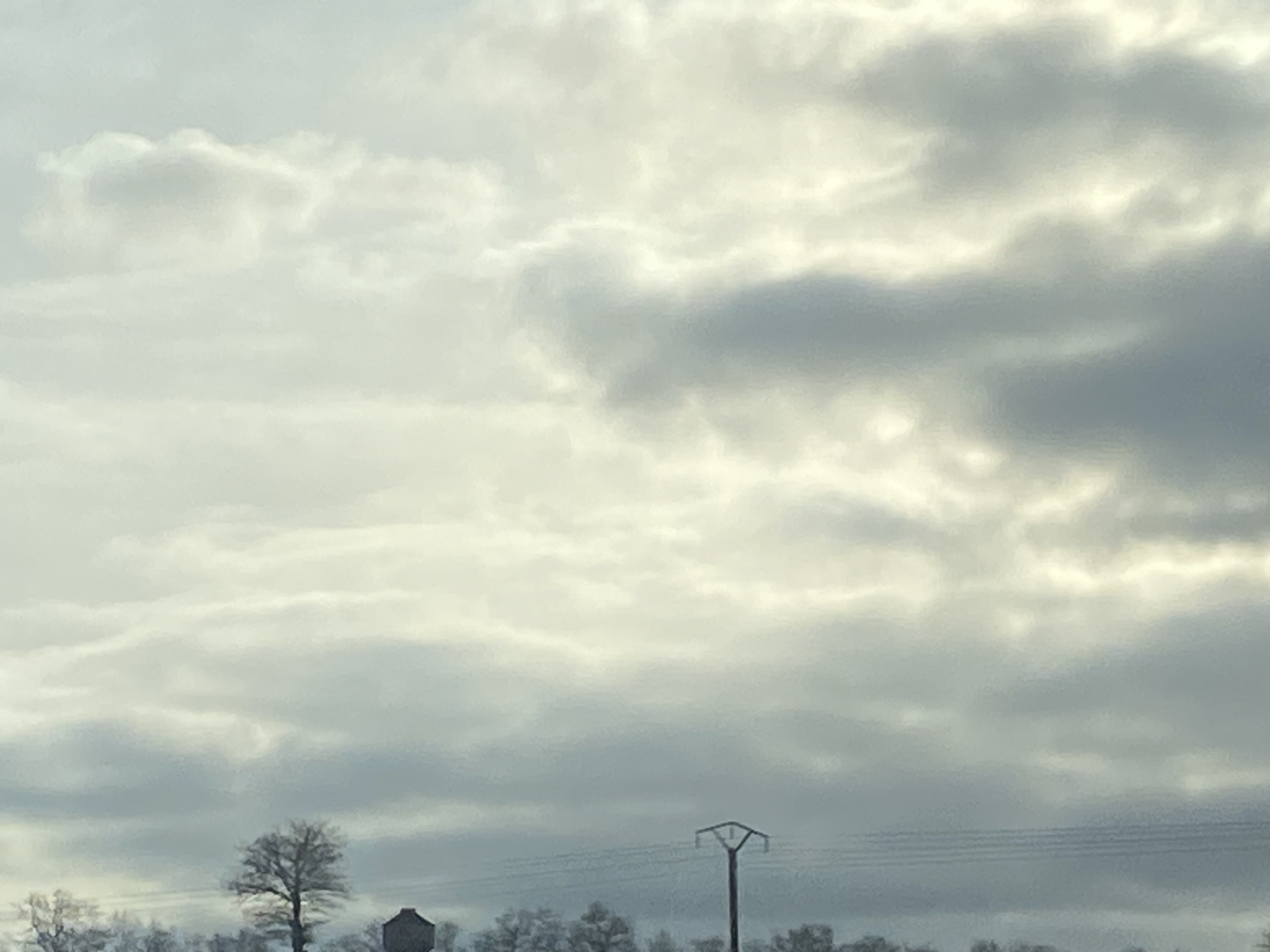
Lovely snowy mountains still visible as we arrive in Perpignon.
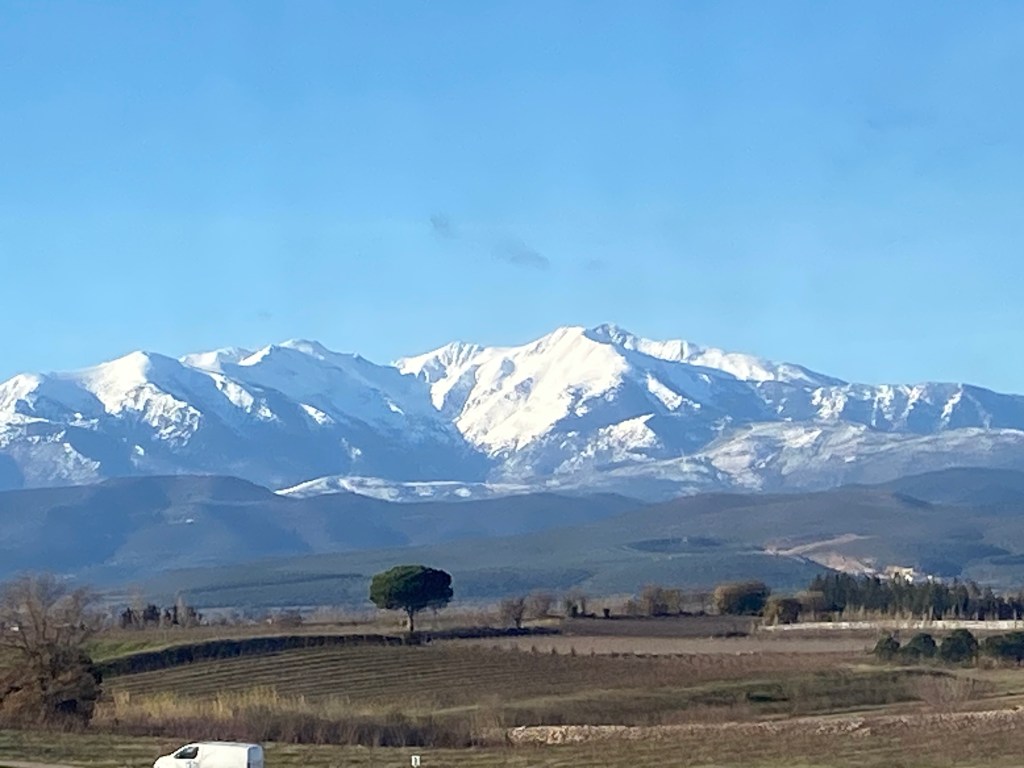
Only the smokers get off and few get on. Nothing by way of official checks as we move between countries but the guard looks at our tickets, reservations and passports. Voluble young man who clearly fails this level of scrutiny is seen off at Béziers.
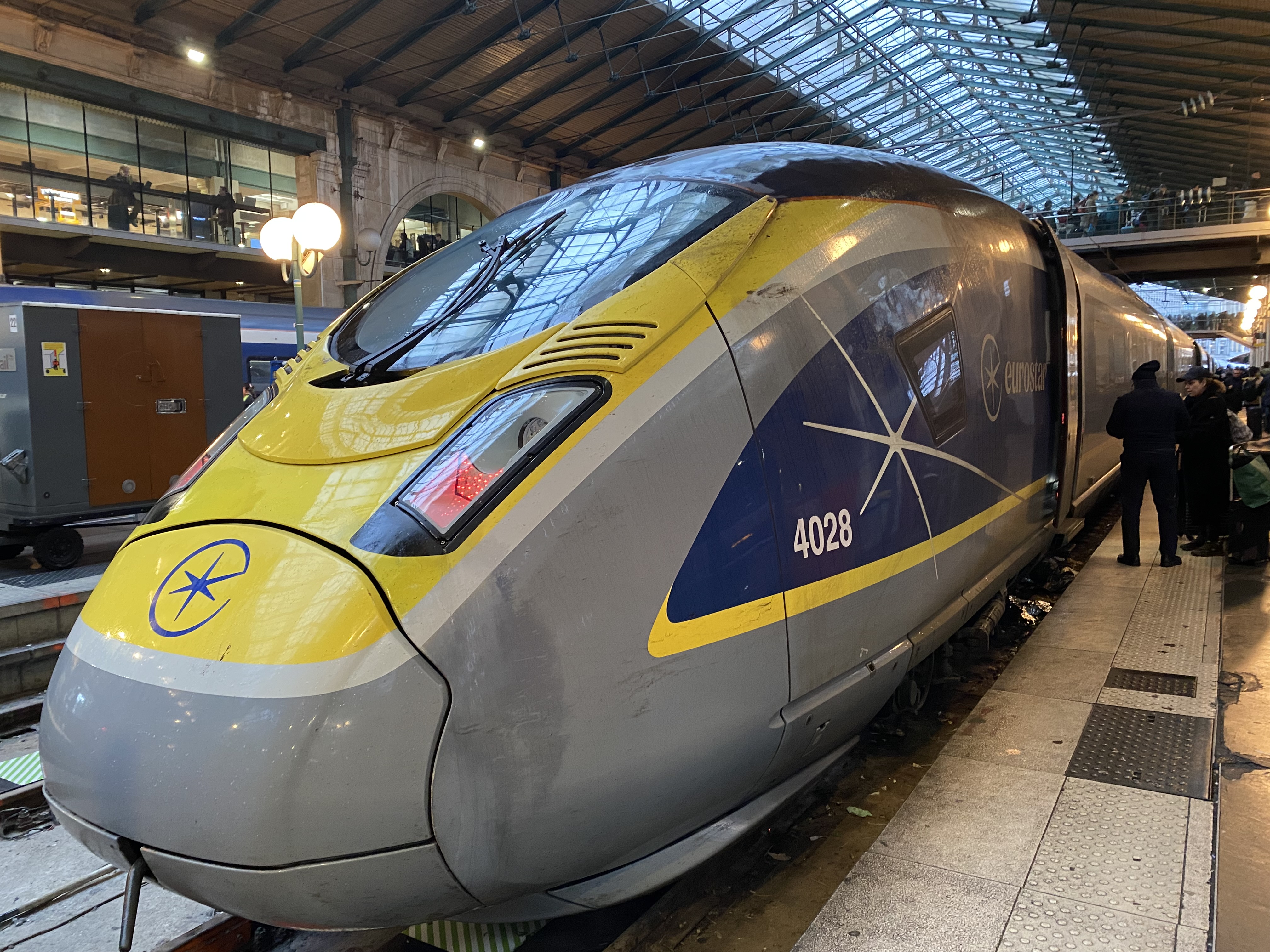
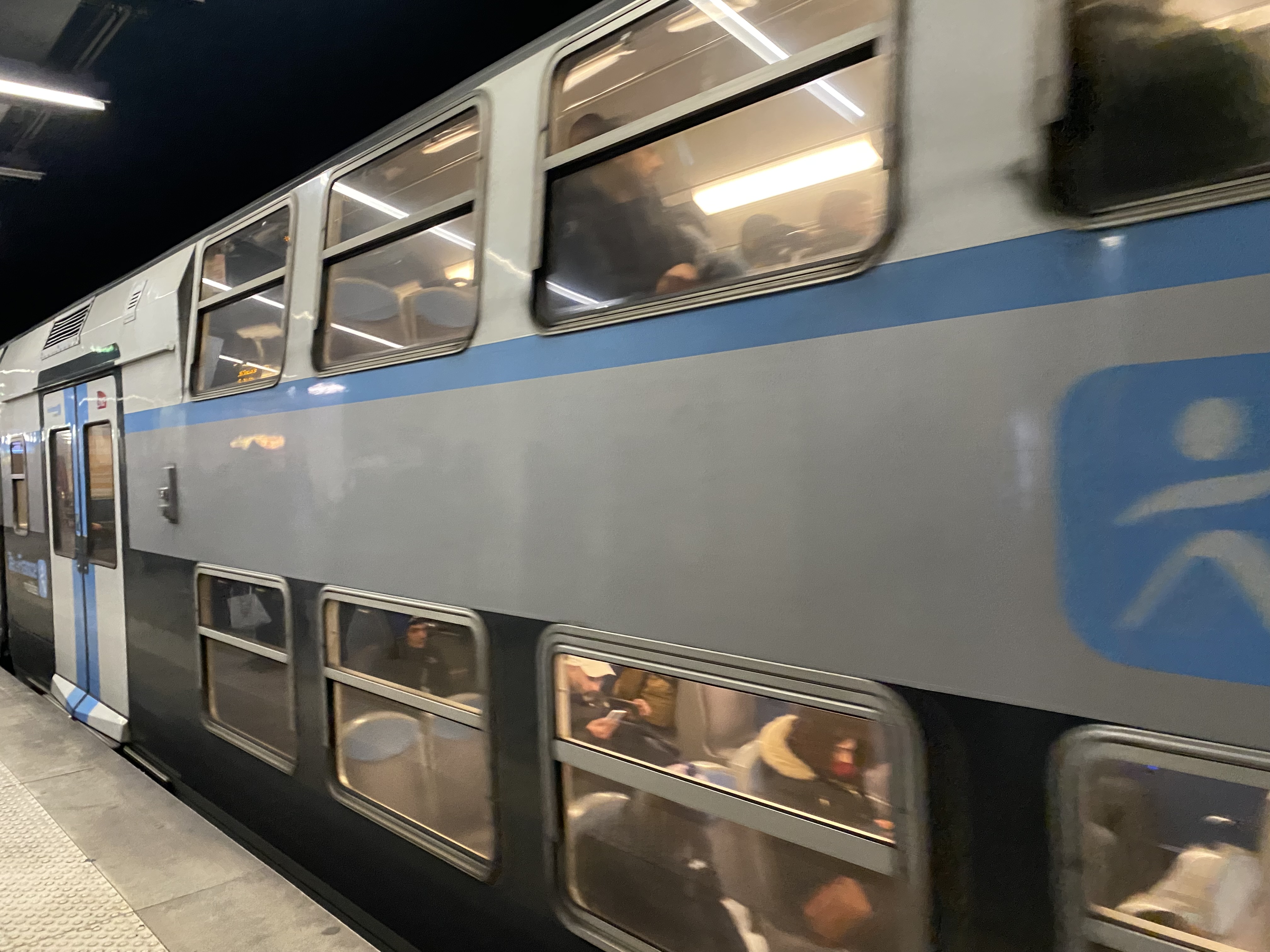
Grind to a walking pace a bit before 3pm but, without another connection today, we take this in our stride. A last cafe cortado from the Spanish-speaking staff. Perfectly on time at Gare de Lyon after an enjoyable train trip. We took the precaution of buying a couple of extra Metro tickets which see us smoothly to the Gare du Nord via RER line D. We walk to the Gare de L’Est through the assembly of cigarette retailers GDN always attracts and on to Little Regina Hotel where we are greeted as returning guests and given a better room – with a kitchen area. Soon out for dinner – Paris is bitterly cold after our weeks at 15°C. Purchase macarons and more of the super-expensive dates I got in Cadiz to take to work next week. Dinner in a Kurdish restaurant with mixed results.
Day 31 Monday 12 Paris to Scotland
No GF bread or cereal or tea bags at breakfast so we manage to get through Paris without tipping. Arrive before 8am at Eurostar to find the 9.02 train has been retimed to 9.12 and the huge number of people waiting will not start to be admitted. When we return the process takes forty minutes and I am glad to have a grumpy photo in my passport when I go through the various electronic scans. When we eventually get through all the checks, the train has been delayed a further thirty minutes, aparently to let the remaining passengers be processed. About 9.15 the delay becomes 50 minutes which torpedoes our planned connections. Frustrating when the boarding pass asked us to arrive at 7.52am.
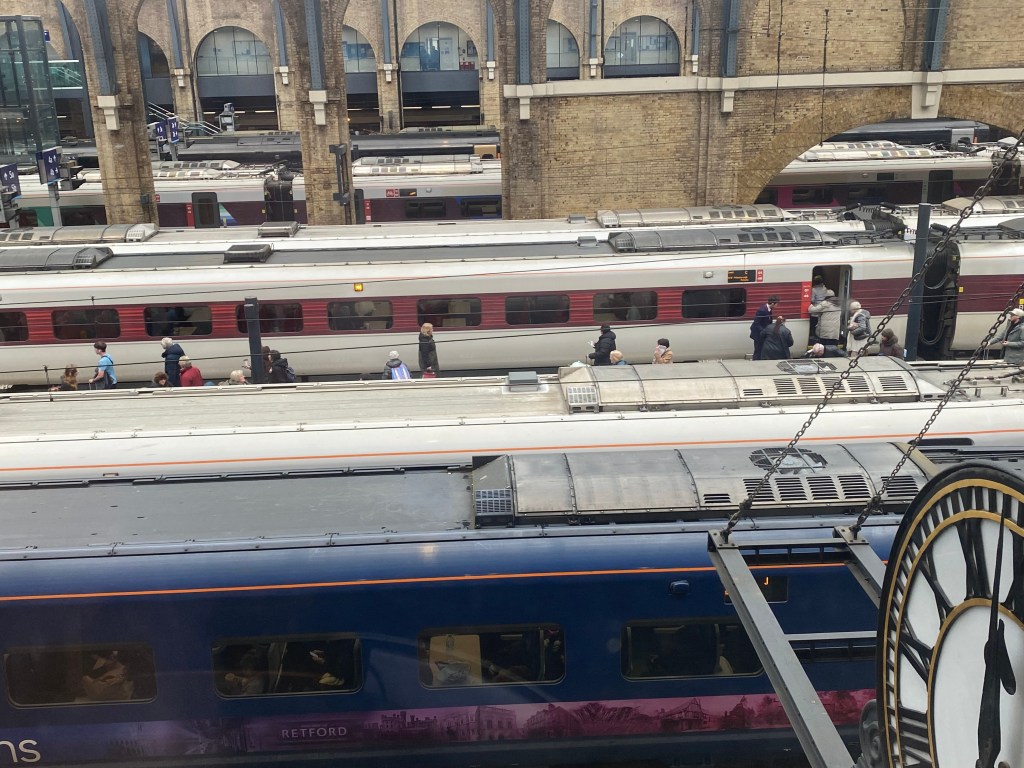
Food on the eurostar and the train north improvised rather than organised – the boiler has failed in first class in the latter.
 undivided-back postcards