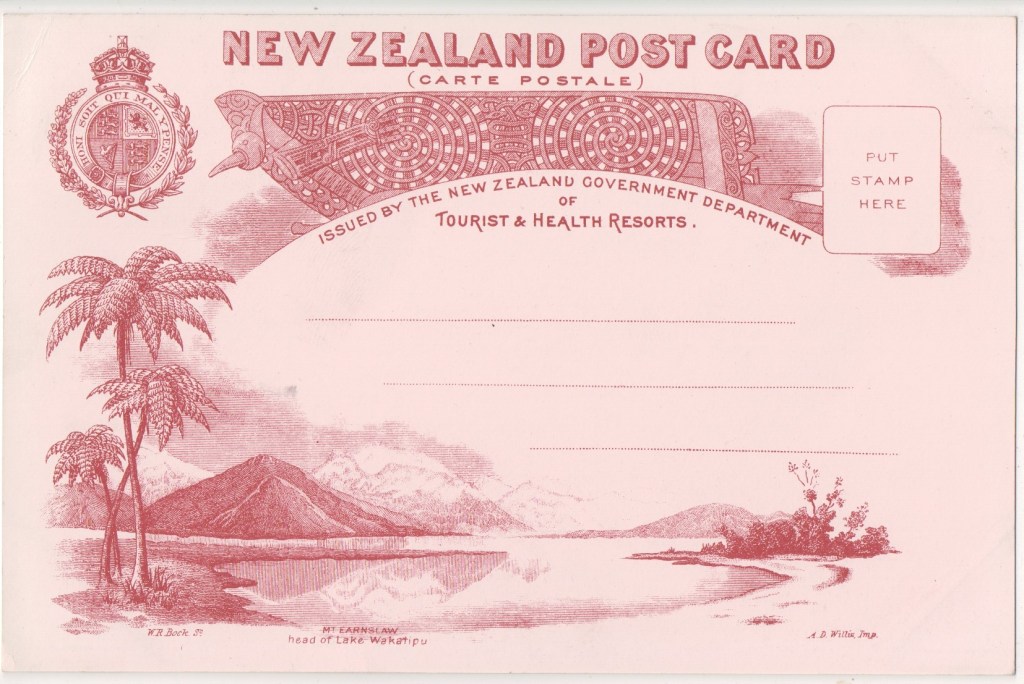
- ISSUED BY THE NEW ZEALAND GOVERNMENT DEPARTMENT OF TOURIST & HEALTH RESORTS Benani White, del W R Bock, Sc. A D Willis, Lithographer, Wanganui, N.Z.
Established in 1901, the New Zealand Department of Tourist & Health Resorts was the first national tourist organisation in the world. This department name is said to have been used from 1902 to 1930 and 1946 to 1951 except for the period 1910 to July 1912.
From the late 19th century the New Zealand government took control of tourist sites such as Rotorua’s thermal pools and the Milford Track, in the hope of boosting overseas tourist numbers. In 1895 the government also took over the Hermitage Hotel near Mt Cook, and soon after built or purchased accommodation houses near Rotorua, Lake Waikaremoana, Waitomo, Lake Pūkaki and Te Anau. The Department was established in part to operate these hotels. These early investments produced disappointing results and attracted few overseas visitors. By 1920 Waitomo was the only resort to consistently return a profit. To reduce its losses, the Department formed partnerships with entrepreneurs. The economic depression and war further delayed hopes of a tourism boom. During the 1940s the government took over four failing tourist hotels, and by 1949 it owned nine.
The Department of Tourist and Health Resorts Court provided a space in the 1906 International Exposition in Christchurch where the major tourist attractions of New Zealand could be promoted. At this time New Zealand’s thermal areas and Māori culture were seen as a drawcard, so these were highlighted along with sporting activities such as hunting and fishing. The Canterbury Times called the Department of Tourist and Health Resorts Court “one of the most artistically pleasing” at the Exhibition. The Department’s preoccupation with advertising New Zealand’s thermal attractions was further reinforced by its outdoor exhibit, located in a small, manuka-fenced enclosure at the back of the Main Building.
Sources: Te Ara The Encyclopaedia of New Zealand;
Christchurch City Council Libraries
Benoni White
- Benoni White del
Benoni White (circa 1858 to 1950) was a dealer in prints and drawings. Del, and Delin, are abbreviations for Delineavit, a Latin term literally meaning “He drew it.” It often appears on prints beneath the bottom picture line after the artist’s name. After the artist’s name on an engraving, it indicates that the print was taken from a drawing and not from an oil painting. On a lithograph, it can indicate “drawn on stone by” the lithographer or artist who created the original picture.
William Bock
- W R Bock, Sc
William Bock (the name Rose was added later) (5 January 1847 to 3 August 1932) was born in Hobart, Van Diemen’s Land, Tasmania. His parents had both been transported to Van Diemen’s Land and subsequently pardoned. He was introduced to his craft by his family; his father was a notable engraver, lithographer and daguerrotypist, important for his paintings of Tasmanian Aborigines. Failing to find employment on the Australian mainland, William Bock sailed to New Zealand on the Gothenburg in 1868. He arrived on 6 May in Wellington, where he was based for the rest of his life. In the 1870s he was responsible for the design and preparation of the dies for the first fiscal and postage stamps to be produced wholly within the colony.
In 1885 he designed the medals and certificates for the New Zealand Industrial Exhibition, at which his firm were awarded a silver medal for engraving. They also gained first prize in engraving and die-sinking, and in lithographic and ornamental printing. In the later 1880s William Bock personally supervised the first full book in chromolithography to be printed entirely in New Zealand. The magnificent Art album of New Zealand flora produced by Edward and Sarah Featon was published with 40 colour plates by Bock and Cousins in 1889. However, the strain imposed by the production proved excessive; further planned volumes did not appear, and the partnership with Cousins was dissolved that same year. Bock carried on business alone, initially as Bock and Company, and gradually recovered from debts of over £800.
Bock’s artistic flair was demonstrated in his work as medallist, stamp designer and engraver, and illuminator. His medals included several marking the 1901 royal visit to New Zealand and the 1913 HMS New Zealand medal. He contributed four values to the 1898 pictorial stamp issue, widely acclaimed as one of the contemporary world’s most attractive. In 1906 he engraved the New Zealand International Exhibition set, the first locally produced large commemorative issue. Bock was the most important and innovative contributor to the development of New Zealand stamp production from 1875 to 1931. His work as illuminator included two jubilee addresses to Queen Victoria and other addresses to Pope Pius IX and to visiting members of the royal family: ‘nobody of any note visiting New Zealand left without taking away some memento of Mr Bock’s skill’.
A robust, cheerful and optimistic man of medium height, William Bock had a wide range of interests including singing, drama, cricket, the Anglican church and the artillery volunteers. He was vice president of the Master Printers’ Association. In later years Bock began a partnership with his son William and at his death was supervising the apprenticeship of his grandson F. R. Bock, who was to continue the Bock engraving tradition in Wellington.
Sc, and Sculp, are abbreviations for Sculpsit, a Latin term literally meaning “He engraved it.” It often appears on early prints following the names beneath the bottom picture line and identifies the engraver of the print.
A D Willis, Lithographer, Wanganui, N.Z.
Archibald Dudingston Willis (20 June 1842 to 27 August 1908) was born on at London, England. At the age of 12 he was employed by a prominent firm of printers, Eyre and Spottiswoode, with whom he remained for three years. After the death of his mother he worked his passage to New Zealand on the Dinapore, arriving at Auckland on 5 August 1857. In Auckland Willis met James Wood, sub-editor of the Southern Cross newspaper. Having tested his capabilities, Wood persuaded the young printer to accompany him to Napier, where they started the Hawke’s Bay Herald. The new paper made good progress. About two years later, much to Wood’s regret, Willis returned to Auckland and from there travelled to Wellington, taking a post as compositor to the New Zealand Advertiser. The lure of gold drew him next to Otago, and for six months he tried his luck at Gabriels Gully. Leaving the goldfields, in Dunedin he met Julius Vogel, who suggested an opening on his Otago Daily Times, which was about to commence printing. Willis remained in Dunedin for only a year, however. At the urging of his Wellington employers he returned to the Advertiser, and then a year later left to take up an offer from the Christchurch Press. By this time he had decided to establish a paper of his own, and at the suggestion of friends and his former employers in Wellington turned his attention to Wanganui. Having purchased the necessary equipment, Willis arrived in Wanganui in 1864. But instead of launching his paper, he accepted an offer from J. U. Taylor to become foreman printer of the Wanganui Chronicle, and disposed of his plant.
In Wellington Willis had met Mary Dixon, and the couple were married there on 22 July 1865. They made their home in Wanganui, where they raised a family of eight sons and five daughters. While working on the Chronicle Archibald Willis made the acquaintance of John Ballance, the founder of the Evening Herald. He soon joined Ballance as a partner in the Herald, beginning a personal friendship which was to last long after Willis left the partnership. In 1872 he bought an established business and set up his own printing and stationery works. The business thrived, becoming one of the most prominent printing houses in the country. In addition to producing an extensive range of stationery items Willis became a bookseller and publisher. Titles appearing under his imprint included a number of pictorial books, including Geysers and Gazers (1888), Collotype views of the Wanganui River (c. 1895) and Edward Wakefield’s New Zealand Illustrated (1889). He was a pioneer of the use of chromolithography in New Zealand.
Willis played an important role in pioneering the river boat era on the Wanganui River, being a founding director of the Wanganui River Steam Navigation Company.
In 1908, while travelling by sea from Auckland to Wellington, Willis fell ill and was hospitalised at Gisborne. Apparently recovering from surgery, he suffered a relapse and died.
Source: Dictionary of New Zealand Biography
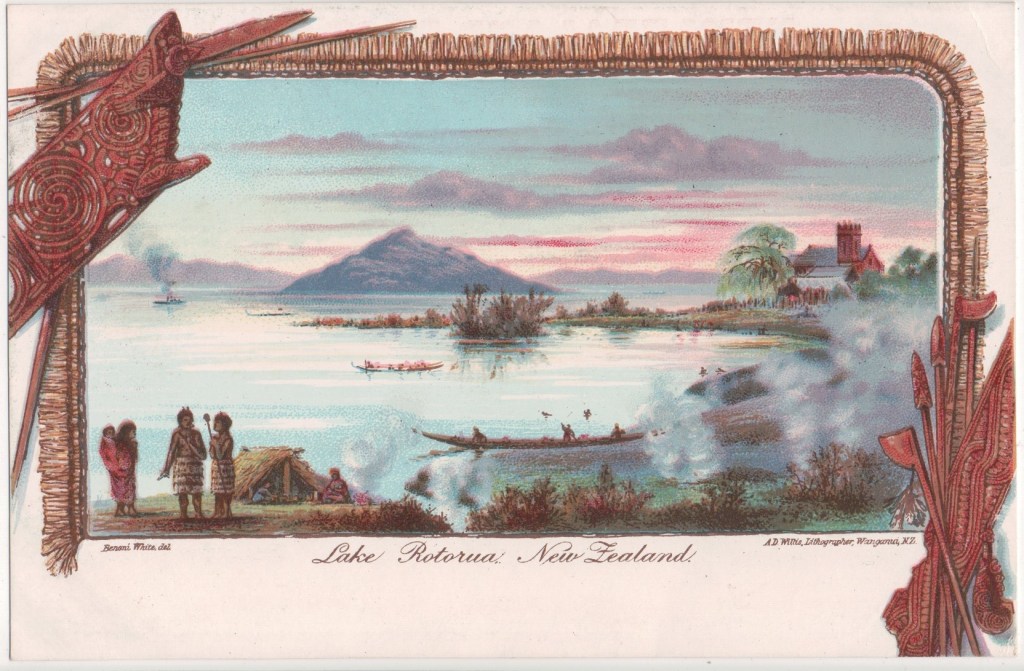
This Card: The main image shows a view of Lake Rotorua from near Ohinemutu, with St Faith’s Church at the far right. In the left foreground stands a group of Maori beside a raupo hut. In the right foreground the shore is steaming. There are waka and a steamship on the lake, with Mokoia Island in the background. The scene is bordered on three side by a grass fringe, and there are Maori tools and carvings at left and right.
Lake Rotorua is the second largest lake in the North Island of New Zealand by surface area, and covers 79.8 km2. Rotorua was New Zealand’s first tourism destination, rising to prominence on the back of the government’s vision for a South Pacific spa to rival those of Europe. In 1902 the government was convinced to invest all available resources in development of one spa, at Rotorua, rather than spread resources around the nation. To support the spa development, government resources were used to develop and support Rotorua infrastructure and tourism industry, like no other in the British Commonwealth, for the best part of the 20th century. This included: airports, drainage, water supply, roads, parks and gardens railways, hotel development, spa facilities, electricity, visitor information, swimming pools, lake launches, deer and possum release, administration of Maori villages, licensing of tourist guides, development of the New Zealand Maori Arts & Crafts Institute, and geothermal tourist attractions. For many decades, Rotorua was New Zealand’s premier tourism destination,
Although a town board was formed in 1880, Rotorua was managed by the Department of Tourist & Health Resorts. The reliance on government resources was such that Rotorua did not have an independent government until 1950. The town’s visitor information centre was managed by the NTO for 90 years. Rotorua’s rose as a tourism destination on the back of New Zealand government intervention during the first half of the 20th century; its decline took place gradually over the next 30 years. The attempt to make it the great spa of the southern hemisphere floundered during the depression years and World War II,
In 1965 the president of the Travel Agents Association of New Zealand described Rotorua as ‘the most squalid place in the country’. Inadequate sewerage arrangements led an overseas scientist to label the lake an ‘unflushed toilet’ in the 1970s. Things have improved since then such that few visitors to Rotorua today would be aware of the negative publicity of the sixties, seventies and eighties.
 undivided-back postcards