British Red Cross and Order Of St. John
- BRITISH RED CROSS AND ORDER OF ST. JOHN

This card was produced during the First World War by the Joint War Committee, consisting of the British Red Cross and the Order of St John.
The International Red Cross
The International Red Cross and Red Crescent Movement started in 1863 and was inspired by Swiss businessman Henry Dunant.
The suffering of thousands of men on both sides of the Battle of Solferino in 1859 upset Dunant. Many were left to die for lack of care. He proposed creating national relief societies, made up of volunteers, trained in peacetime to provide neutral and impartial help to relieve suffering in times of war. In response to these ideas, a committee, which later became the International Committee of the Red Cross, was established in Geneva. The founding charter of the Red Cross was drawn up in 1863. Dunant also proposed that countries adopt an international agreement, which would recognise the status of medical services and of the wounded on the battlefield. This agreement – the original Geneva Convention – was adopted in 1864.
The British Red Cross
When war broke out between France and Prussia in July 1870, Colonel Loyd-Lindsay (later Lord Wantage of Lockinge) wrote a letter to The Times. He called for a National Society to be formed in Britain just like in other European nations.
On 4 August 1870, a public meeting was held in London and a resolution passed:
a National Society be formed in this country for aiding sick and wounded soldiers in time of war and that the said Society be formed upon the rules laid down by the Geneva Convention of 1864.
The British National Society for Aid to the Sick and Wounded in War was formed. It gave aid and relief to both warring armies during the Franco-Prussian War and in other wars and campaigns during the 19th century. This was done under the protection of the red cross emblem.
In 1905, the Society was renamed as the British Red Cross. It was granted its first Royal Charter in 1908 by HM King Edward VII. Queen Alexandra became its president.
The Red Cross needed many skilled volunteers for its wartime role. In 1907, a permanent structure of local Branches was adopted and extended the presence of the British Red Cross to communities around the country.
The Order of St John
The Order of St John traces its origins back to the Knights Hospitaller in the Middle Ages, which was later known as the Order of Malta. In 1831 the Order was revived in England after a long period during which it had existed only in name. The emphasis was now to be on the charitable rather than on the military aspect of the Order. Yet it was the experience of war, notably the Crimean War, the War of Italian Liberation, and the Franco-Prussian War, that inspired the ambulance work from which sprang the First Aid Movement with which the Order has been particularly associated in the United Kingdom and overseas. The St. John Ambulance Association was founded in 1877 to teach first aid to the general public. Ten years later, the St. John Ambulance Brigade was formed so as to give first aid certificate holders opportunities for organised active service.
During both world wars, the Red Cross combined with the Order of St John to carry out relief work at home and overseas through the Joint War Committee (1914 to 1919) and the Joint War Organisation (1939 to 1947). Peacetime co-operation between the two bodies was undertaken by a Joint Council (1919 to 1946) and a Joint Committee from 1943.
Today Red Cross/Red Crescent is more internationally recognised and does a lot of work in war zones. St John Ambulance generally operates only in Commonwealth countries and tends to do more general health service work.
Sources: British Red Cross Historical Collection Museum of the Order of St John Museum of the Order of St John

Croce Rossa Italiana
- Croce Rossa Italiana COMITATO DI PESARO
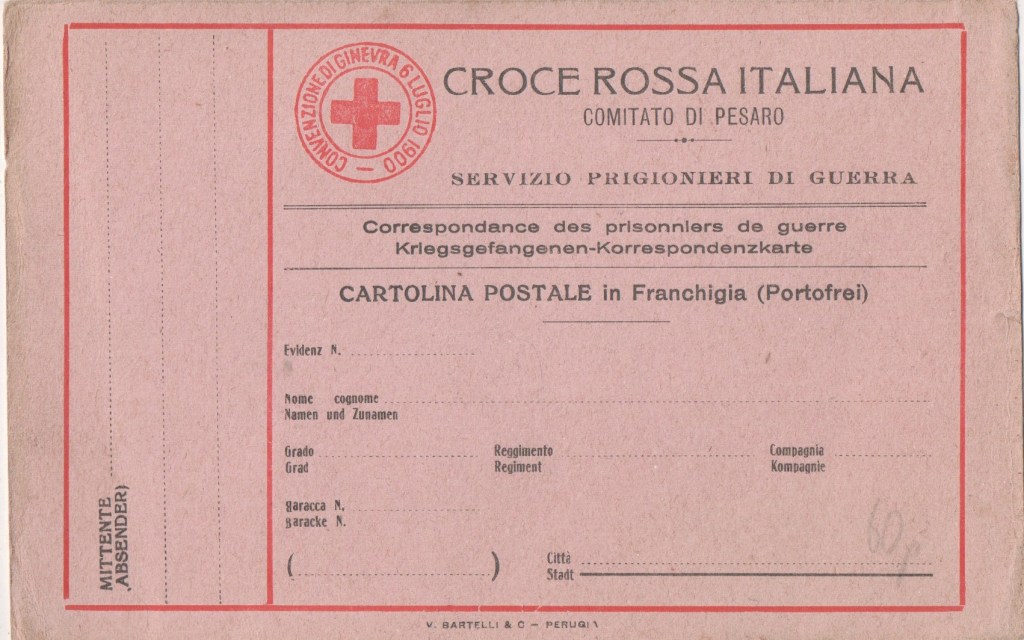
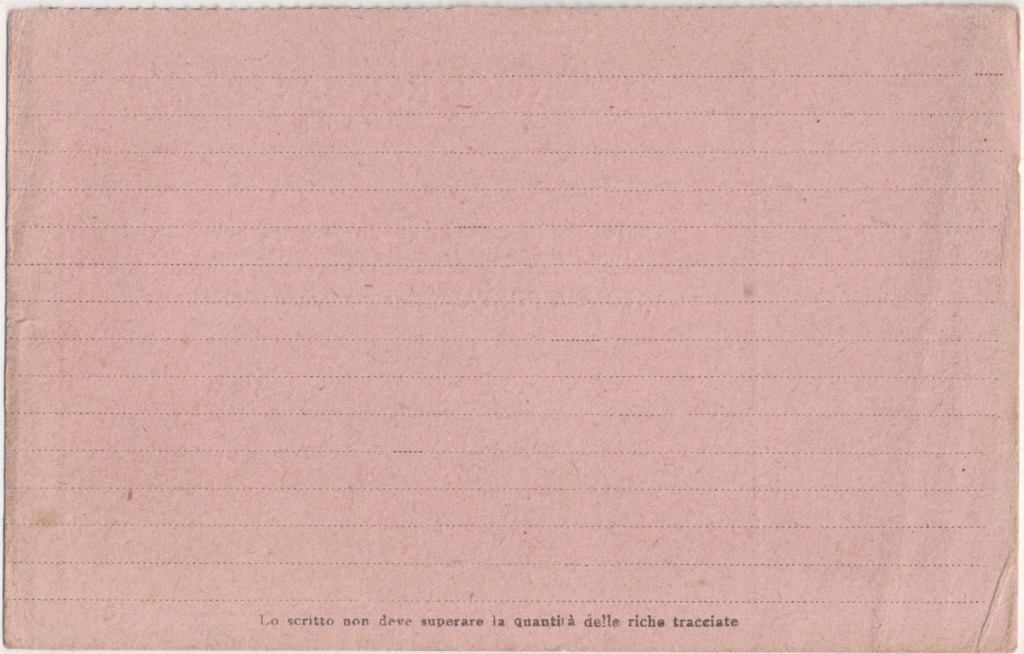
Italian Red Cross was organised by a Central Committee in Rome, passing to regional, provincial and local committees. The Pesaro Committee of the Italian Red Cross currently has its registered office at 8 Via Saffi and its operational headquarters at 2 Via Gradara. Pesaro is a town on Italy’s Adriatic coast.
Before being distributed to the families, Italian prisoners letters were subjected to a censorship on enemy soil, then went to the ICRC that then sent it to the Italian Red Cross, where was cleared by Italian censors who weree 80 employees of the I.R.C., and finally was placed in regular Italian mail. The Italian Command was always opposed to the assistance to prisoners of war, considering them to be cowards or traitors who had not wanted to fight. It was only the Italian Red Cross together with the families that limited the suffering and the deaths. Enemy correspondence such as this card would facilitate would presumably be subjected to a similar regime in reverse.
The Italian soldiers taken prisoner during the First World War who were lucky enough to survive hardship, hunger and disease and therefore return to their homeland, were not immediately able to return to their homes but were sent to special camps, distributed in the rear of the Italian lines, to be interrogated on what they had experienced (there was even, on the part of the military leaders, the suspicion of their being carriers of subversive ideas and deserters) and, as a precaution, to be placed in a kind of quarantine for fear of transmission of infectious diseases such as Spanish flu. These camps were established well before the end of the war, after the defeat of Caporetto. The Battle of Caporetto was fought on 24 October 1917, between the Italians and a combined Austro-Hungarian-German army. It was one of the most decisive battles of World War I, and ended in an Italian defeat with about 500,000 casualties and 250,000 more taken prisoner. The defeat left 11,000 Italian soldiers dead and 29,000 injured. The battle saw the Austro-German forces advance around 80 miles and reach a position from which they could strike at Venice.
The military authorities had to reorganise the army because of the considerable number of soldiers retreating after the battle, soldiers given the name of Caporetto stragglers. For the reorganisation, collection camps were created, which were then reused for ex-prisoners of war in 1918. One of the camps for officers only was at Pesaro and presumably this card was issued to prisoners-of-war there.
During WWI Italian command set up 83 prison camps where 10,000 soldiers from the central empires and 5,000 Italian deserters stayed. Public buildings such as schools and barracks and the Asinara island were used.
Thousands of Russian soldiers passed through Italian prisoner-of-war camps. 6,200 Russian prisoners who had been freed from Austrian captivity at the end of the WWI were then interned in Italy until 1920. These soldiers were enemies, the so-called Carpatho-Russians, Ukrainians, and Galicians of Russian origin, who had fought in the Austro-Hungarian army and were imprisoned by Italy. Italian authorities called all of them Ruthenians and estimated that there were at least 40,000 of them held in Italian camps at the end of the war. Many of the so-called Ruthenian prisoners considered themselves Russians, or Irredentist Russians (“russi irredenti”); they harbored anti-Austrian sentiments and deserted along the Italian front. Like other enemy prisoners of Slavic nationalities, Irredentist Russians also sought to be freed from prison camps and return to fight against Austria.
The Red Cross 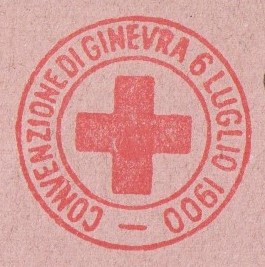
In 1906 a further conference was organized by the Swiss Government and attended by 35 States. On the basis of proposals submitted to it by the International Committee of the Red Cross the conference adopted the new Convention on 6 July 1906, replacing the 1864 Convention. Out of respect to Switzerland, Article 18 of the new Convention continued as the emblem and distinctive sign of the sanitary service of armies the heraldic emblem of the red cross on a white ground formed by the reversal of the Swiss federal colours.
The 1906, Convention was the first revisal of the 1864 Geneva Convention; This card’s reference to the 1900 Convention in the logo seems to be a mistake.
Sources: ICRC; The Fall Of Mussolini Italy, The Italians, And The Second World War Philip Morgan Oxford University Press; Wikipedia History of Italian Red Cross; Italian Red Cross Operations During World War I (The“Grande Guerra”) Duccio Vanni & others; Pietri Grande Guerra Ex-prisoners of war and Italian concentration camps
 undivided-back postcards