The General Postal Union was formed on 1 July 1875, the 21 initial members including Great Britain and the U.S.A, with France joining on 1 January 1876. The Union agreed standard postage rates and methods of indicating and collecting postage due charges on underpaid mail sent between GPU member countries. Prepaid postage was to be kept by the country of origin whilst postage due charges were to be kept by the country of destination, thereby stopping the complicated accountancy procedures previously necessary on all underpaid (and many prepaid) letters. Underpaid letters were to be marked “T” whilst the value of postage paid was marked in francs and centimes; overweight letters were to be marked with the number of rates in the upper left corner. Unpaid and underpaid mail was then charged with twice the unpaid rate less the postage paid. On 1 April 1879 the Union changed its name to the Universal Postal Union, and regulations were altered so unpaid and underpaid mail was charged twice the deficiency, the same practice already used within the UK on internal mail. The UPU rules also stated the deficiency was now to be shown (rather than the prepayment), in francs and centimes; from 1 October 1907 double the deficiency was to be shown.
½d postal stationery postcards were first issued on 1 October 1870. Cards had to be of the prescribed size, nothing could be applied to them and they could not bear any writing or cachets on the front other than the address. If cards contravened these regulations they were deemed to be letters and charged. Regulations were strictly enforced. Cards with messages on the front were charged, but so too were cards simply with the word “important” or “immediate” or the date. Private cards bearing adhesive stamps could not be sent as postcards until September 1894, although they could go as ½d printed matter if they bore no personal message; an 1875 stamped card with both the message and address on the front was correctly charged as a letter.
In 1890 postcards without any message could be sent to or from abroad as printed matter, but only if headed as such. Picture postcards and private postcards bearing adhesive ½d stamps were not permitted until September 1894. The message could only be on the picture side until 1902; however the UPU did not adopt this practice until 1906 with cards to or from certain countries being treated as letters until then if they bore a message on the address side. Cards were charged as letters if the address and message were written on the wrong halves of the card, if any part of the message went onto the address half or if the address was written on the picture side. Picture postcards could not exceed a specified thickness, be made of anything other than standard card, or have anything inserted in or attached to the card. Any contravention of these rules, even the addition of ‘glitter’ to the card, was enough to make them liable to letter rate. Leather and wooden cards were charged, as was a card franked ½d but also bearing a charity label sold in aid of the Stockport Sunday School at their 1905 Centenary bazaar.
The use of T, short for taxe shows something of the frame of mind of those in charge of the postal system at the time.
France
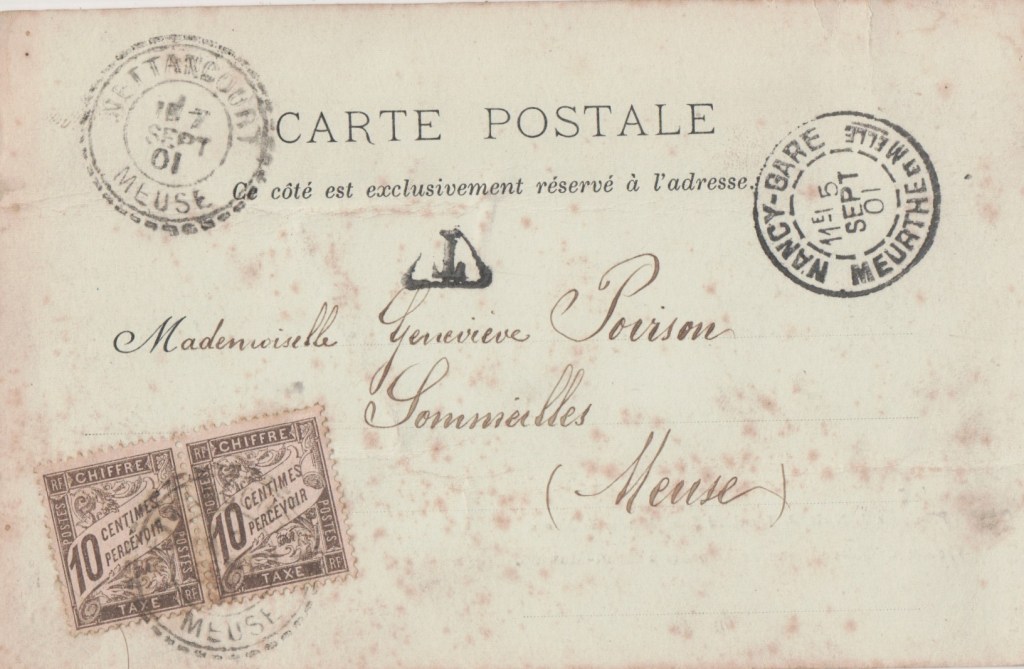
This postage due stamp was in use by 1896

Italy
A card published by Portéhaut’s bookshop in Pithiviers has an Italian postage due stamp here.
United Kingdom

IS – Inland Section
FB – Foreign Branch
FS – Foreign Section
The increase in postal traffic led to an increase in the importance and role of the Foreign Branch of the London Chief Office of the Post Office. By 1859 it had its own postmarks. At this time the Inland Section began to expand and the Foreign Branch became the Foreign Section. In general the Inland Section dealt with things posted within the United Kingdom and the Foreign Branch/Section with things coming from abroad. However, there was overlap so that one finds the Inland Section postmarks on correspondence from abroad such as this card.
The letter below IS could be a code for the amount attracted by that particular piece of printed matter but it seems more likely to indicate the part of the department. The format was still in use in 1956.
In 1888. hexagonal postmark stamps were issued to 18 offices with letters to identify the office. Glasgow hexagonal taxe marks came into use in 1888 within a few months of the issue of hexagonal taxe marks to London.
Widely used in WWI to give the troops free mailing home, “On Active Service” came in during the Boer War after there was a public outcry when in the early part of the war, letters from troops on active service, unable to obtain stamp, had their mail taxed and surcharged on arrival back home. This resulted in the Post Office paying the postage.

United States
A card sent from Hungary to the US in 1906 and bearing a T postmark showing underpaid postage here.
Sources: A Display given to The Royal Philatelic Society London by Patrick Frost 7th June 2012; UK Taxe Marks and their Offices of Use in the Centimes Era Philatelic Specialists Society; UK Taxe Marks for International Mail 1875-2000 Usage and Listing Ken Snelson
 undivided-back postcards