Henry R Willett, Bristol, England
- H. R. Willett & Son BRISTOL BRIDGE BRISTOL & TAUNTON
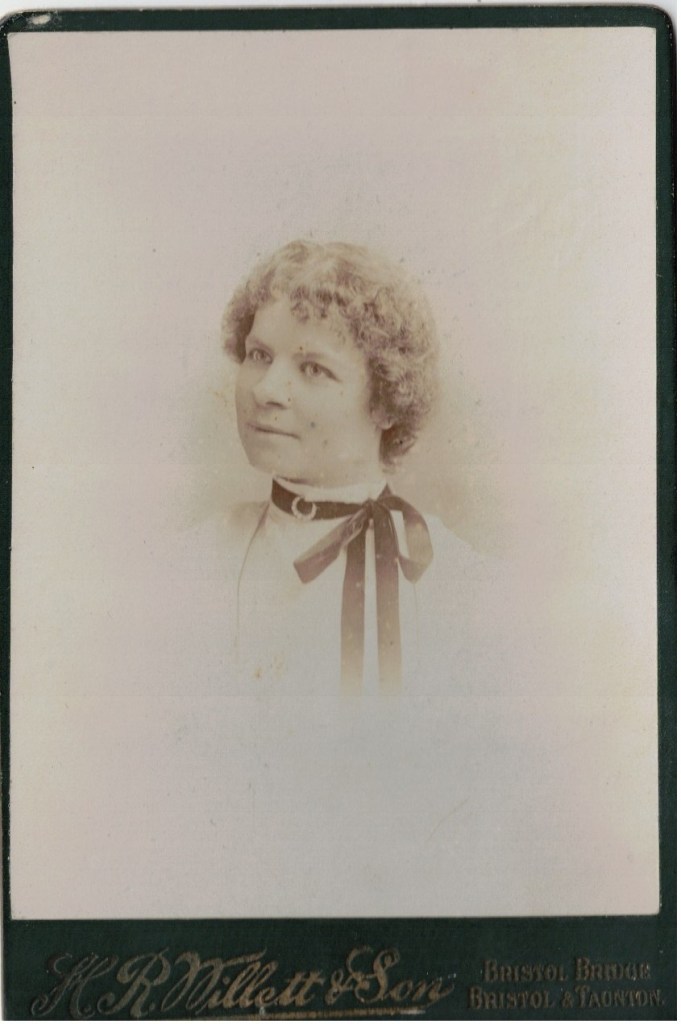
Bristol-born Henry Robert Willett (September 1850 to January 1912) was a professional photographer in Bristol from the late 1870s to the early years of the twentieth century. Although mainly at Bridge Studio on Bristol Bridge, he had a number of studios in Bristol over the years:
In 1873 he was at 26 Triangle, a confluence of roads that formed an elegant triangle of grand architecture which was very popular with photographers. In 1874, he was at 5 Denbigh Street and, in 1879 is recorded at 10 St Augustine’s Parade. Willett was at 139 Redcliffe Street in the priod to 1903.
Bristol Archives places him at Bristol Bridge between 1891 and 1906 and at Bristol Bridge and High Street from 1892 to 1901. Ogden’s Guinea Gold real photograph cigarette cards used a photograph of Marie Tyler (1872? to 1905), an English music hall comedienne and pantomime principal boy crediting H.R. Willett, 5 Bristol Bridge, Bristol. Also while at 5 Bristol Bridge, Willett took studio portraits of a number of young men with their bicycles – possibly the local cycling club. Willett sold CDVs in the name H R Willett, 6 Bristol Bridge, Bristol and is also recorded at number 8 Bristol Bridge. This crossing point over Bristol harbour had long been a main thoroughfare into the city. By the time that Willett was there, access was free and the two domed toll houses were no longer in use as such.
In the Clifton and Redland Free Press Willett advertised on Friday 26 August 1904: “Willett, Photographer, Bristol Bridge. Reduced prices. 12 Stickybacks 1/-, 12 Cartes de Visite 3/6, 12 Cabinets 6/6“
From 1886 to 88 Willett is recorded at 27 Fratton Street, Portsmouth, ninety miles to the south east. He also seems to have had studios at Lower Church Road, Weston-Super-Mare (25 miles south-west of Bristol) and 23 Fleet Street, Swindon, forty miles to the east.
Willett died Nantwich, Cheshire in 1912
Sources: Bristol Photographers. U.K; Stickyback Photographs; Bristol Archives; Portsmouth Photographers
Monsieur Williams
Chipping Norton,Oxfordshire, England
- MONS. WILLIAMS, PHOTOGRAPHER, AMERICAN SALOON, CHIPPING NORTON.


Scott Archer published the details of his wet collodion positive technique in 1852. The following year, a French photographer, Adolphe Martin, is said to have described a variant of Archer’s positive process which came to be known as the ferrotype. In the ferrotype, the glass support which carried the collodion was replaced by a thin sheet of iron coated with black enamel. However, it was to be in America, that the ferrotype was to enjoy its greatest commercial success.
The 1870s saw a resurgence in the use of the gem tintype process, popular in North America, largely explained by the rapid expansion of chains of American-style studios owned by companies Anglo-American Photo and American Gem. In the 1880’s travelling photographer Frank Walton (1833 to 1923) began to use the term ‘American Studio’ in his promotional information and in relation to all four of his locations – Leeds, Southport, Boston and Manchester.
According to Walton in 1921, he specialised in photography ’63 years ago in the days of the old, wet collodion plates’ (i.e. 1858), otherwise known as ambrotypes. At the time he was a travelling showman and later went on to have several travelling studios operated by himself and others. Without a doubt, the ferrotype in Victorian Britain was regarded as the cheapest, nastiest and lowest form of photographic life such that little attention was paid to it in the editorial sections of the photographic press. This makes any account of its history difficult and conjectural.
This carte bears signs of all the features of the ferrotype business: the designation Monsieur Williams is evocative of the French origins of the process while his American Saloon joins Chipping Norton to the chains of American-style studios. The use of a hand stamp on the back suggests a smaller, perhaps shorter-lived studio, consistent with the lack of information about Williams.
Sources: Photographers of Great Britain & Ireland; wikipedia collodion process
 undivided-back postcards