J. N. Guggenheim, Oxford, England
- J. GUGGENHEIM, 56 HIGH STREET, OXFORD

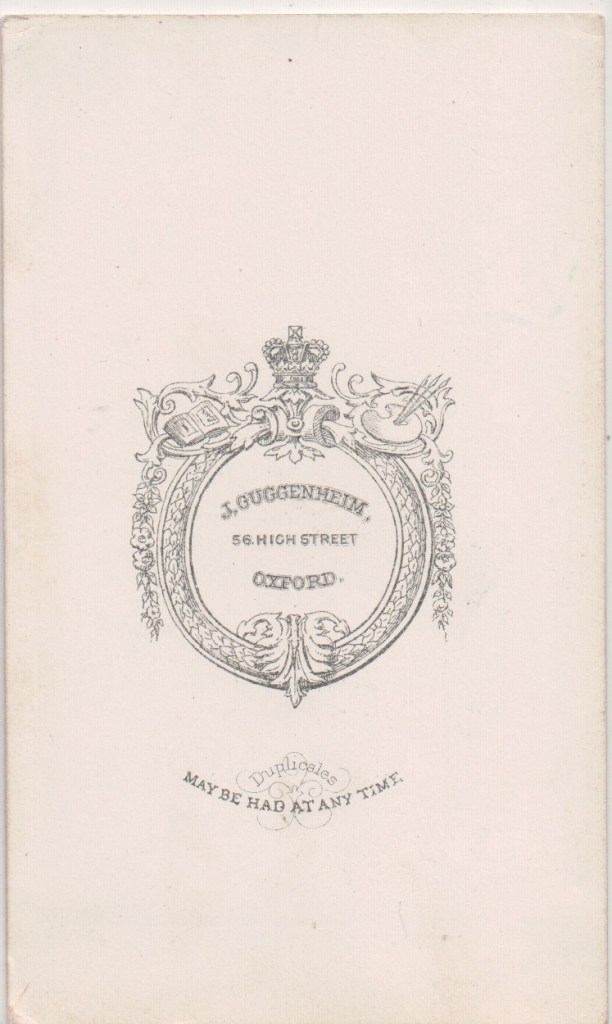
Jules Nicholas Guggenheim (1821 to 8 December 1889) was born in Budapest and arrived in England in 1848 as a refugee.
On 29 November 1790 the Jews of Hungary handed a petition claiming equality with other citizens, to King Leopold II at Vienna. This led to led to the law De Judaeis, which not only afforded Jews protection, but also gave them the assurance that their affairs would soon be regulated. However, although on 7 February 1791, the Diet (parliament) appointed a commission to study the question, the amelioration of the condition of the Hungarian Jews was not effected till half a century later, under Ferdinand V. Meantime, it is estimated that the Jewish population in Hungary grew by about 80% between 1815 and 1840, bolstered by immigration prompted by a perception of royal tolerance. In consequence of the petition of the Jews of Pest (the part of Budapest where Guggenheim was born), the General Assembly of the County of Pest drafted instructions for the delegates on 10 June 1839, to the effect that if the Jews would be willing to adopt the Magyar language they should be given equal rights with other Hungarian citizens.
From then on much attention was paid to the teaching of Hungarian in the schools; Various communities founded Hungarian reading-circles; and the Hungarian dress and language were more and more adopted. Many communities began to use Hungarian on their seals and in their documents, and some liberal rabbis even began to preach in that language.
However, at the sessions of the 1839–1840 Diet and in various cities, there was a decided antipathy and on 19 March 1848 the populace of Pressburg (Bratislava), aroused by the fact that the Jews were leaving their ghetto around Pressburg Castle and settling in the city itself, began hostilities that were continued after some days, and were renewed more fiercely in April. At this time the expulsion of the Jews from Sopron, Pécs, Székesfehérvár, and Szombathely was demanded and there were pogroms in the last two cities. Nor did the Jews of Pest escape, while those at Vágújhely (Nové Mesto nad Váhom) suffered particularly from the brutality of the mob. Bitter words against the Jews were also heard in the Diet. Some Jews advised emigration to America as a means of escape; and a society was founded at Pest, with a branch at Pressburg, for that purpose. A few left Hungary but the majority remained.
Guggenheim settled in Henley-on-Thames where he worked as a teacher and photographer. He moved to Oxford in 1860 where he set up as a photographer and lithographic printer on the Cowley Road before moving to more prestigious premises in the High Street near Magdalen College in 1863. On 10 June 1863 New College granted Guggenheim a 99-year lease for 56 High Street at a rent of £6 a year. On 24 October 1863 Guggenheim announced in Jackson’s Oxford Journal that he had moved from Cowley Road to more commodious premises at 56 High Street. At the time of the 1871 census Guggenheim was living there over his studio with his wife and seven children, plus three servants and an undergraduate lodger. They were still there in 1881, with eight children.
After some success, the business declined. In 1882 Guggenheim and the Warden and Scholars of New College entered a Deed of Covenant. In 1883 a trustee was appointed in proceedings Guggenheim brought for Liquidation by Arrangement or Composition with Creditors with all equipment sold at auction. The trustee was discharged in 1885.
Guggenheim was a member of the Oxford branch of the Socialist League in which context he was described in October 1885 as ‘half starving and would be only too happy to translate from French or German if he could get a little money by it’. He died in the Radcliffe Infirmary in Oxford, the father of twelve children.
The present numbers 55 and 56 High Street were built by New College in about 1933 to replace the old shops it had bought in about 1862.
Sources: Philip Webb’s visit to Oxford, November 1886 Stephen Williams in The Journal Of William Morris Studies Summer 2014; wikipedia History of the Jews in Hungary; Oxford History Jules Guggenheim
 undivided-back postcards