Maison Cayez, Lille, France
- FINE ART PHOTOGRAPHY – HONORARY DIPLOMA 690 GOLD AND SILVER MEDALS – ED. CAYEZ SUCCR – 9 Gold and Silver Medals Honour Diploma – 75 RUE DE BETHUNE 75 LILLE – ENLARGEMENTS REPRODUCTIONS – INDUSTRIAL WORKS
- Dessin JAMOIS
- B.P. GRIMAUD PARIS

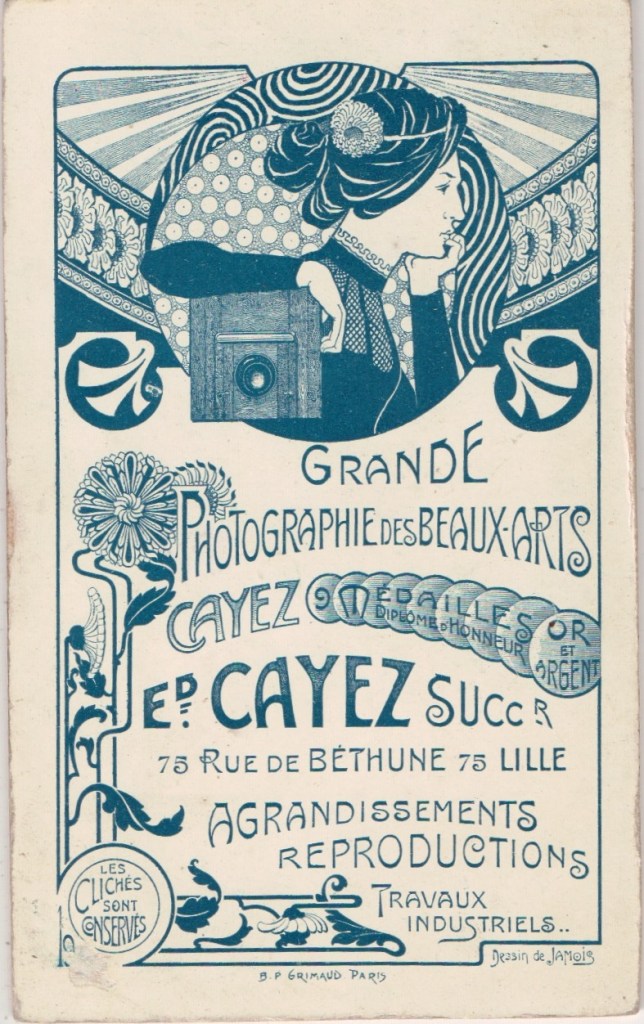
Alfred Cayez (1845 to 1916) 75 and 77 Rue de Béthune, Lille. Cayez started in business in Lille in 1875 and in Dunkirk in1890. In Dunkirk the slogan was: “Photography of the Three Cities” while in Lille: “Great Photography of the Fine Arts”. Cayez’ photographs of the Lequeux Theatre after the fire of 1903 were sold as postcards.
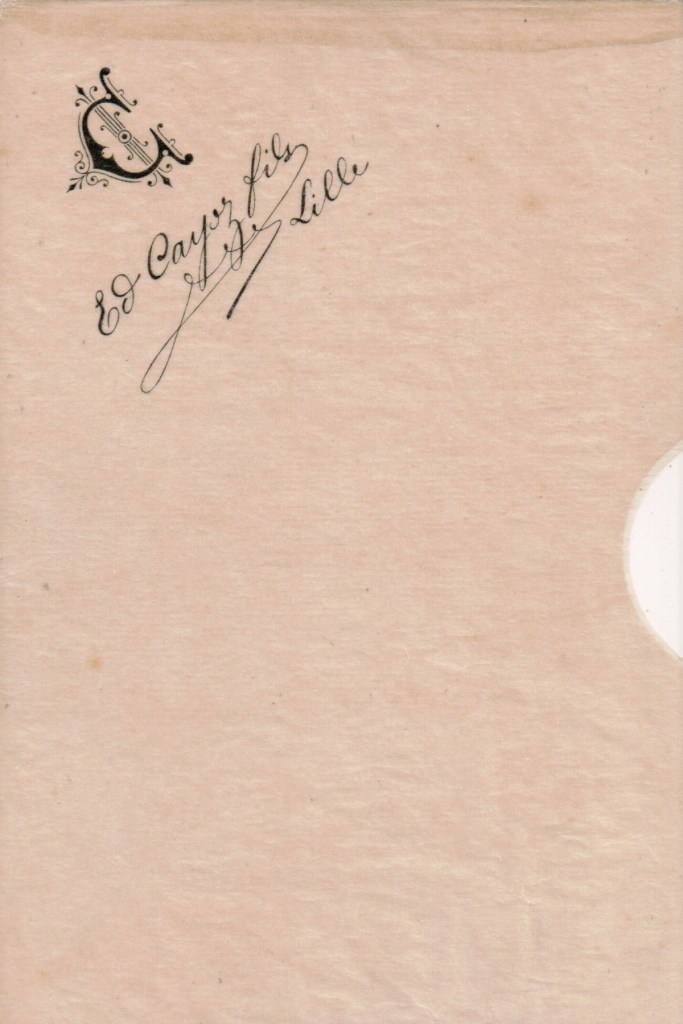
At some stage, Albert was succeeded by Edouard Cayez (died 16 January 1940 aged 65). As Edouard put the word fils after his name, there may have been more than one Edouard in the business.
In 1918 one of his images was used to illustrate a development project for the site of the former town hall in Lille . Edmond Robrecht, a graduate of the Beaux-Arts and textile designer, began his photography career in the 1930s by joining the Cayez studio in Lille, then a studio specializing in artistic and industrial photography.
In 1933 Edouard was a longstanding member of the association of professional photographers of the north west. His state of health kept from attendance at their meetings and prompted his retirement. His daughter died in January 1934.
Source: Le Journal de Lille January 2001; L’ Atelier des photographes du XIX siecle
B.P. Grimaud Paris
Baptiste Paul Grimaud (1817 to 1899) 54 rue de Lancry, Paris made these cards.

In 1840, Grimaud, then 23-years-old moved to Paris from Brûlain near Niort. In 1851, he joined forces with two merchants, Eugène Martineau and Marcel Bourru, who eventually sold him their cardmaking operation. A few years later, the company implemented a process to manufacture round-cornered playing cards, an innovation that was very successful.
Industrializing the card manufacturing process and buying out or outdoing its competitors, Grimaud gradually became the biggest French cardmaker. At the 1900 Paris Exposition Grimaud marked its high point when the company was awarded numerous prizes. After the death of Baptiste-Paul Grimaud in 1899, his nephews succeeded him.
Grimaud pioneered rounded corners and added gilding to make the cards more resilient; Their cards today still feature gold gilded corners. It is a sign of being high-end that Cayez employed Grimaud to produce his cartes de visites and cabinet cards.
Source: Grimaud.com; wikipedia Grimaud
Dessin Jamois

Edmond Victor Jamois (3 April 1876 to 8 February 1975) born in Lille, a French painter, designed this card.
A student of Pharaon de Winter and Jean-Paul Sinibaldi , Jamois exhibited at the Salon from 1905. He painted Flanders in general and Lille in particular. The Edmond Jamois Drawing and Painting Club still exists in Lille, bringing together drawing and painting enthusiasts.
The craze for collecting celebrity cartes de visite in albums reached its peak during the 1860s, but the format remained popular until the beginning of the 20th century. Art nouveau was popular between 1890 and 1910. Jamois was 28 when he created this hugely ornate and fashionable art nouveau design.
Sources: wikipedia Edmond Jamois
William Church, Belfast, Northern Ireland
- Wm CHURCH 25 CASTLE PLACE BELFAST


William Church, photographer, Belfast. Church features as a photographic artist at 25 Castle Place in 1877-78 directories, living at Albert Villas, Strandtown. By 1880 Thomas Williams & Co were the photographers at 25 Castle Place. Church was no longer living in Strandtown in 1896. Strandtown is now a district of Belfast, in the east of the city, in the BT4 postcode area, lying south of the City Airport and north of the Newtownards Road.
Not to be confused with: E.T.Church, photographer who was at 56 Donegall Place, Belfast about the same time.
Not to be confused with: William Church Jnr. was Secretary to the Photographic Committee of the British Association for the Advancement of Science when the BASA had its Annual Meeting in Glasgow in 1855 and a large photographic exhibition was held to coincide with the meeting.
Sources: JOHN ADAMSON 1810-1870 AND EARLY PHOTOGRAPHY AT ST ANDREWS Bruce F. Pert THESIS FOR DEGREE OF M. PHIL. 1994; List of Belfast Photographers, compiled by Liam McFaull and directories on https://lennonwylie.co.uk/
 undivided-back postcards