
This page introduces a series of pages consisting of a directory of photographers who produced cartes de visite and cabinet cards in the second half of the nineteenth century. Although many of them went on to involvement in early postcards and are thus part of the main directory, many did not and are simply included because I have a photograph from them. Although not featured as such, the more modest stickybacks are dealt with below. CDVs are shown side by side with their backs while cabinet cards are shown above their backs.
In addition to the carte-de-visite and the cabinet card, dealt with below, there appear to have been a significant number of other styles of cards, most likely distinguished by variations of size. These are dealt with here.
the background
In 1839 the astronomer and chemist, John Herschel coined the term ‘photography’. A roundel on one of Pierre Vuillot’s cartes de visite bore the names Niépce, Daguerre, and Talbot.
Nicéphore Niépce invented a very very slow emulsion based on bitumen of Judea (a naturally occurring light sensitive glop which hardens, very very slowly, upon exposure to light) and a way of fixing the image eventually formed (wash away the glop that has not hardened.)
In 1839, Louis Daguerre in France and Henry Fox Talbot in England, who had been working independently, announced competing photographic discoveries. Their processes were very different, but both played major roles in the history of photography. Daguerre’s method was initially superior, but the future belonged to Talbot’s technology.
Daguerre’s process exposed an image on a silver-plated copper plate. Talbot’s process created a negative image on paper from which multiple positive images could be printed.
The daguerreotype had two advantages over Talbot’s paper process. First, the daguerreotype was crystal clear, whereas Talbot’s images were not sharply defined because imperfections in the paper negative reduced the quality of the final print. Second, Daguerre’s process was freely available to the public (the French government had given Daguerre a pension for life), while Talbot patented his invention and charged fees to license its use. The result was that the daguerreotype exploded in popularity and was the dominant form of photography from 1839 to 1855, while Talbot’s process languished. In 1840 Edgar Allan Poe declared the daguerreotype “the most important, and perhaps the most extraordinary, triumph of modern science.”
There are some shenanigans involving patents and intellectual property which initially make Talbot’s processes less attractive to use, and Niépce’s process while historically important was never practical for photography, with its exposures measured in hours.
As a result, daguerreotypes briefly dominated the scene. They had some problems. A daguerreotype is a unique object, it cannot readily be reproduced, it is fragile, and it is, ultimately, a thin sheet of metal. It is a little hard to look at as some viewing angles work and others do not. On the other hand, it is cheap and very very sharp. This made it suitable for portraits, at least portraits conceived as keepsakes. The daguerreotype is largely useless for hanging on the wall, and while it is useful as a reference for, say, making a woodcut, it is not suitable for directly making copies for, say, books.
Therefore, inevitably, the daguerreotype became the preferred medium for the portrait and had a secondary life as a source of artist references for various uses (everything from figure studies to a guide to engravings of various sorts).
Talbot’s process, the calotype, was a bit soft, relying as it does on a paper negative. While Impressionism had not quite arisen, there were precursors in painting. J.M.W Turner has some influence at this point, Jean-François Millet is rising, and so on. Whether or not any given photographer was influenced by any given painter may not always be clear, but in the air we have the idea that perhaps clarity of detail, sharpness, is not always a necessity. Perhaps, photographers began to think, the softness of the calotype could be worked with rather than struggled against. And so, they did that.
The calotype was, as noted, somewhat encumbered by patents as Talbot tried to monetize his invention. But, it could be reproduced, being the first form of what we now recognize as a standard positive/negative process, and it did make objects suitable both for hanging on the wall and gluing in to books. These were desirable properties. After some tinkering, the French successfully bypassed the Talbot’s patents, at least well enough, and began making lots of paper negatives and from those, paper prints. At the very tail end of this era, just as the glass plate methods are being devised, the French Government commissioned the Mission Héliographique, to document the nation’s architecture. This produced a modest collection of rather beautiful architectural studies.
But the daguerreotype had serious limitations. The mirror-like surface of the image could only be viewed from a narrow angle. Further, the process produced a one-of-a-kind image that did not permit printing duplicates. While the daguerreotype was supreme for the first fifteen years after photography’s invention, it was Talbot’s process—paper copies printed from a negative—that became the basis of 19th and 20th century photography.
Sources: Dawn’s Early Light Cornell University; Photo PXL
Cartes de Visite
A carte de visite is a photograph mounted on a piece of card the size of a formal visiting card — hence the name. The format was patented by the French photographer Andre Adolphe Eugene Disdéri (qv) in 1854.
Most professional portrait photographers of the 1850s took either daguerreotypes or collodion positives. With both processes, each picture was unique and multiple copies could only be made with difficulty, if at all. People wanting larger portraits or more than one copy could have whole plate prints made from wet collodion negatives, but there was little demand for these except in the most fashionable studios because they were expensive.
It was widely recognised that there was a market for a process which could produce a large number of prints cheaply; Louis Dodero, a photographer from Marseilles is credited with inventing the carte de visite in 1851 by applying a photograph to such a card and a similar suggestion appeared in the American Journal Practical Mechanics in 1855 but it is to Disdéri that we owe their large-scale commercial development.
Disdéri devised a way of reducing costs by taking several portraits on one photographic plate. This required the use of a special camera and many different types were developed. Some had several lenses, which could be uncovered either individually, or all at the same time to give 4 or 8 photographs on the same plate. Others had a mechanism for moving the photographic plate so that each image was recorded on a different area.
In 1859 reports that Napoleon III , on his way out of Paris to conduct a military campaign in Italy stopped at Disdéri’s shop to have his portrait taken created a sensation and a huge rise in the popularity of the product. Cartes de visite were introduced to England in 1857 possibly by A Marion & Company of Soho Square, London who printed many of the cards on which they were mounted. In May 1860, J.E. Mayall took carte portraits of Queen Victoria, Prince Albert and their children. These were published later that year and the popularity of carte portraits soared.
People began to collect portraits of their family, friends and celebrities and mount them in photograph albums. Celebrity cartes were sold at stationer’s shops in the same way as picture postcards were as the century turned.
The craze for collecting celebrity cartes de visite in albums reached its peak during the 1860s, but the format remained popular until the beginning of the 20th century, and cartes can still be found in large numbers, loose or in family albums. The market for Daguerreotypes finished.
The story of Disdéri is in many respects the story of the carte de visite; at his peak he had studios in Madrid and London as well as Paris and was patronised by high society and royalty. After others started producing cartes without his technique and then moved on to cabinet cards, his business failed to keep up with the lavish lifestyle he had adopted. Postcards must have been the final straw.
William Duffus (qv) placed an advertisement in the Huddersfield Chronicle on 15 August 1885 which offers some insight into the prices of the day:
“CARTES”-DE-VISITES. ¾ length, 8 shillings per dozen. Vignettes, 10 shillings per dozen.
“CABINETS. ¾ length, 16 shillings per dozen. Vignettes, 18 shillings per dozen.”
A vignette is a small illustration or portrait photograph which fades into its background without a definite border.
Dating Cartes de Visite
… the visitor is conducted into the large photographic studio filled up with all the necessary blinds etc., to regulate the amount of light required. On one side of this is a waiting room and a dressing room and around the studio are various objects used for the sake of giving effect to the photographs, namely balconies, cabinets, old oak, stones, ornamental chairs etc., etc. At the further end of the room are arranged a large number of Seavey’s celebrated backgrounds and several local backgrounds taken from photographs, and notably Chatsworth Gardens, with the Emperor Fountain playing. All these are so constructed that with very little trouble backgrounds required can be let down by ropes and pulleys, and by these means a visitor may be taken so as to appear almost in any place he wishes. He can appear to be by the seaside, or in Chatsworth Gardens, or in the precincts of a large mansion.
Report of a tour of Alfred Seaman’s Chesterfield studios Derbyshire Times Saturday 29 May 1886
Cartes de visite were popular from the 1850s until around 1900. They consisted of photos measuring about 3½” x 2¼”, mounted on trade cards measuring about 4″ x 2½”. This size remained unchanged throughout the carte’s history. In France the “business card” format was 6.3 x 10.5 centimetres, the negative (cliché) 9 x 12 centimetres, In Italy the format was 10.4 x 6.2 centimetres.
The clothes of the subject are a key element of dating a photograph, particularly the style of dress, hat and collar. Be sure you are researching the fashion history of the country in which the subject was dressed.
1860s
- Generally, the thinner the mount, the earlier the photograph;
- Square cornered mount;
- Ballustrade, column, curtain accessories
1870s
- Mounts with rounded corners were introduced;
- Rustic bridge and stile accessories.
My latest success is a Rustic Stile. This accessory naturally gives poses that are new. Can be used with any landscape background, and produces charming, novel, and attractive rustic pictures. Price, $15. I also announce Spring Blossoms, Central Park Arch (for panels and promenades), and other new backgrounds and accessories. Samples sent to known responsible parties.
letter to Philadelphia Photographer of 1880 from Lafayette W. Seavey of 8 Lafayette Place, New York
1880s
- Hammock swing and railway carriage accessories
1890s
- Palmtrees, cockatoos, bicycles accessories
Cabinet cards
1868 saw the introduction of a new format, the “carte-album” or “carte-cabinet,” measuring 10.7 x 7.5 cm. Cabinet cards are photographs mounted on stiff pieces of cardboard. They were introduced in the 1860s and gradually superseded the smaller carte de visite format.
Photographers Window and Grove’s studio in Baker Street in London is credited as the birthplace of the cabinet portrait. Mr. Window was the first to suggest and press upon the attention of the public this familiar style, which become popular in the UK and, as the “carte album” in favour throughout the Continent and in America.
The front of the card is usually printed or embossed with the photographer’s name, and the back of the cabinet card is often printed with elaborate designs incorporating the details of the photographer and his services.
The popularity of the cabinet card waned around the turn of the century, particularly after the introduction of the photographic postcard, though they were produced up to the First World War.
The cabinet card was basically a larger version of the carte de visite. Paper prints measuring about 5.5 x 4 inches were pasted to standard sized cardboard mounts measuring 6.5 x 4.25 inches (16.5 x 11 cm).
Dating Cabinet Cards
The clothes of the subject are a key element of dating a photograph, particularly the style of dress, hat and collar. Be sure you are researching the fashion history of the country in which the subject was dressed.
1870s
- Cabinet card mounts are usually thicker than those of cartes de visite;
- Cream mounts were always popular;
- Rustic bridge and stile accessories.
1880s
- Mounts sometimes had bevelled edges, and were often finished in gold or silver;
- Cardboard mounts in bolder, dark colours like black, dark brown, green or burgundy began to appear in the 1880s;
- Hammock swing and railway carriage accessories
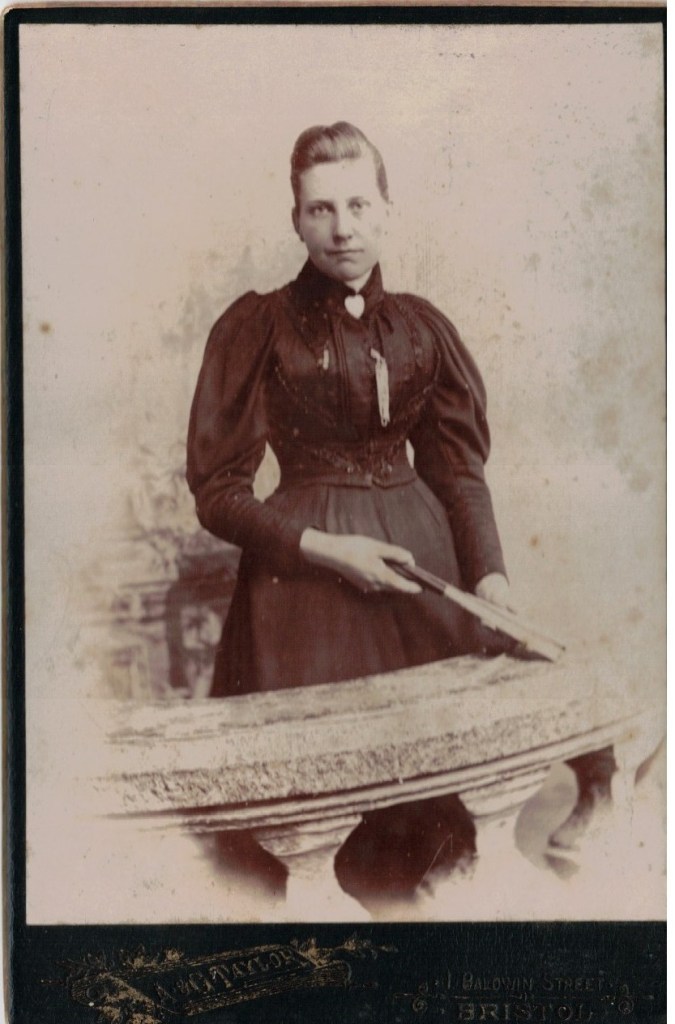
This 1880s lady has her hair brushed straight back with no parting; height, not width, emphasised; hair had a softer look but was still confined. She has high, tight collars; her corsets create a very small waist and her sleeves have a “poof” at the top of the shoulder, moving toward leg-o’-mutton style. Her skirt is very narrow and fitted in the front, excessively trimmed, no train.
The darker board and the fan are perhaps pointers to a 90s event while the ballustrade is more of the 60s but the style seems to fit the 80s
Source: Legacy Tree Genealogy Sleuthing Part II: Using Women’s Fashion to Date Old Photos
1890s
- Very much as the 80s;
- Palmtrees, cockatoos, bicycles accessories.
1900s
- motor cars as accessories
Stickybacks
A stickyback was a type of small sized photographic portrait which enjoyed popularity in some parts of the UK in the early 20th Century, disappearing during and after the first World War. The earliest use of the term stickyback dated from the promotions of Liverpool photographer Spiridione Grossi, who ran a photographic copying and printing business and a seasonal portrait studio on the Isle of Man.
Stickybacks were tiny black and white portraits, produced cheaply and quickly, for a new mass market – the working classes. At this time serious commercial photographers were producing cabinet photographs, cartes de visite, various mounted enlargements and postcard format portraits. Their business was directed towards a middle class clientele, and having your portrait taken was still a serious and expensive business. The stickyback photographer made the process not only affordable with prices designed to promote repeat business and also fun – photographers often taking short leases on premises in prominent positions which they then plastered with advertisements.
Some photographers taking up this style of photography incorporated the word stickyback or some variation into their business or studio names. For others, this could have been simply an addition to a range of services already offered. Many of their clients had never been photographed before and for some, 12 portraits for sixpence, or even, at times, for thruppence, was an exciting experience. The clientele attracted to the stickybacks establishment was very different from those at a top photographic studio and some stickyback studios employed doorkeepers.
The “Stickyback” name originated from the fact that the original differentiating features of this format was that the rear of the photograph had adhesive applied, which operated, as with a postage stamp, with the addition of moisture.
All over the country [the professional photographer’s] trade is diminishing. Amateurs are doing his work, and they are to the fore in all classes of society, from Queen Alexandra, who is an expert with the camera, to Tommy, who, with a Kodak costing a few shillings, takes pictures of mother, father, and the baby in the back yard. But the advent of the “sticky back ” man has done even more than the amateur to curtail the business of the photographer proper. In every town a “sticky back” man, who produces a dozen photographs for a shilling, occupies expensive premises in the main street and, especially at watering-places and other holiday centres, takes the trade that used to go to the legitimate artist.
THE “STICKY BACK” MAN Daily Mirror, Friday 29 March 1907
In response, mainstream professional photographers referred to their stickyback colleagues in disparaging terms, sneering at their inferior products. Years after the first appearance of the stickyback, C Stanley Priestley, an official in the Institute of British Photographers, described the main object of a local photographic exhibition as: “… to get the public more photo conscious. We do hope to guide them to tell the difference between a ‘sticky-back’ photo and a real photo: between rubbish and good work”. (Croydon Times – Saturday 5 April 1947).
Those involved in designing and patenting stickyback equipment included Spiridione Grossi, Dennis Benjamin Seaman, and George Thomas Bayley. Stickyback photographers generally exposed their plates in cameras with multi-position camera backs. This allowed them to take multiple tiny images on a single plate, much reducing their costs. Examples of two different multi-purpose backs by Marion are shown on our site here . Stickyback photographers also used multi positioning printing frames, allowing them to make multiple prints from the same part of a negative onto strips of photographic paper. A number of camera manufacturers produced multi-position camera backs, but some photographers patented special stickyback camera backs and printing apparatus. A minority of Stickyback photographers may have used stamp cameras instead of moveable back cameras. The stamp camera was a multi-lens camera simultaneously taking multiple images on one plate.
Higher volume low cost portraiture posed a particular problem for the photographer – when the subject picked up their prints, how to match the right print to each sitter and to do so quickly? Those photographed for the first time might well not recognise their own likeness. Many stickyback photographers matched the client to the photograph by showing a negative, job or ticket number within the image itself, matched to the customer’s ticket or a written list in the studio. The number was sometimes shown by the simple expedient of hanging a slate on the backdrop, scratching the number on the slate and including this in the photograph. Sometimes the number was recorded using a counter inside the camera which simultaneously photographed the internal counter and the sitter. Sometimes a number on a card was propped up on the studio floor and included in the image. Some stickyback photographers posed their sitters under, or behind, a sign board bearing the studio name and address as well as the negative or job number. These often have the name “Stickyback” on the sign board, making it simple to identify these as stickyback photographs. As the reverse of these photographs could not be printed or rubber-stamped, and as the photos were not sold on printed mounts, the in-shot sign board was used to remind the sitter of the studio taking the photo. These photographs were usually printed and sold in strips, sometimes attached vertically and sometimes horizontally. Usually the customer cut up the strip after purchase.
Sources: National Science and Media Museum; A Concise History of Photography De Helmut Gernsheim 1986; Stickybacks definition; The Photographic News 22 April 1881
 undivided-back postcards