Paarl, Cape Province, South Africa
- Photographers Gribble & Co Published by Paarl Printing Co., Ltd.
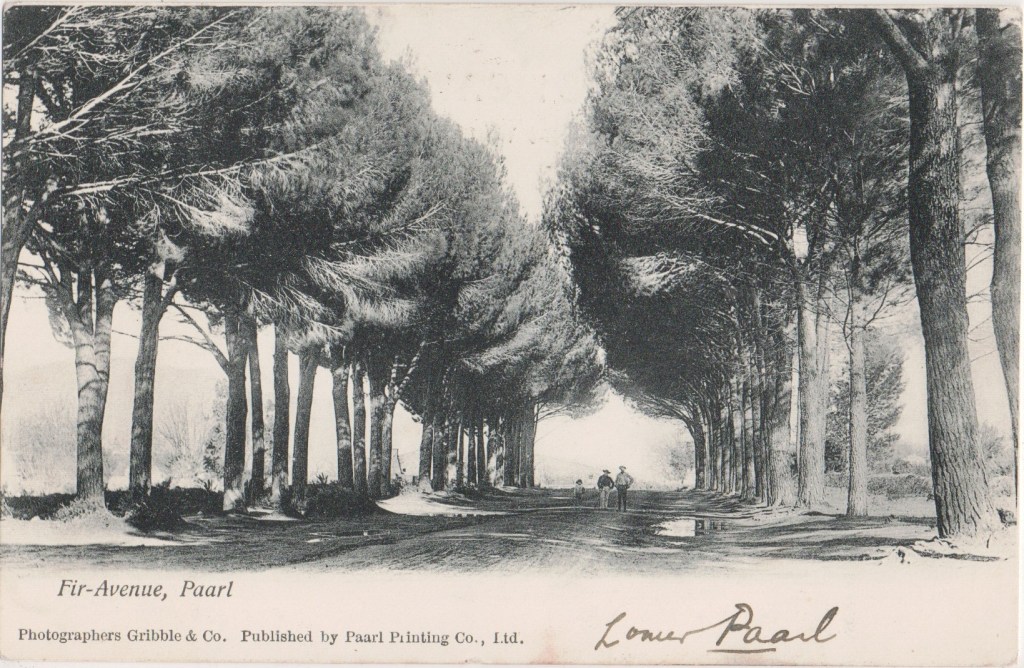
Paarl is a city in the Western Cape province of South Africa.
Die Genootskap van Regte Afrikaners (The Society of True Afrikaners) was the first group to work for the elevation of Afrikaans to the status of a fully-fledged language. The society was founded on 14 August 1875 in Paarl by a group of Afrikaans and Dutch speakers from the English Cape Colony, the present-day South African province of Western Cape. Their early literature in Afrikaans was printed in Paarl by D. F. du Tait & Co. From 15 January 1876 , the society published a journal called Die Afrikaanse Patriot, as well as several books such as dictionaries, religious material and history books.
The Albion press built by Frederick Ullmer of London, numbered 2607 and dated 1869 was used at Paarl by P.J. Malherbe to print the first number of Die Afrikaanse Patriot, the first Afrikaans newspaper, on 15 January 1876, is preserved in the Huguenot Museum.
Die Afrikaanse Patriot ceased publication in 1905 and first issue of the non-political Paarl Post Newspaper published on 14 January 1905.
Malherbe’s firm was reconstituted in 1905 as the Paarl Printing Company Proprietary Limited
However, the word Proprietary was omitted when it published Historical Representation of Incidents in the life of the Voortrekkers. At Rosebank, a pamphlet of 8 pages in bilingual text; The opportunity of the South African Student” Report of the annual conference of the Student’s Christian Association of South Africa (1906); and A Sermon Delivered by the Rev. W. H. Evans, BA at The Memorial Service of the late King Edward VII, a 12 page pamphlet (1910).
The company is today the official printer to the Dutch Reformed Church in South Africa.
Source: NICPRINT-50 Being some account of the history of the printing, packaging and newspaper industry of South Africa, and of the National Industrial Council for Printing, prepared to mark the Jubilee of the Council 1919-1969. L J Picton 1969
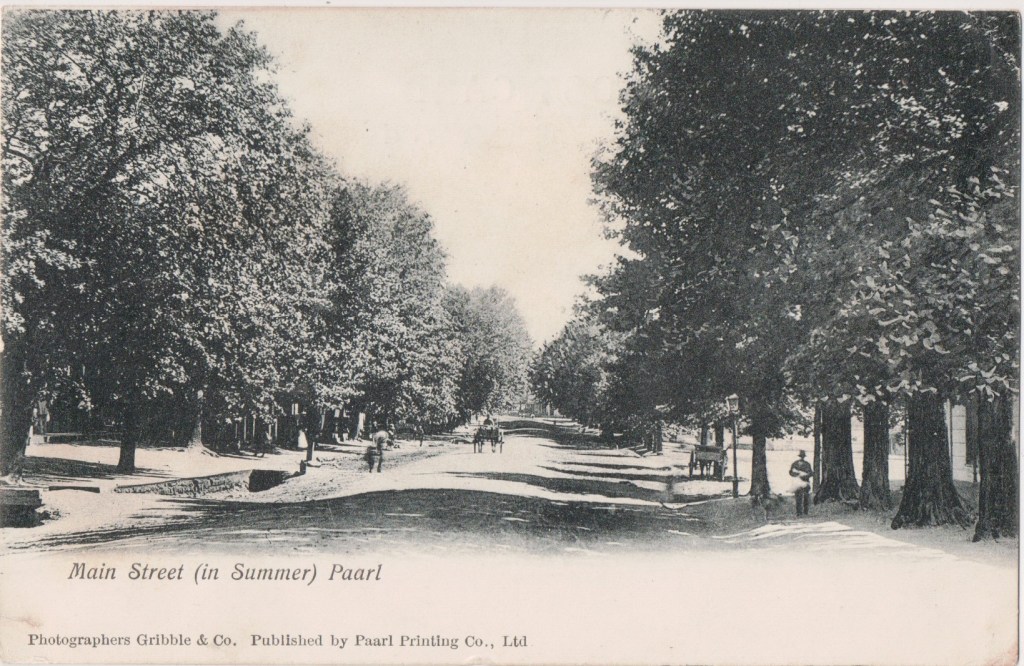
Gribble & Company, Paarl
- Photographers Gribble & Co Published by Paarl Printing Co., Ltd.
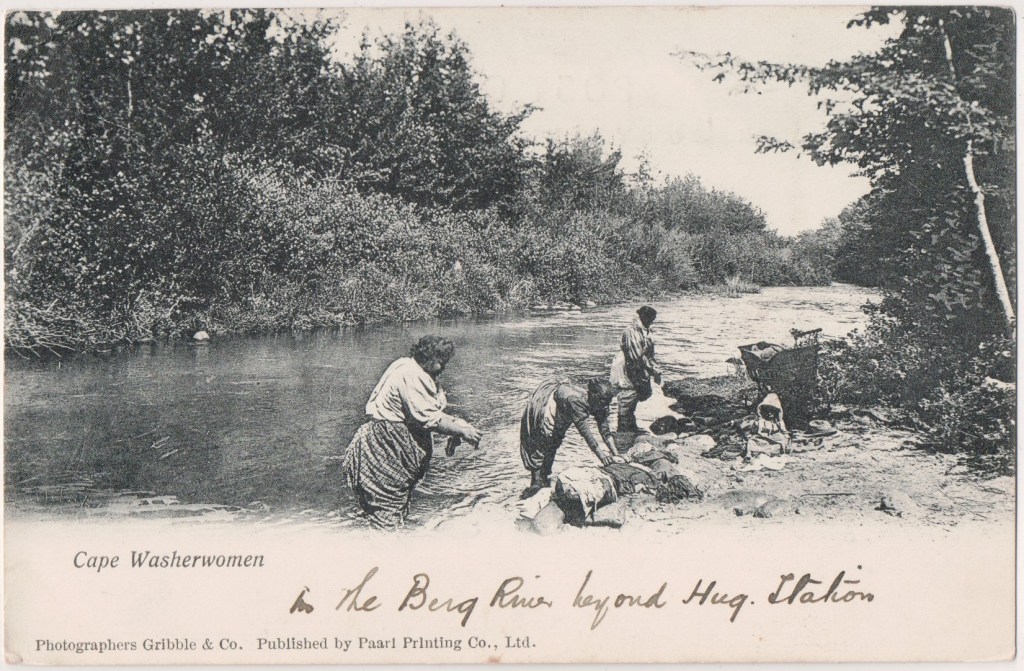
James Gribble (17 October 1836 to May 1872). Born in Goldsetting, Cornwall, England, Gribble came from a mining family and was a tin miner before losing an eye from an axe splinter. This resulted in him being paid off after which he became a wheelwright at which time he also took up photography as a hobby.
Late in 1860 he and his wife arrived in Cape Town on board the “Mary Simmons”, a vesssel registered in Truro that year. He and his wife Jane Quick had 5 children – all born in Rondebosch where they settled. When he arrived at the Cape he started as a wheelwright, but could not get on with the Dutch workmen and language. So when his health broke down he stepped away from wooden wheels and became a grocer/flower dealer based in Mowbray, less than two kilometres away from their home in Rondebosch.
This business failed and Gribble was bankrupt in 1865. Gribble had returned to photography soon after his arrival in South Africa and his assets recorded at that time include a camera, photographic chemicals, magic lantern slides and two camera stands. The art of photography was in its infancy when Gribble landed in Cape Town; The first commercial photographer active in Cape Town, the German Carel Sparmann, had captured his first Daguerreotype photograph just 13 years earlier.
Gribble became an assistant to the famous Cape Town photographer Samuel Bayliss Barnard who opened his studio in Adderley Street in May 1865.
Gribble’s own first studio was in Rondebosch in 1866, followed by 54 Hanover Street (1868 to 1869). His work would have been cartes-de-visite, the first paper-based photographs, introduced into South Africa in 1861 though none of it seems to have survived.
Gribble’s son Jimmy (27 January 1863 to 23 January 1943) was only 9 years old when his father died at the age of 35. It is he whose work would be in the postcards of Paarl to which the business contributed. This card illustrates the use of the “Gribble & Co” name at the turn of the century.
Jimmy’s described his life with the man his mother then married as a living hell and his employment as a house boy as “my prison” but things looked up after his step-father died when he was sixteen and he was able to follow in his father’s footsteps and began his photographic apprenticeship with Barnard in 1879. Jimmy stayed with Barnard for 8 years until he turned 24 years old.
Jimmy would take pictures of passengers as they disembarked from ships arriving in the Cape Town harbour, process and have prints ready for sale that same night when the passengers returned to their ship.
Whilst Barnard was away on business trips he would leave Jimmy in charge. In 1887 he was sent to Paarl to take photographs at a wedding after which he decided to move to Paarl where he started business for himself on 1 January 1888, when he was 25.
At this time, there were several photographers working in Paarl – at least two other Cape Town based photographic studios also expanded by opening branches in Paarl.
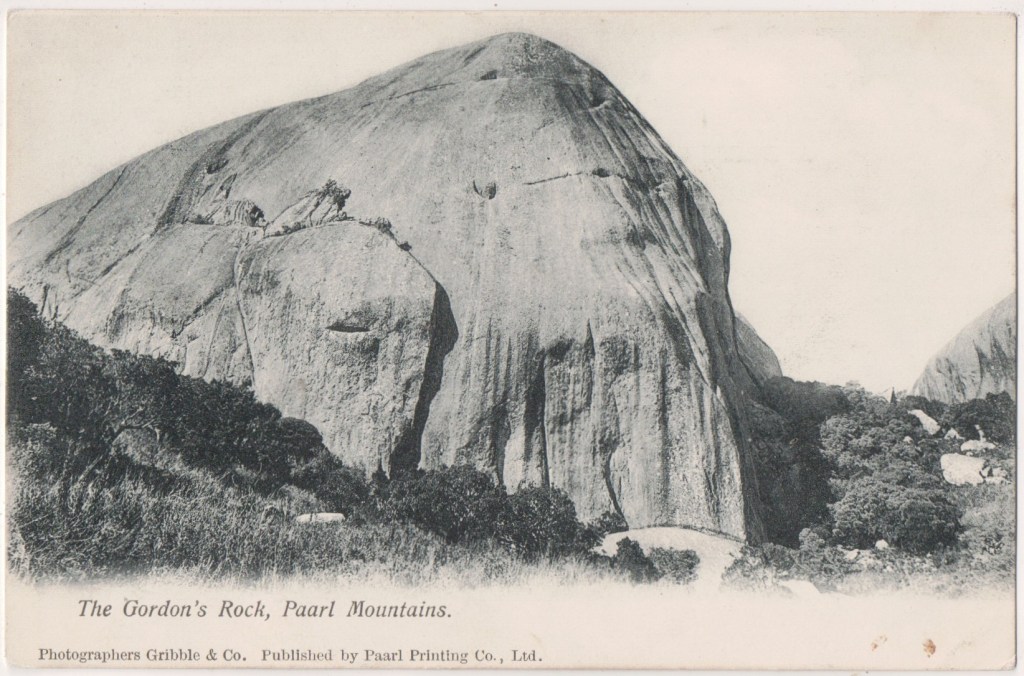
Jimmy travelled fairly extensively as photography outwith the studio became increasingly possible. In 1888 he travelled to Kimberley (Northern Cape) and from there onto the Free State, visiting Bultfontein where he took a photograph of President Reitz, then onto Grahamstown, George, Knysna, Heidelberg, Swellendam, Caledon, Wellington and Calvinia. He would often load his cart and horses onto the train. At Beaufort West he would then disembark and travel into the wide-open plains to go and photograph people. The large and heavy, breakable glass negatives were then transported back to his Paarl studio from where the end result, a fixed photograph mainly in cabinet card format, was posted to the sitters. Of these trips Jimmy wrote:
I was a young man building my future and business and felt quite happy jogging along in my cart at six miles an hour. At the bank at Bloemfontein I would hand over 100 pounds in gold for a cheque which I then posted on to the bank in Paarl.
Jimmy advertised that he had travelling studios in inland towns of Transvaal, Natal, Free State & Cape Colony. Jimmy also dealt in toys, sweets, cycle goods, Transvaal Tabacco and English periodicals. He was also an agent to Harrison & Co. (dyers and cleaners).
The Jameson Raid (29 December 1895 to 2 January 1896) was a botched raid against the South African Republic (the Transvaal) carried out by British colonial administrator Leander Starr Jameson, under the employment of Cecil Rhodes. It involved 500 British South Africa Company police and was launched from Rhodesia over the New Year weekend. Paul Kruger, for whom Rhodes had great personal hatred, was president of the South African Republic at the time. The raid was intended to trigger an uprising by the primarily British expatriate workers (known as Uitlanders) in the Transvaal but it failed.
However, Jimmy clashed with the Paarl Dutch at a crowded meeting held in the Town Hall called to unite the Dutch in revolt to the British. The other Britishers present left the meeting so Jimmy was the only one to vote against the resolutions.
His business was boycotted and in 1897 his health broke down and he went to England for a rest. On return, his mortgage would not have taken long to pay off but the Second Boer War (11 October 1899 to 31 May 1902) started soon after causing more hardship; a pro-Boer studio with German professionals opened. They didn’t wipe him out but, for years, he earned practically nothing: “I had to pay my retoucher ₤10 salary per month – his only work was to dust the place. I was glad when his contract was up.” Jimmy used to go selling the evening Argus out in the military camp beyond White Bridge of a night.
The pro-Boers, who had been his friends, made things worse when they found out that he was one of a Committee of Three who placed volunteer local patrols to guard the railways at night when military trains were passing.
In 37 years, Jimmy had 3 different studios in Paarl. The first studio was in a converted house on Klein Reservoir street and Main road, followed by the studio in Market street and finally the studio at 271 Main street (corner of Pastorlielaan) – the studio that was eventually taken over by his son Harold.
Harold Quick Gribble (20 July 1899 to 9 January 1983) was the third and last generation of the Gribble male photographers in South Africa. Jimmy retired around 1931 – six years after Harold took over the studio.
Harold donated all the glass negatives still in his possession to the Drakenstein Heemkring, a private collection accessible to researchers, which holds some 30 000 photographic images, many of them by Jimmy & Harold Gribble. The Paarl-based photographic establishment came to an end in 1987.
Source: Century old photographs reveal the story of James Gribble, Paarl based photographer The Heritage Portal Carol Hardijzer 4 February 2022 https://www.theheritageportal.co.za/article/century-old-photographs-reveal-story-james-gribble-paarl-based-photographer
 undivided-back postcards