- NONPAREIL PTG. & PUB. CO., CIN., O.
Nonpareil Printing & Publishing Company, Cincinnati and Council Bluffs, Ohio. The Weekly Nonpareil and Herald was published in Cincinnati from 1849 into the 1850s. The Cincinnati Daily Nonpareil from November 1851 to May 1852 is held by Hamilton County Library in Cincinnati. Nonpareil Printing & Publishing Company published Nonpareil weekly from 1855 and daily from 1856.
Action now moves to Council Bluffs, 800 miles to the west of Cincinnati. Known as the Mormon community of Kanesville until 1852, Council Bluffs was an important outfitting post for the Mormon Exodus to Utah and is recognized as the beginning of the Mormon Trail. It was incorporated in 1853 and is the county seat of Pottawattamie County.
William Wirt Maynard is associated with the publication of the Council Bluffs Chronotype between 1854 and December 1856. 1n 1857 he accepted an offer of financial backing and decided to return to Council Bluffs. The offer came from John T. Baldwin and G.M. Dodge who had formed a banking and land agency that bore their names in January 1856. They thought that controversial issues dividing the country needed a Republican spokesman, and Maynard knew what he wanted to say on questions of states’ rights versus federal supremacy, and admission of new states with or without slavery.
The young newspaperman came back to Council Bluffs by stagecoach in March, 1857, riding the coattails of the bitterest winter weather in years. After conferring with his brother-in-law, A. D. Long, who was to be a partner in the venture, Maynard took his sponsors’ $880 and made the four-day trip by stage and train to St. Louis to buy a press. Several weeks elapsed before the steamboat swung in to the dock at Wray’s Landing south of town, to unload the precious “Wells Celebrated Power Press.’’ The publisher’s twenty-fifth birthday was almost lost in the rush to install the press and type cases. He and Long concentrated their whole effort on that important maiden issue on 2 May 1857. The masthead revealed its chosen name, The Council Bluffs Nonpareil. Readers accepted the editor’s definition as “without equal” in the same zesty spirit that prompted it.
That first issue had four pages of eight columns in twenty-three-inch depth, thirteen columns devoted to news and eleven to advertisements. Publication was to be “Every Saturday morning, at No. 1 Palmer Block on the third story” (now the corner of Broadway and Scott Street). Editorially, the paper espoused Republican principles, with reservation of “the right to adopt whatever coincides with our views and to condemn what we cannot reconcile with our belief … in a fearless and independent way.” Subscriptions cost $2.00 a year, and job printing was solicited. Advertising from all the principal business houses and professional men was generous, amounting to a virtual town directory.
William H. Kinsman, (1834 to May 1863) spent five years in Iowa and with the coming of the Civil War, made a mark on the history of the state which has not been effaced. He had gone to sea at the age of fifteen. By May 1858 he was engaged in studying law in the offices of Clinton and Baldwin, writing copy for William W. Maynard of the Weekly Nonpareil, and making friends with properly placed individuals in the town.
In 1859 he was engaged as a special correspondent of the Nonpareil and sent west to the Pike’s Peak region where a gold rush of sizeable proportion was in progress. Kinsman made a remarkable trip on foot to the gold regions of Colorado, established to his own satisfaction the richness of the finds, and returned to Council Bluffs to answer the many naysayers who claimed the gold rush was the creation of outfitters and others along the banks of the Missouri River.
Kinsman’s value as a correspondent was recognized by Maynard, and when the young man went to Washington City in 1859 he continued to file long despatches with the Nonpareil about life and politics in the nation’s capital until well into April 1860 when he returned to his adopted home town. He was killed at the Battle of Black River Bridge in the general vicinity of Vicksburg, Mississippi.
In early December 1858, A.D. Long died unexpectedly after being caught in a winter storm. Following Long’s death, Maynard continued as editor and proprietor of the Nonpareil. In March 1859, he partnered with Charles E. Provost, who was joint publisher of the paper for about a year until April 1860, when Maynard became the sole editor and proprietor once again. He hired William S. Burke in November 1860 to serve as the local editor. In his introductory column, Burke wrote: “my object will be to furnish the readers of the Nonpareil with the latest and most reliable information of what is transpiring throughout the world in general and Council Bluffs in particular.” Burke’s role expanded in August 1861, when he became co-editor with Maynard. Then in November 1862, he purchased Maynard’s interest in the business, and he became sole editor and proprietor.
Burke published the Nonpareil to December 1866, when he sold the business back to Maynard and his new partner, John W. Chapman. At this time, the title was changed to the Council Bluffs Weekly Nonpareil, to distinguish it from the daily edition that Maynard and Burke established a few years earlier. The Nonpareil changed hands a number of times through the following years, and in 1883, the title changed again to the Weekly Nonpareil.
In 1894 Earnest E. Hart sought to foreclose a chattel mortgage on the property of the Company. His mortgage covered the presses and machinery of the Company and all fixtures, and furniture used in the publication of the Daily and Weekly Nonpareil. The weekly edition ceased publication in 1911 but by 1912 there was a New Nonpareil Company which successfully fought off a defamation case by a Mr Flues, establishing along the way that describing someone as “unchaste” was defamatory on the face of it and that reports of statements even in lower courts were privileged.
Arthur Richard “Dick” Gross (died 11 October 2016 aged 88) was appointed publisher and general manager of the Nonpareil in 1969, four years after the newspaper had been purchased by Thomson Newspapers Inc. He continued in this role until his retirement in April 1988.
The Daily Nonpareil continues to publish today, from 300 W Broadway, Ste 108 Council Bluffs, IA 51503. It remains southwest Iowa’s largest newspaper.
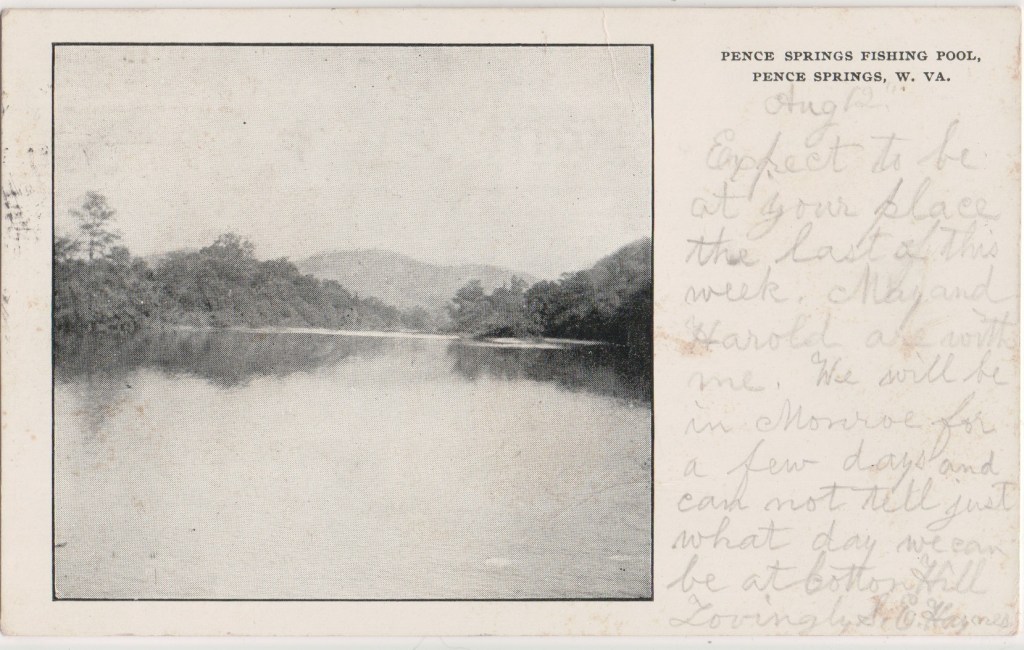
The Company published topographical photocards of the state and West Virginia.
Patrick Tracey was not among the larger printers in Cincinnati, but he and his wife Kate were able to invest in Price Hill property and platted a subdivision in 1889 just north of Mount Echo Park. The subdivision had only two streets, Pica and Nonpareil, both printer’s measurements. A pica equals one-sixth of an inch and a nonpareil is half a pica. Nonpareil Street has vanished, and Pica Street survives only on paper. Ohio Nonpareil was a commercially important variety of apple in the region during the 19th century.
Sources: Yours, in Haste, W H Kinsman Raymond A. Smith, Jr The Palimpsest 11 January 1985; Hart v Nonpareil Printing & Publishing Co Supreme Court of Iowa. Oct. 3, 1899; State Historical Society of Iowa; The Nonpareil Is Born GP Mauck, The University of Iowa, 1961
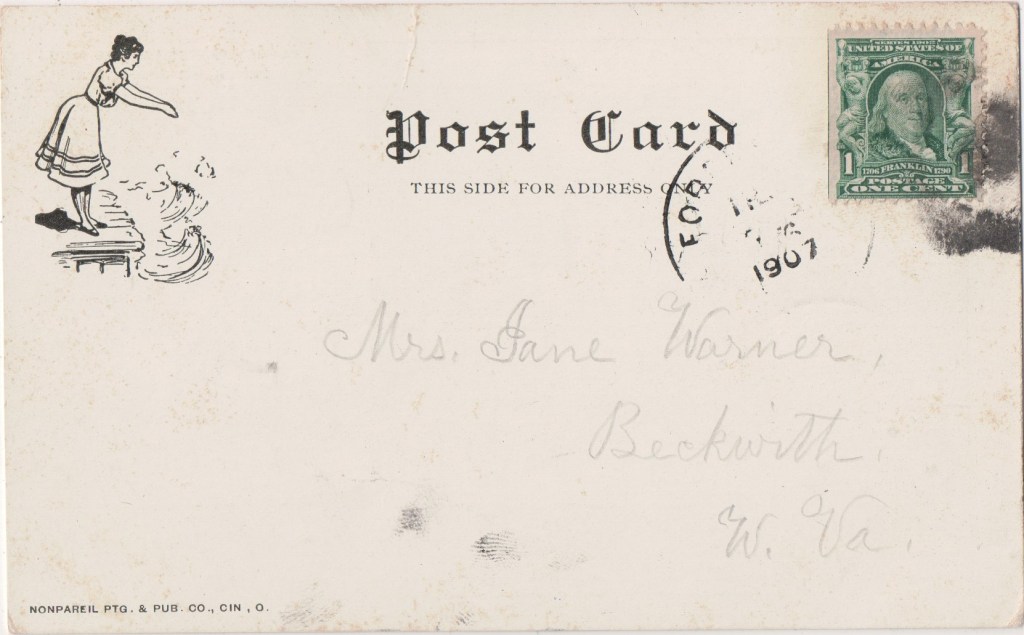
 undivided-back postcards