Seating for the Medieval Monk
Throughout the Middle Ages, the Christian churches of Europe advanced both art and architecture by building larger, grander churches called cathedrals. Cathedrals were massive structures with the finest design and adorned inside and out with the very best in sculpture and art. Inside these architectural marvels, fine woodwork, paintings, murals, tapestries and sculptures were installed.
The early Middle Ages had cathedrals built in the Romanesque style with thick walls and tall, thick pillars to support the roof and ceiling. Improvements in building technology and engineering led to the development of thinner, taller walls supported by arches on the outside called flying buttresses. This made walls much stronger and allowed for more and larger windows. This new style was called Gothic, and appeared around the year 1150.
As part of a Medieval church, the choir (also sometimes spelled as quire) was the area where services were sang. Situated near the high altar, it was one of the most sacred parts of the church, separated from the nave by a screen.
Monks and priests were required in church several times a day and the devine offices were said standing.
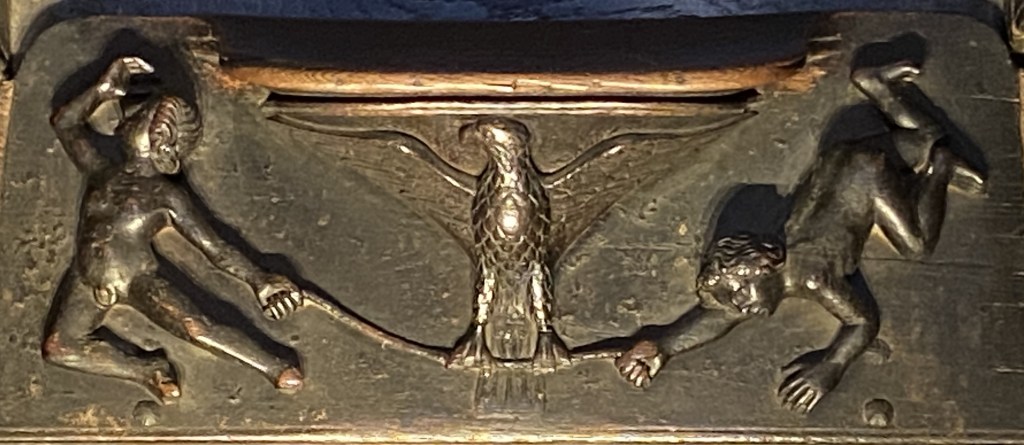
Seats in the choir were carved in wood and fixed to the walls. In due course seats were hinged to tip when the user was standing. On the underside of the seats, a wooden ledge was built in at an angle that provided support for the user to lean against when standing. Plain gave way to decorated and, particularly in England, the decoration extended from the actual ledge either side – referred to as supporters.
As regards subject, few of the medieval misericords feature religious themes, rather they are reflective of popular culture. The medieval mind was keenly imbued with satire. It was a huge joke to present the world where the ordinary relations of life were inverted – rats hanging a cat or the husband doing the housework while his wife watched.
Earlier theories that misericords were done by monks are belied by the quality of the work and are no longer followed, the current assumption being that they were carved by the craftsmen responsible for the woodwork in the church in question.
The Krauses regard the reason why such a small number of misericords had religious themes as obvious:
The clerics were delicate about allowing the lower body to be in direct contact with effigies of Christ, Mary or the Apostles.
They attribute the fact that a high proportion of the misericords in England survived the reformation to the fact that so many had secular subject matter.
How to make a Misericord
The construction of a misericord stall is very peculiar. The shaped standards or elbows are cut out of wide planks. They are notched over a deep and massive bottom rail (to which the misericords are hinged in many cases), and are housed into the massive capping, which is very wide and hollowed out with semi-circular recesses to form curved backs for the stalls. The space between this capping and the bottom rail is filled in with thin wide boards, forming a sloping back. The capping is often fixed square with the back and is consequently tilted up in front. In most cases the back of the stalls is hidden by the screen against which they are fixed, but in a few cases it is concealed by special panelling, as at Beverley St Mary, or it is exposed as at Higham Ferrers, where the parclose screen is built on the top of the stalls.
The misericords are generally carved in the solid with a typical disregard for wasted material. They are sometimes pivoted to the standards by a pin worked in the solid, and they rest on the lower edge of a quadrant-shaped sinking in the standards. An alternative method is to hinge them to the upper edge of the bottom rail. The shape of the standards is therefore governed very largely by the misericord and the position of its pivots and sinkings. The front edge below the seat is usually vertical, and is wrought into a little shaft, above which the moulded edge follows the path of the front edge of the misericord, finally turning upwards and outwards to support the arms. These are worked out of the solid capping, and are generally very deeply and elaborately moulded, but these mouldings almost always die out against the back, probably for practical reasons of comfort. The front of the arm is usually semicircular on plan, giving the effect of a little capital when seen from the front; sometimes a cluster of capitals is attempted, as at Southwold, where the plan is a trefoil.
English Church Woodwork Howard & Crossley (Batsford 1927)
The misericord pages of this site are a combination of postcards and my own photographs of misericords. Misericords continued to be made long after the medieval period and I have included any misericord from any period. The postcards are all from the divided-back era (post 1902). These pages are therefore off-topic on the undivided back site.
England and Wales
Cheshire
Cumbria
St Andrew’s Church, Greystoke, Penrith
Herefordshire
St Lawrence’s Church, Canon Pyon
Nativity of the Virgin, Madley
Powys
Dominican Friary of St Nicholas, Brecon
Worcestershire
Yorkshire
Germany
Baden-Wurtenburg
Spain
Andalusia
Madrid
Bibliography
English Church Woodwork Howard & Crossley (Batsford 1927)
The Medieval Carver M D Anderson (Cambridge University Press 1935)
English Church Craftsmanship Fred H Crossley (Batsford 1941)
Misercords Medieval Life in English Woodcarving M D Anderson (King Penguin Books 1954)
A Catalogue of Misericords in Great Britain G L Remnant (Clarenden Press 1969)
Church Woodcarvings A West Country Study J C D Smith (David & Charles 1969)
A Guide to Church Woodcarvings Misericords and Bench-Ends J C D Smith (David & Charles 1974)
The Hidden World of Misericords Dorothy & Henry Kraus (Michael Joseph 1975)
The Cathedral Builders Jean Gimpel (1980 in French; translated by Michael Russell 1983; paperback Pimlico 1993)
English Misericords Marshall Laird (John Murray 1986)
Church Misericords and Bench Ends Richard Hayman (Shire Album 230 1989)
The World Upside-Down English Misericords Christa Grossinger (Harvey Miller 1997)
England
In the 1990s Mike Salter wrote and published a series of guides to the old parish churches of regions of England, Wales and Ireland which are very useful reference books for those interested in the misericords of lesser establishments.
Misericords of North West England Their Nature and Significance John Dickinson (Centre for North-West Regional Studies University of Lancaster 2008)
Spain
The Gothic Choirstalls of Spain Dorothy & Henry Kraus (Routledge & Kegan Paul 1986)
Individual Churches in England
Carlisle Cathedral Misercords Dr Christa Grossinger 2002
The Misericords and Screen in Cartmel Priory Eric Rothwell 1997
Chester Cathedral Quire Misericords The Pitkin Guides
Medieval Woodwork in Exeter Cathedral Marion Glasscoe and Michael Swanton 1978
Medieval Misericords of Great Malvern Priory The Labours of the Months Katherine Wells
Ancient Misericords in The Priory Church Great Malvern Vera L Edminson
Hereford Cathedral Church Misericords F C Morgan (1975)
The Misericords of Hereford Cathedral Church F C Morgan Illustrations by Dominic Harbour
Hereford Cathedral Misericords Ioan O’Reilly 2022
The Choir Stalls of Lincoln Minster M D Anderson
The Misericords & Choir Stalls of St Laurence’s Church, Ludlow Peter Klein
The Misericords of Manchester Cathedral
The Quire and Misericords of Nantwitch Percy Newton Corry
The Misericords of Norwich Cathedral Rose & Harvey (The Larks Press 1994)
Medieval Woodcarvings of Ripon Cathedral Taylor & Ching
The Misericords of Holy Trinity Church Stratford-upon-Avon (Hammond & Cheal 2013)
Tewkesbury Abbey The Misercords The Abbey Church of St Mary the Virgin
A Picture Book of the Misericords of Wells Cathedral J C D Smith 1975
Misericords of Winchester Cathedral Michael J Calle
 undivided-back postcards